Why it matters
- Memory bandwidth is becoming a first-order constraint as edge-AI models and sensor workloads grow.
- Secure flash adds a separate system concern: protecting firmware and device trust as AI endpoints become more valuable targets.
- Packaging, controller support, production availability and reference designs will determine whether these technologies become practical alternatives in edge systems.
Edge AI is creating two memory problems at once
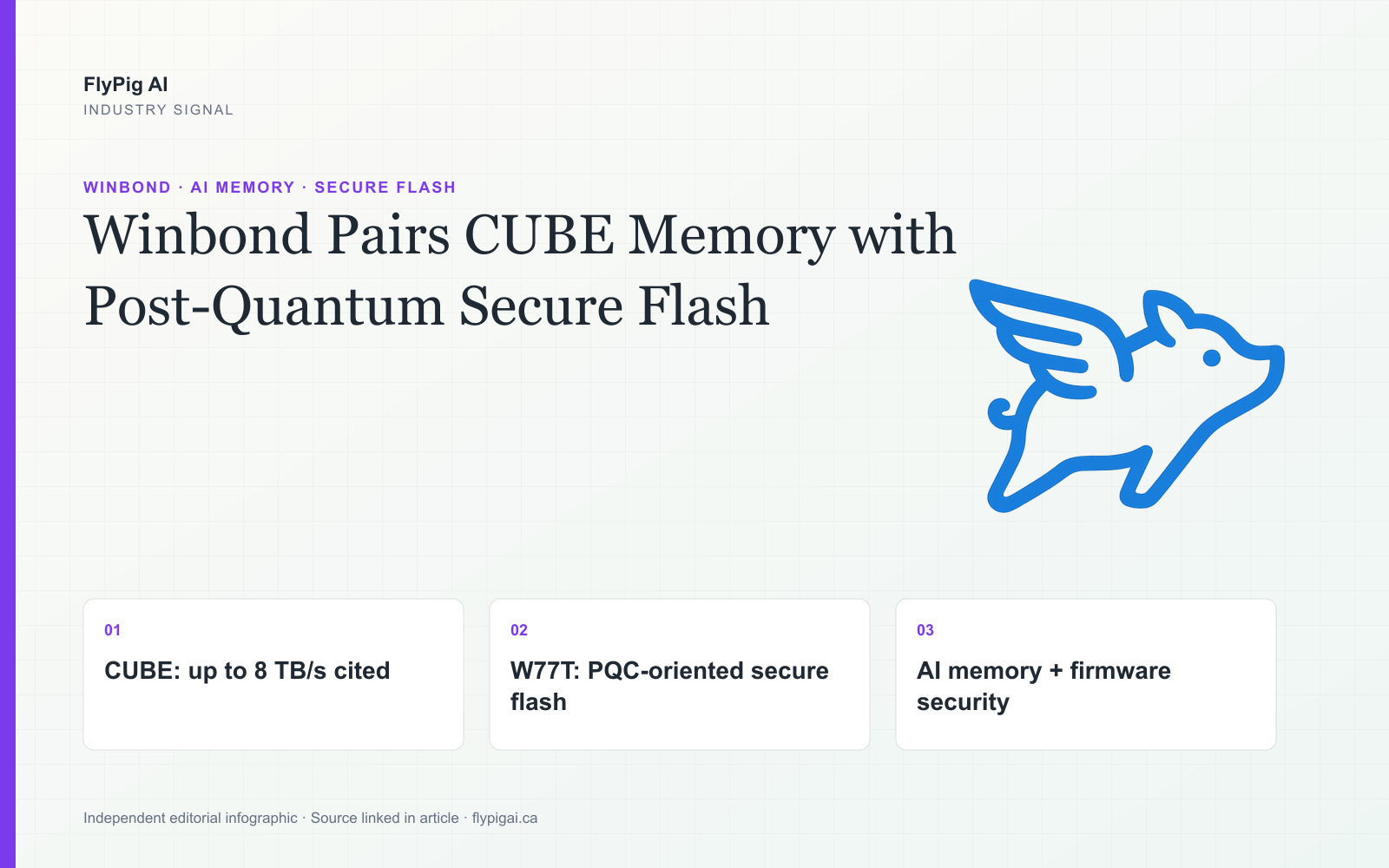
AI systems need to move more data quickly while also protecting the firmware and credentials that make the device trustworthy. Winbond’s current roadmap addresses both sides through CUBE memory and W77T secure flash.
The company has cited bandwidth of up to 8 TB/s for CUBE, positioning the technology as a high-bandwidth memory option for AI-oriented architectures.
Bandwidth claims need to be translated into package-level design routes
A headline bandwidth number does not by itself tell an OEM how the memory connects to a processor, how it is packaged, what capacities are practical or what thermal and cost trade-offs apply.
For FlyPig’s design-intelligence use case, the next important data are packaging, host compatibility, sample timing and which Taiwan compute platforms intend to support the memory.
Security flash is moving into the post-quantum discussion
W77T extends the memory conversation into firmware protection and post-quantum cryptography. That can matter for long-lived IoT and industrial devices where software authenticity and secure update remain requirements long after deployment.
The combination is a reminder that future edge-AI BOMs will be judged on data movement and device trust together, not inference performance alone.
FlyPig AI interpretationWinbond’s signal is less about one finished product than about the memory architecture around edge AI. FlyPig will track which compute vendors and modules make CUBE and W77T actionable, because interoperability will decide their design-in value.
Status, open questions and Canada relevance
Current product status
Winbond publicly describes CUBE as a customizable high-bandwidth memory technology and lists W77T secure-flash products with security and post-quantum features. Packaging, host integration and program availability remain design-specific.
What remains open
- Which processor, package and module programs expose CUBE as an orderable edge-AI design route?
- Which W77T variants, certifications and post-quantum functions are available in production for each target application?
Why Canadian teams may care
Canadian industrial and IoT teams planning long-lived edge-AI products need both memory bandwidth and firmware trust, especially where devices must remain secure and serviceable for years.