Why it matters
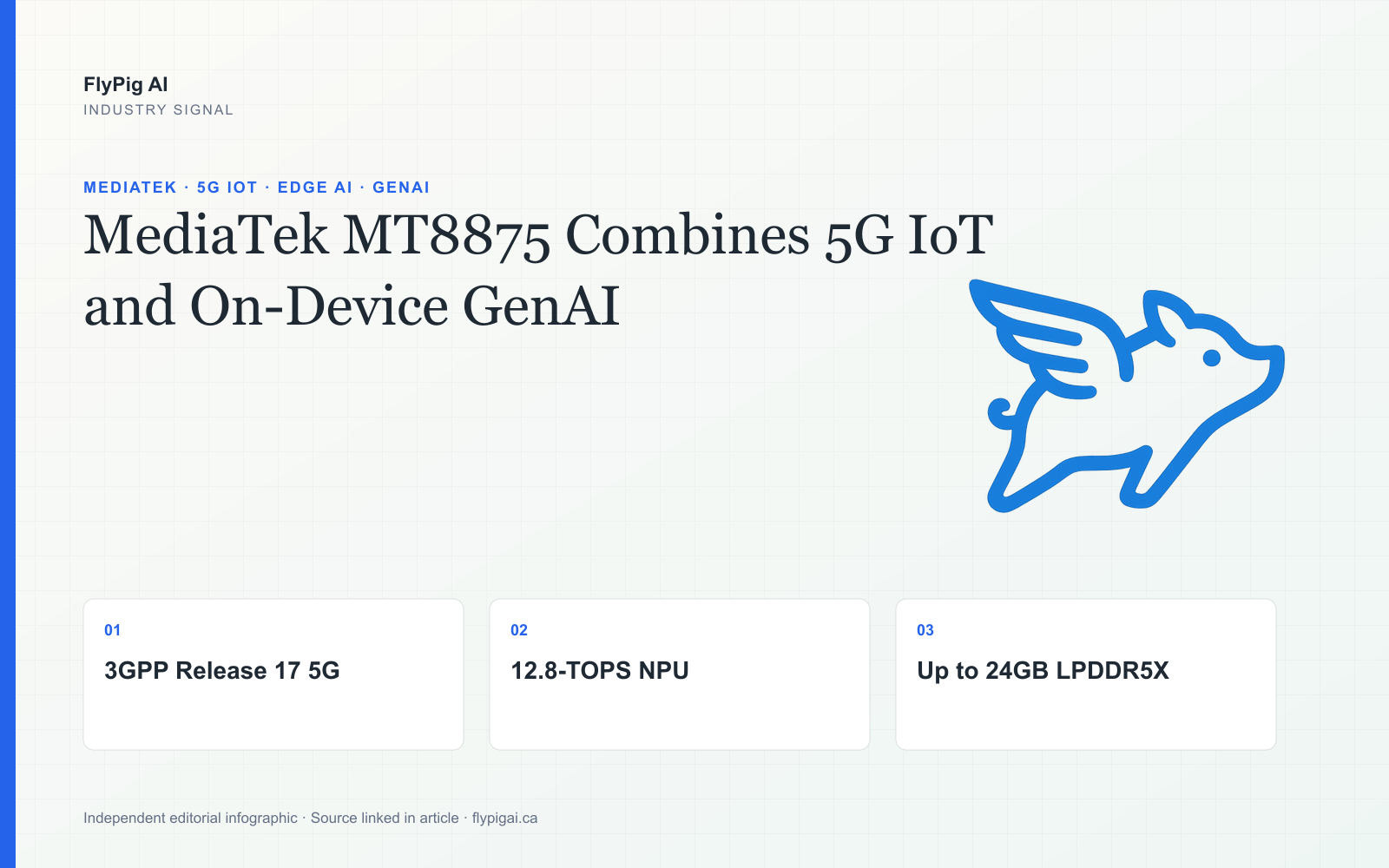
- The platform pairs 5G connectivity with on-device GenAI capability instead of treating the modem and AI processor as separate architectural blocks.
- A 12.8-TOPS 8th-generation MediaTek NPU, support for up to 24GB LPDDR5X and multi-camera interfaces make the device relevant to richer local inference workloads than conventional modem-centric IoT designs.
- For product teams building smart retail terminals, mobile enterprise devices, AI gateways or connected vision systems, integration could lower BOM complexity and shorten system validation work.
A modem-based IoT platform is moving closer to an edge-AI computer
MediaTek formally detailed the MT8875 on August 25, positioning it as a next-generation modem-based IoT platform for mobile enterprise, industrial and smart-retail applications. Built on a 4nm process, the device combines four Arm C1-Pro cores and four C1-Nano cores with MediaTek’s eighth-generation NPU.
The NPU is rated at 12.8 TOPS and MediaTek explicitly describes the platform as capable of on-device generative AI and large-language-model workloads. That matters because connected IoT hardware has traditionally split high-speed cellular connectivity and substantial local AI compute across separate silicon or modules.
Connectivity is part of the product architecture, not an add-on
MT8875 integrates a 3GPP Release 17 5G modem with three-component-carrier aggregation up to 220 MHz. MediaTek also lists integrated Wi-Fi 6E and Bluetooth 5.4, with an external Wi-Fi 7 and Bluetooth 6 option.
The platform adds multi-camera support, dual displays, 4K30 video encode and decode, USB 3.2 and PCIe Gen 3. For developers of portable or remotely deployed AI products, that combination can reduce the amount of board-level integration required around the main compute platform.
The commercial question is now ecosystem readiness
The silicon specification is only the first layer of the design decision. MediaTek’s product page states supply support through 2032 and highlights Android support, but system builders will still need to understand EVK availability, module partners, regional 5G certification, camera compatibility and the roadmap for Linux-class operating systems where applicable.
For Canadian product teams, the next useful signal will be which Taiwan module, board and ODM partners expose MT8875 in forms that can be evaluated without committing to a large custom program. That is the point where a promising silicon platform becomes a practical design route.
FlyPig AI interpretationMT8875 is notable because it compresses several previously separate design decisions into one platform: wide-area connectivity, edge inference, camera processing and application compute. FlyPig will track the Taiwan module and development ecosystem around the device, because that ecosystem will determine how quickly North American product teams can actually design it in.
Status, open questions and Canada relevance
Current product status
MediaTek has formally detailed the MT8875 platform and states supply support through 2032. Evaluation-kit, module, operating-system and regional certification timelines require ecosystem confirmation.
What remains open
- Which Taiwan module, board and ODM suppliers will expose MT8875 in evaluation-ready form?
- What Linux support, Canadian carrier certification, thermal data and production pricing will be available?
Why Canadian teams may care
Canadian mobile-enterprise, smart-retail and connected-vision teams could consolidate cellular and local AI compute if modules and certification paths become accessible.