Why it matters
- Primax is positioning itself across modules, subsystems and complete robot solutions rather than as a single-component supplier.
- Market trials in Japan and Korea provide a commercialization signal beyond a trade-show prototype.
- A first mass-production rollout planned for 2027 suggests a concrete path from sensor-fusion technology to volume robotics.
The interesting part is the vertical integration
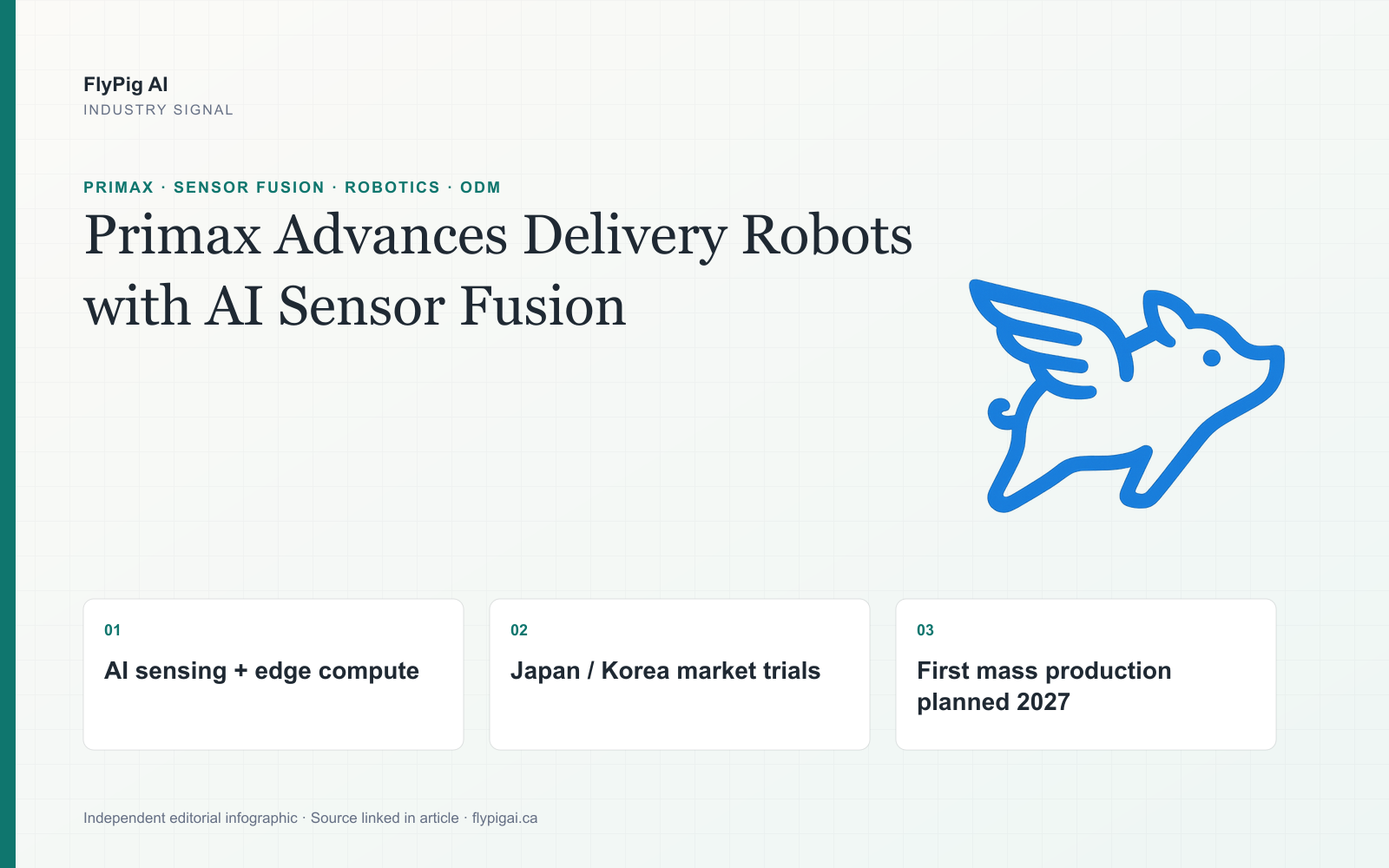
Primax describes its AI Sensor Fusion work as spanning AI vision, acoustics, edge computing and intelligent robotics. At Automation Taipei 2026, the group presented that stack from sensing modules through complete robot systems.
For an OEM, that creates the possibility of working with one Taiwan organization across several layers of a Physical AI design rather than sourcing every sensing block independently.
Delivery robots are becoming the proof point
Primax says autonomous delivery robots are undergoing market trials with customers in Japan and Korea, with a first mass-production rollout expected in 2027.
That moves the story from component capability toward commercialization. It still does not guarantee broad product availability, but it provides stronger evidence that the integrated stack is being validated outside the lab.
ODM scope will determine whether the model travels
The most important questions for Canadian product teams are which sensing modules and compute platforms can be purchased independently, what SDK or APIs are exposed, and how much customization Primax accepts in an ODM engagement.
If those interfaces are clear, the company could become relevant not only for delivery robots but also retail, service, security and industrial automation products.
FlyPig AI interpretationPrimax is strategically interesting because it sits at the boundary between component supplier and full-system ODM. That is precisely where FlyPig can create value by translating a Canadian application into the right module, subsystem or co-development scope rather than treating the company as a generic factory.
Status, open questions and Canada relevance
Current product status
Primax states that autonomous delivery robots are in customer trials in Japan and South Korea, with a first mass-production rollout expected in 2027. These are supplier-stated forward milestones, not independent deployment verification.
What remains open
- Which modules, subsystems and software interfaces can be purchased independently from a full ODM engagement?
- What trial scale, service model, certification plan, NRE and MOQ apply to a Canadian deployment?
Why Canadian teams may care
Canadian hospitality, retail and service-robot teams may gain a shorter integration path if Primax exposes modular sensing and compute options rather than requiring a complete robot program.