Why it matters
- More capacity per package could help reduce board area in embedded vision systems when controller and package compatibility allow it.
- LPDDR4 x16, LPDDR4 x32 and DDR4 represent distinct design decisions; memory density alone cannot establish interchangeable interfaces.
- The end-2026 availability target and Q2 2027 mass-production plan must be separated from confirmed samples, stock or shipments.
New densities fill gaps in a familiar memory family
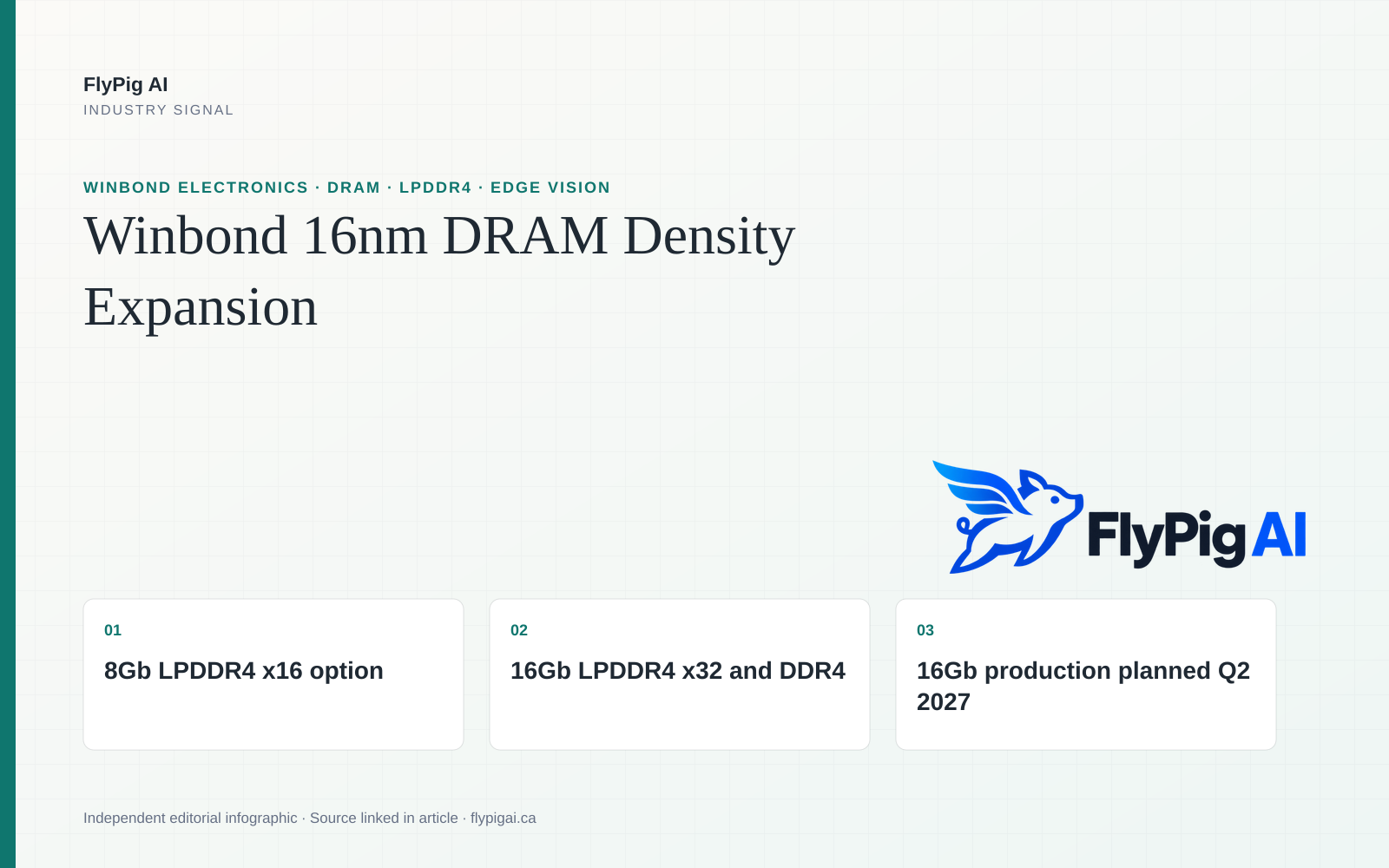
On November 4, 2026, Winbond announced an 8Gb LPDDR4 part organized x16, a 16Gb LPDDR4 part organized x32 and a 16Gb DDR4 device built on its 16nm process. The supplier identifies AI image-signal processing, surveillance and drone systems among potential applications of its LPDDR4 range. That does not indicate that any particular robot, camera or North American product has adopted these chips.
For designers, the practical opportunity is component count and footprint flexibility. Greater density may permit fewer DRAM packages for a target capacity, but bus organization, device packaging, memory-controller support, signal routing and firmware configuration all govern whether a migration makes sense. A 16Gb component is not automatically a drop-in replacement for an 8Gb part.
Design-in is a controller and qualification problem
Camera pipelines and other edge workloads can consume considerable frame-buffer and working-memory capacity even when inference runs elsewhere in the system. The new density choices may help next-generation platforms balance memory footprint, capacity and price. Winbond's announcement does not provide a controlled system-level power comparison, a specific BOM saving or an independent performance benchmark; those are design-specific questions.
A Canadian embedded-equipment team should first check exact device part numbers, package drawings, target temperature grades, the supported DDR and LPDDR controller modes, validation boards and sample allocations. The use of a familiar memory standard may simplify planning, but electrical characteristics and timing training should still be proven on the actual product architecture.
The announced schedule is still future-looking
Winbond says the new 16Gb DDR4 and LPDDR4 parts are scheduled to become available by the end of 2026 and targets mass production in the second quarter of 2027. Availability is not the same as broadly orderable inventory, and a planned manufacturing date does not verify qualification yields, shipping commitments or long-term supply arrangements.
This makes the announcement a useful planning signal for teams revising hardware in 2027. Programs with near-term launch dates should retain already qualified memory choices unless the supplier provides samples, a supported platform and concrete commercial terms. Even for long-life industrial products, supply continuity and multi-year support require direct confirmation.
FlyPig AI interpretationThis is a density-roadmap story rather than an AI speed breakthrough. The value to FlyPig's design-intelligence graph is knowing which future memory organizations may unlock more compact edge products, and when those devices become testable.
Status, open questions and Canada relevance
Current product status
Portfolio announced November 4. Winbond targets end-2026 availability for new 16Gb devices and Q2 2027 mass production; samples, lead times, prices, supply commitments and shipments are not independently confirmed.
What remains open
- Which exact 16nm part numbers, packages, temperature grades and evaluation samples will be supported?
- Which embedded controller families and reference boards are qualified, and how firm is the Q2 2027 production schedule?
Why Canadian teams may care
Canadian machine-vision and rugged-device OEMs may evaluate the new 16Gb LPDDR4 density for a later platform revision, but should retain confirmed sourcing plans until qualification evidence exists.