Why it matters
- NOR Flash and nonvolatile memories sit underneath boot, firmware, parameter storage and recovery functions in industrial, automotive and infrastructure products.
- If completed, the transaction could broaden Winbond's portfolio and support footprint in markets that overlap Edge AI and Physical AI, but that is a future integration question rather than a current sourcing change.
- Qualification continuity matters more than corporate ownership for long-life products. OEMs should wait for controlled migration, lifecycle and manufacturing information before changing approved-vendor decisions.
What changed
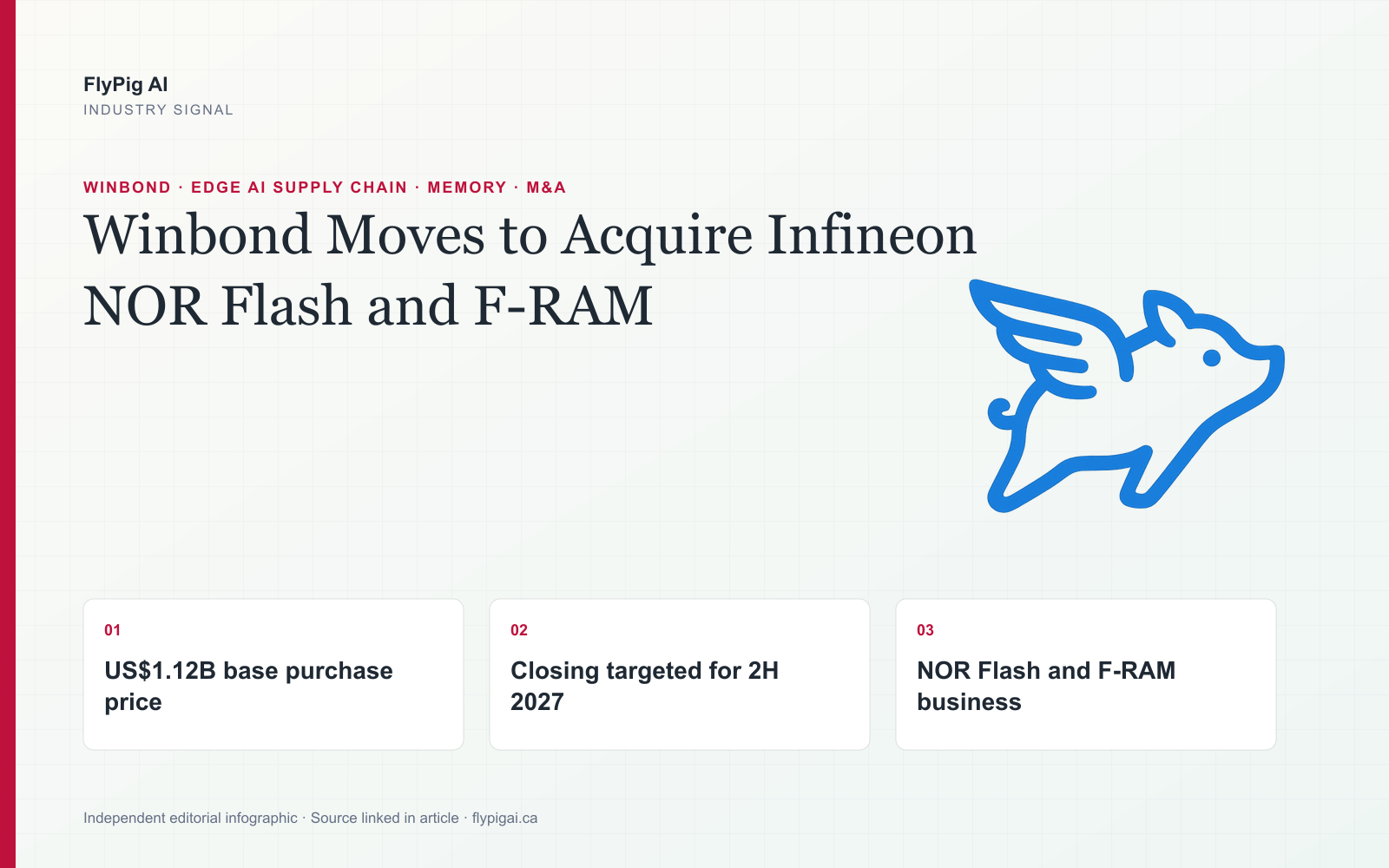
Winbond and Infineon have entered into a definitive transaction covering Infineon's NOR Flash and F-RAM business. Winbond states a base purchase price of US$1.12 billion, subject to customary adjustments before closing.
Infineon's first-party announcement independently matches the transaction value and says the portfolio serves automotive, industrial and infrastructure customers. Infineon also states that it will retain specialty memories including SRAM, HYPERRAM, nvSRAM and SONOS-based radiation-hardened products.
What has not changed yet
Closing is targeted for the second half of 2027 and requires regulatory approvals. Until then, the announcement does not establish a present transfer of ownership, manufacturing responsibility, product support or commercial terms.
Winbond says the acquired company will be named Spansion upon closing. That future naming should not be interpreted as a currently operating relaunched Spansion business or as evidence that existing product branding has already changed.
Design-in implications
For long-life industrial and automotive programs, the critical future documents will be part-number continuity, fab and assembly sources, qualification status, product-change notification processes and lifecycle commitments.
Edge AI teams should watch whether the combined portfolio creates new options for secure boot, code storage or high-endurance parameter memory, but no such new reference design or supply advantage is confirmed by the transaction announcement itself.
FlyPig AI interpretationThe strategic signal is portfolio consolidation, not an overnight product event. Memory substitutions can touch boot code, qualification, functional safety, sourcing and years of lifecycle planning. The right response is to track the transaction and wait for controlled product-transition evidence before assuming any design-in benefit.
Status, open questions and Canada relevance
Current product status
The acquisition is a signed transaction, not a completed ownership transfer. Winbond and Infineon target closing in the second half of 2027 subject to required regulatory approvals and other closing conditions. No immediate product migration, availability, pricing, MOQ, lead-time or manufacturing change is established by the reviewed announcements.
What remains open
- Which NOR Flash and F-RAM part numbers, fabs, assembly sites and qualification records will transfer at closing?
- How will automotive and industrial product-change notification, longevity and approved-vendor status be handled through the transition?
- When will Winbond publish any portfolio integration, cross-reference, secure-memory or reference-design roadmap after closing?
Why Canadian teams may care
North American automotive, industrial and infrastructure OEMs that depend on long-life NOR Flash or F-RAM should track the transaction for qualification continuity and sourcing changes, especially because the acquired business is expected to operate as a standalone U.S.-headquartered entity after closing.