Why it matters
- Flash-backed memory extension attacks a different bottleneck from NPU TOPS: the capacity needed to keep larger models local.
- The approach could let more modest systems run workloads that otherwise require substantially more DRAM or accelerator memory.
- Latency, endurance and workload-specific performance remain critical; this should not be read as a general replacement for DRAM or HBM.
Local AI is running into a memory-capacity wall
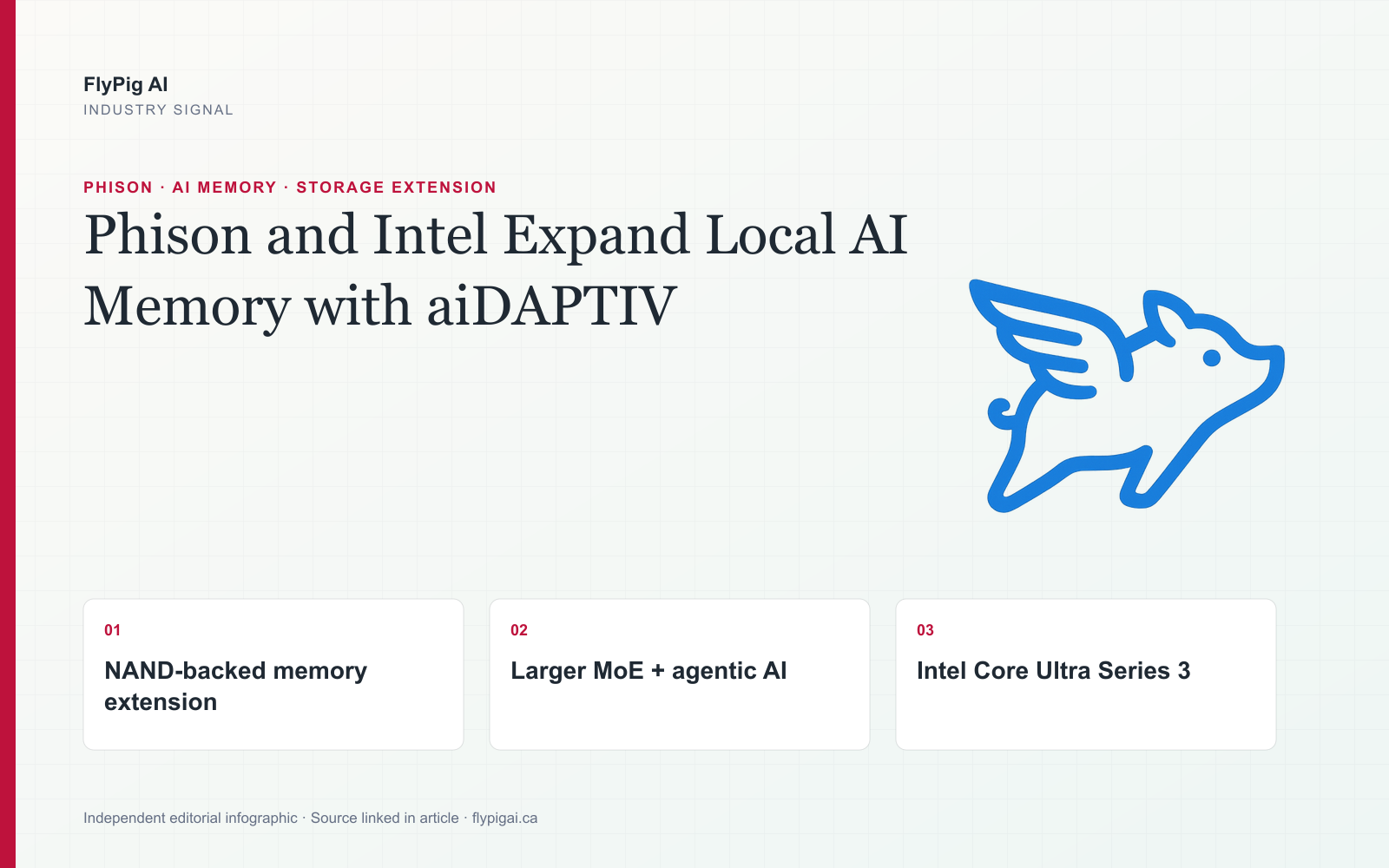
As local models grow, inference is constrained not only by compute but also by how much model state can be kept close to the processor. Phison’s aiDAPTIV approach treats NAND as an additional memory tier rather than only persistent storage.
The June collaboration with Intel positions that idea around Core Ultra Series 3 systems and larger mixture-of-experts and agentic workloads.
A new tier changes system economics, but also the performance model
Using flash to extend effective memory can change the cost curve for AI PCs and edge appliances. It may allow a system to trade some latency for much larger local model capacity instead of scaling expensive DRAM linearly.
That trade-off has to be measured workload by workload. Random access behaviour, flash endurance, model paging patterns and software orchestration all affect whether the architecture is useful.
The edge opportunity is broader than PCs if the stack proves portable
If the mechanism can be exposed cleanly in compact AI appliances, private AI boxes or industrial edge systems, it could become a useful architecture tool for teams trying to keep models local.
The important next evidence is therefore not headline model size, but reproducible performance data on representative local workloads and clear platform support.
FlyPig AI interpretationaiDAPTIV is interesting because it reframes storage as part of the AI memory hierarchy. FlyPig would treat it as an architecture option for capacity-constrained local AI, not as a substitute for fast memory without workload-specific validation.
Status, open questions and Canada relevance
Current product status
Phison and Intel publicly announced collaboration and platform support for aiDAPTIV on Intel Core Ultra Series 3. Workload performance and supported model sizes depend on the validated hardware and software configuration.
What remains open
- Which OEM systems, SSD capacities and software versions are validated for production use?
- How do latency, endurance, thermals and total cost compare with adding conventional system memory or GPU memory?
Why Canadian teams may care
Canadian AI developers and device makers could evaluate larger private local models on PC-class hardware before committing to workstation GPUs or cloud inference.