Why it matters
- The amplifier moves speaker protection, distortion compensation and diagnostics closer to the audio power stage instead of leaving all tuning to the host processor.
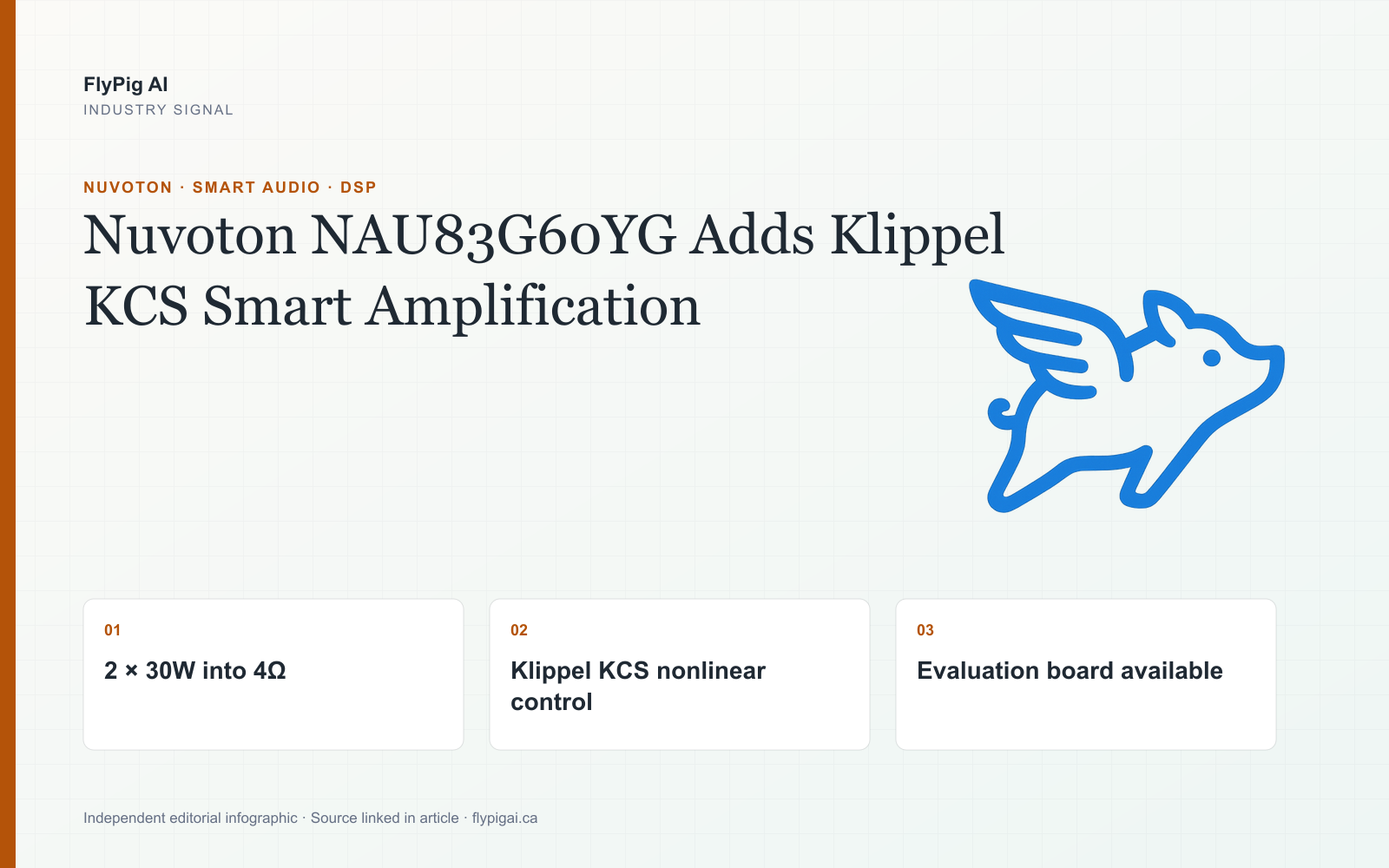
- Nuvoton says the device can deliver up to 2 × 30W into 4Ω loads and provides low-latency processing relevant to voice and ANC systems.
- An evaluation board is already available, making this a more actionable design-in signal than an early technology demonstration.
Smart audio is moving more intelligence into the amplifier
The NAU83G60YG combines Class-D amplification, DSP, current and voltage sensing, and Klippel Controlled Sound. The goal is to control the loudspeaker as a nonlinear, changing mechanical system rather than assume a fixed linear model.
That can improve output, protection and consistency from smaller speakers, which is useful in smart speakers, conferencing devices and other compact audio products.
AEC and ANC can benefit from a cleaner reference signal
Nuvoton emphasizes that the device can provide a linearized reference signal for acoustic echo cancellation and low-latency processing for active noise cancellation.
The amplifier does not replace the complete voice stack, but it can remove part of the acoustic burden from the main SoC.
The part is already entering the evaluation phase
Nuvoton lists the NT-NAU83G60 evaluation board as available through its sales channels and direct store. That gives product teams a concrete path to measure speaker performance rather than rely on marketing claims.
Licensing terms around KCS, production pricing and tuning workflow still need to be understood before a full design-in decision.
FlyPig AI interpretationNAU83G60YG is a useful reminder that local AI products are also acoustic systems. Moving nonlinear speaker control into the amplifier could free host compute and improve voice interaction, but the real value has to be measured with the product’s actual speaker and enclosure.
Status, open questions and Canada relevance
Current product status
Nuvoton has officially announced the NAU83G60YG and an evaluation-board path for Klippel KCS integration. Production timing, licensing and supported loudspeaker profiles require confirmation.
What remains open
- What KCS licensing, tuning services and evaluation resources are included with the device?
- Which thermal, acoustic and protection results have been validated across representative speaker designs?
Why Canadian teams may care
Canadian smart-device, mobility and kiosk teams could use integrated nonlinear speaker control to improve output from compact enclosures without adding a separate DSP path.