Why it matters
- A GUI stack with optimized graphics and on-chip memory could simplify some appliance and dashboard boards that otherwise need external memory.
- Target-specific tooling and Qt framework support can save bespoke UI work, but exact target tiers, software rights and long-term support remain critical.
- Public joint announcements can lag engineering availability; a precise chronology prevents misleading claims about what is newly released.
A familiar UI framework meets an integrated-memory HMI device
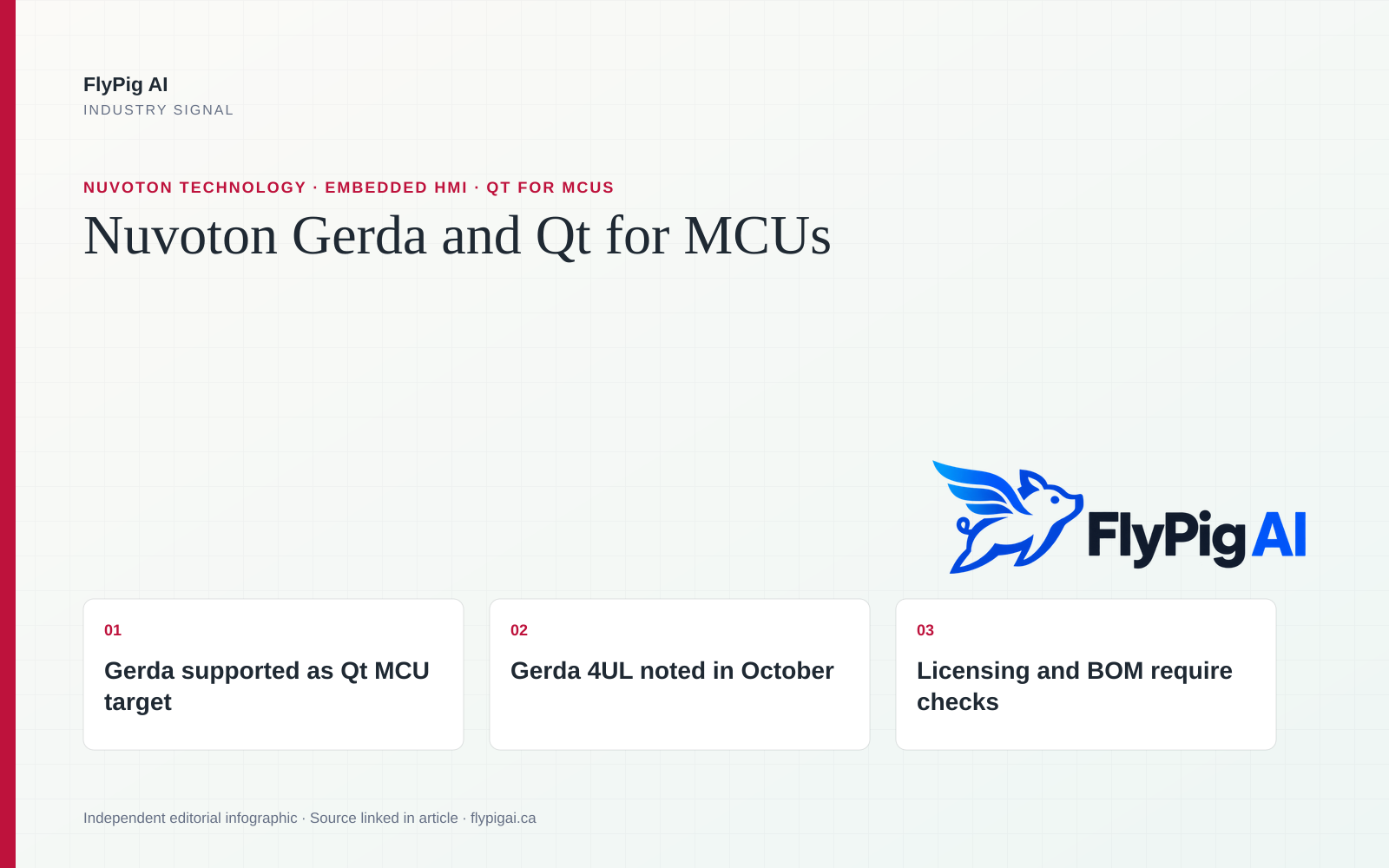
Nuvoton Technology Corporation Japan and Qt Group announced on November 5 that the Gerda controller family is supported as target hardware for Qt for MCUs. Nuvoton describes on-chip memory and graphics compression that can enable certain display interfaces without external memory. The target applications include motorcycle clusters, automotive HMI and appliance control panels, not a newly introduced AI NPU.
For product developers, a supported GUI toolkit may reduce the effort required to create animations, interface components and repeatable display workflows. But the cost benefit depends on screen resolution, asset compression, RAM headroom, graphical performance, update constraints and licensing. This is not a universal guarantee that an external memory chip can be removed from every product.
The software timeline needs an explicit correction to the launch framing
Qt's October 7, 2026 release notes for Qt for MCUs 2.12.3 LTS already listed Gerda 4UL as a Tier-2 target available through the online installer with Qt Creator integration. The November 5 joint announcement may therefore be best understood as formal positioning for the ecosystem and wider communication of compatibility, not the original date when Gerda support first became usable.
Exact controller variants may also have differing support status, examples or maintenance commitments. Companies evaluating Gerda should request a versioned board support matrix, target tier, tested Qt release, QML capabilities and reliable update path. Without those details, a generic statement that the family is supported is insufficient for a production software plan.
The commercial decision still depends on a real board
Qt for MCUs can affect embedded-product development costs as much as the controller itself, particularly when multiple interface revisions are planned. A suitable toolchain might help iterate UI layouts without rebuilding an entire graphics stack. That is an engineering possibility, not evidence of a quantified BOM saving, vehicle certification, mass-production shipment or official Canadian distributor agreement.
Canadian OEMs should prototype with the precise Gerda device, display and touch hardware; confirm boot-time and response requirements; check update security and long-term software maintenance; and obtain software licensing, board availability and silicon supply details. The joint announcement provides a useful integration lead, but production suitability requires direct validation.
FlyPig AI interpretationThe opportunity is a mature embedded GUI development route rather than a new AI chip. FlyPig would preserve the October-to-November chronology and compare toolchain cost, feature coverage and memory headroom before recommending Gerda for a new device.
Status, open questions and Canada relevance
Current product status
Joint announcement dated November 5. Qt release notes dated October 7 already identified Gerda 4UL Tier-2 support. Availability of individual silicon SKUs, commercial licenses, full family target coverage and production stock remain unconfirmed.
What remains open
- Which Gerda board variants and Qt for MCUs versions have tested, downloadable packages and stable support terms?
- Can the target interface fit its full GUI asset set, secure updates and supplier licensing budget without external memory?
Why Canadian teams may care
Canadian appliance and embedded-HMI teams can prototype the Gerda and Qt combination, while independently checking silicon, software licensing, toolchain and long-term support.