Why it matters
- Microphone arrays feed voice activity detection, beamforming, speech recognition and multimodal AI pipelines, so front-end latency and channel synchronization can directly affect responsiveness.
- Integrated microphone diagnostics and flexible I2S, PCM and TDM output can reduce glue logic around a host SoC and make failure detection easier in multi-mic products.
- An evaluation board and buying path lower the barrier to characterization, but teams should confirm IC production status and supply terms before treating the part as a production-ready sourcing decision.
What changed
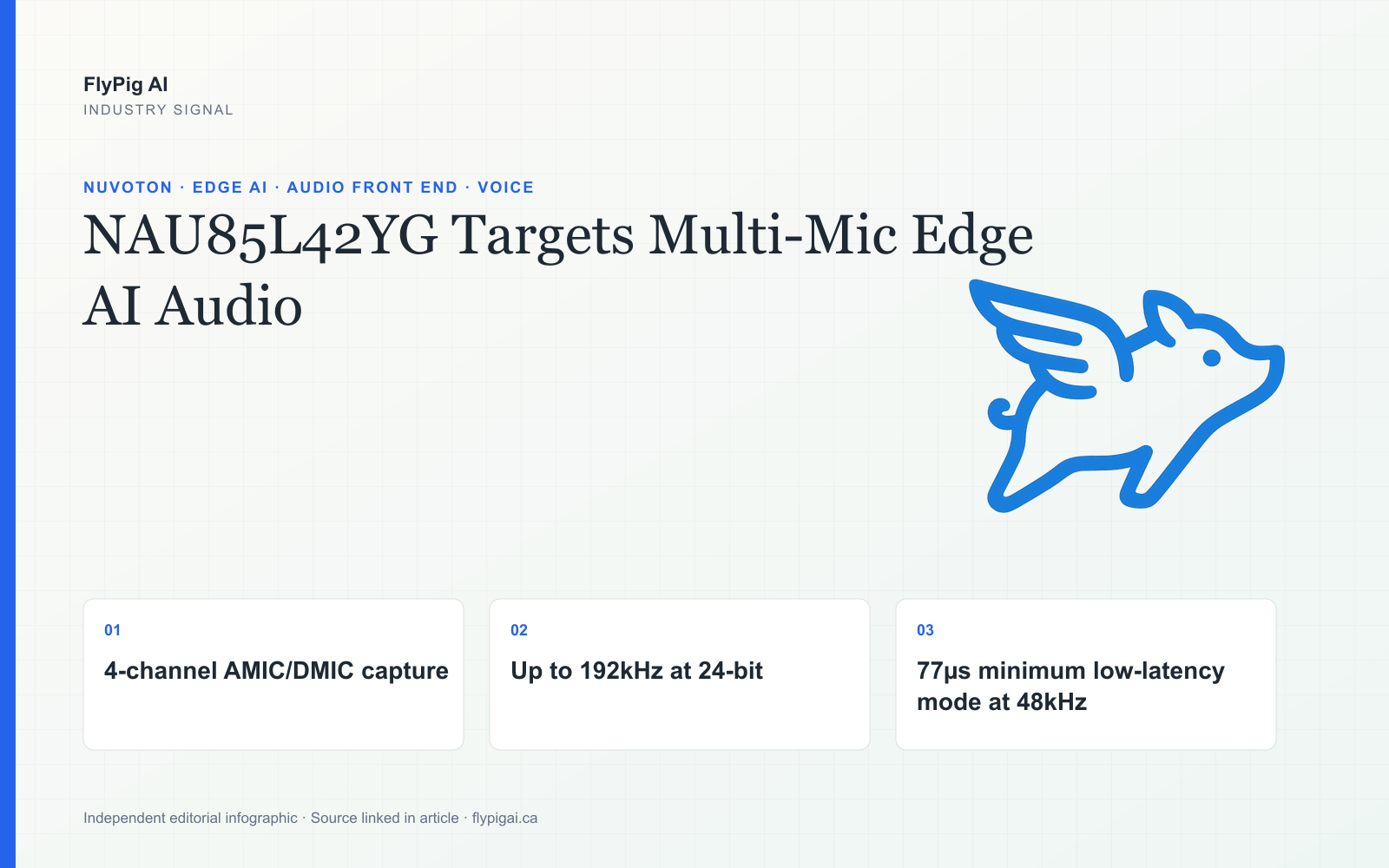
Nuvoton's new NAU85L42YG consolidates four audio ADC channels with support for both analog and digital microphones. Its current product page lists sample rates from 8kHz to 192kHz at 24-bit and provides I2S, PCM and TDM output options.
The same page lists a minimum 77 microsecond low-latency decimation mode at 48kHz and 106dB A-weighted SNR at 0dB gain. Nuvoton's launch release separately claims latency can be reduced to one-sixth of conventional quad ADCs; FlyPig treats that as a vendor comparison rather than an independently reproduced benchmark.
Why it matters to Edge AI products
Real-time audio agents and robots depend on the capture path before any model runs. Lower front-end delay can help interactive voice systems, while microphone diagnostics can support reliability in products that depend on several sensors operating together.
For a North American OEM, the practical decision is not whether the ADC is branded for AI, but whether it improves end-to-end latency, acoustic performance and fault handling once paired with the actual microphones, enclosure and host processor.
Commercial and design-in questions
Nuvoton has a product page, an NL-NAU85L42 evaluation board and purchasing links. The reviewed first-party material does not establish production volume, regional IC inventory, price, MOQ or lead time.
Design teams should characterize latency across filter modes, AMIC and DMIC configurations, clocking, channel count and power states, then validate how the part interacts with the host's beamforming, echo cancellation and inference pipeline.
FlyPig AI interpretationAudio Edge AI is often limited by the sensor path before it is limited by model compute. A four-channel ADC with explicit low-latency modes and microphone diagnostics is therefore more strategically useful than the category sounds, but only if Nuvoton's vendor figures hold up in the enclosure, microphone and host architecture that will actually ship.
Status, open questions and Canada relevance
Current product status
Nuvoton formally announced NAU85L42YG on September 15, 2026 and currently lists the part plus an NL-NAU85L42 evaluation board. The reviewed official sources do not establish IC mass-production volume, regional inventory, pricing, MOQ or lead time.
What remains open
- What are the measured end-to-end group delay and power consumption across each filter, sample-rate, AMIC and DMIC configuration?
- What IC sampling and production status, regional inventory, MOQ and lead time apply to North American and Taiwan design teams?
- How robust are the microphone diagnostics across real-world array tolerances, enclosure acoustics and clocking conditions?
Why Canadian teams may care
Canadian conferencing, robotics, smart-building and voice-interface teams can evaluate the part as a microphone-array front end where local inference benefits from lower capture latency and explicit sensor-health diagnostics.