Why it matters
- Robots and smart machines need deterministic motor, joint and actuator control even when perception and planning run on a separate Linux or AI processor.
- The 5V-capable MCU can fit legacy and noise-prone control domains, while PWM, encoder and ADC trigger paths can keep time-critical loops local instead of pushing them onto the application processor.
- Dual-bank Flash, ECC, Bank Swap, TrustZone and Secure Boot make firmware maintenance and security part of the control architecture rather than an afterthought.
What changed
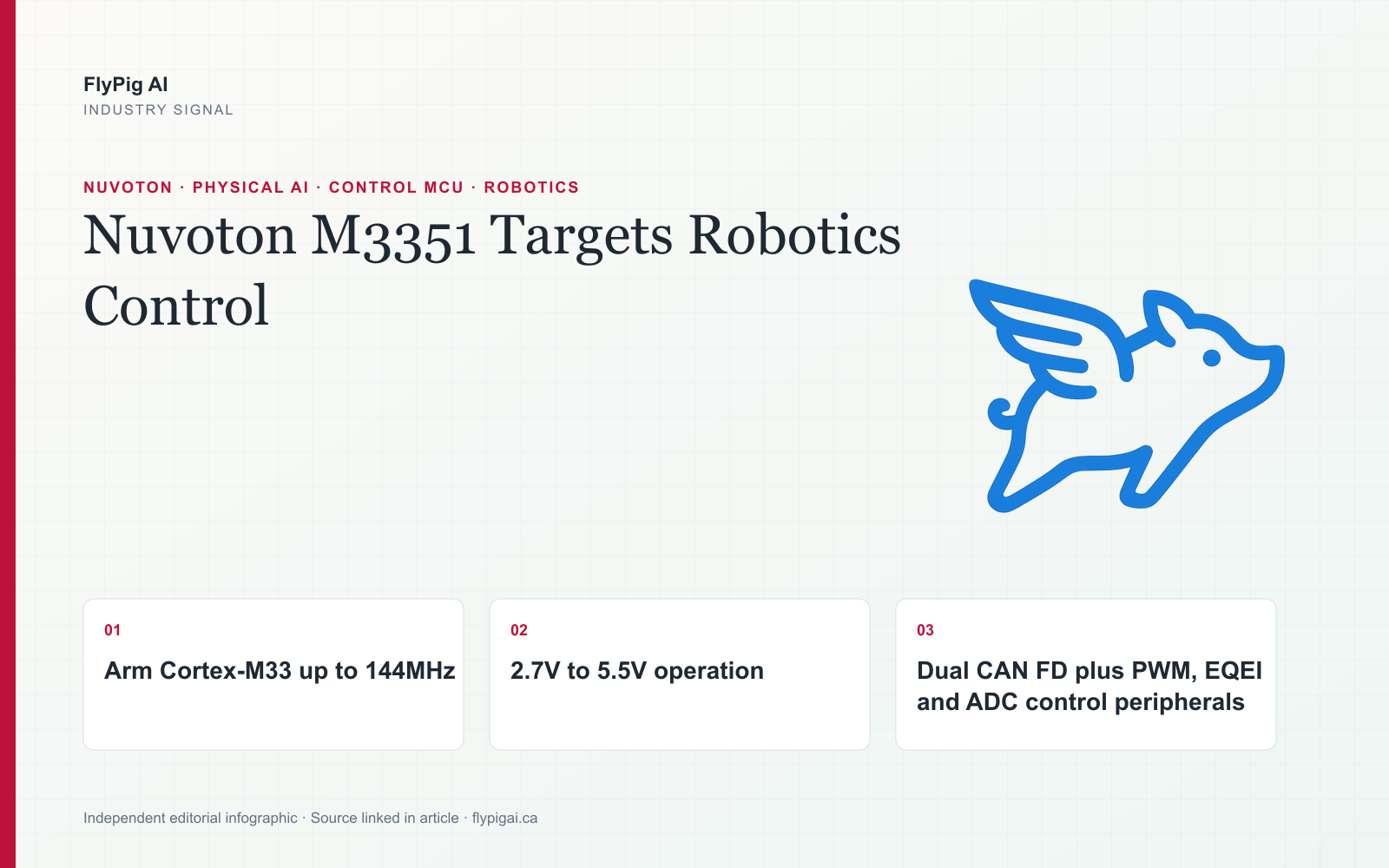
Nuvoton's M3351 family extends to 1MB of Flash and 128KB of SRAM, with selected high-capacity devices supporting dual-bank operation, ECC, background operation and Bank Swap. The company positions that combination for firmware update and control workloads.
Peripheral integration includes up to two CAN FD interfaces, up to 24 PWM/BPWM channels, up to two enhanced quadrature encoder interfaces, plus 12-bit and 14-bit ADC resources. Those are directly relevant to motor, joint, valve, pump and actuator subsystems.
Why Physical AI teams should care
A Physical AI product normally contains more than one compute layer. A powerful NPU can plan or perceive, but a lower-level MCU still has to execute deterministic control, supervise faults and keep actuators safe when the application processor is busy or restarting.
The M3351 therefore competes on control integration, voltage range and firmware resilience rather than AI throughput. Its value should be evaluated against the actual motor topology, encoder interfaces, communication buses and safety requirements of the machine.
Commercial and documentation questions
Nuvoton's announcement says it provides a NuMaker-M3351KJ board, while the same page's Buy Online link points to a NuMaker-M3351KI. That mismatch should be resolved before a team standardizes its development hardware or documentation.
The IC family is formally launched, but the reviewed sources do not establish regional inventory, production volume, MOQ or lead time. Those are procurement questions for Nuvoton or authorized channels, not facts to infer from the presence of a buy link.
FlyPig AI interpretationAs Physical AI moves toward real products, the control MCU becomes more important, not less. The upper stack may change models and accelerators frequently, while motors, encoders, power stages and field buses need deterministic behavior for years. M3351 is interesting because it addresses that durable control layer with modern security and update mechanisms.
Status, open questions and Canada relevance
Current product status
Nuvoton formally launched the M3351 series on September 18, 2026 and publishes a product family page plus development-board purchase links. The launch release names NuMaker-M3351KJ, while its Buy Online link points to NuMaker-M3351KI. The reviewed source does not establish M3351 IC production volume, regional inventory, price, MOQ or lead time.
What remains open
- Are NuMaker-M3351KJ and NuMaker-M3351KI distinct board revisions, and which board maps to each M3351 device package and reference design?
- What IC sampling, production, regional inventory, MOQ and lead-time status applies to each device in the family?
- Which reference designs and software examples cover closed-loop motor or robotic-joint control using CAN FD, EQEI, PWM and ADC hardware triggers?
Why Canadian teams may care
Canadian robotics, industrial automation and smart-equipment teams can evaluate M3351 as the deterministic control companion to higher-level AI compute, particularly where 5V I/O environments, CAN FD and field-updatable firmware are useful.