Why it matters
- MediaTek is extending the integration model it has used in mobile devices into premium personal computing, where CPU, GPU, NPU, ISP, memory, storage and connectivity choices are tightly coupled at the platform level.
- For Edge AI teams, a 55 TOPS-class NPU inside a client PC SoC expands the workloads that can stay local, but real throughput, memory pressure and thermals still need device-level validation.
- For Taiwan's supply chain, a new Arm-based PC platform can create design-in work around ODM systems, cameras, memory, storage, power, thermal design and wireless subsystems if OEM adoption moves beyond the announcement stage.
What changed
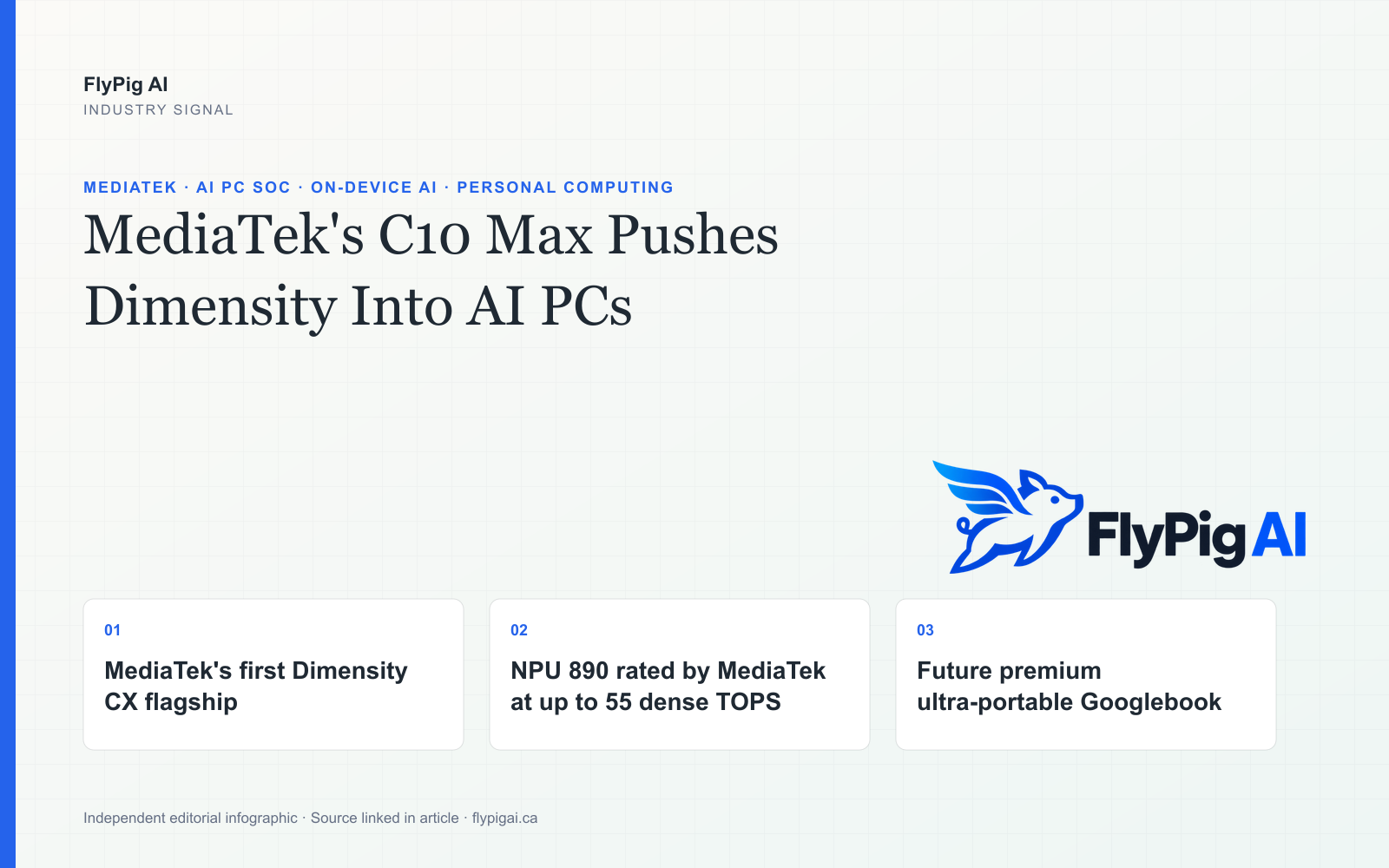
MediaTek's September 22 Taiwan announcement turns its broader PC ambitions into a named flagship platform. C10 Max is the inaugural Dimensity CX device, with an eight-core all-big-core CPU topology, an 11-core Immortalis-G925 GPU and the NPU 890. The product page specifies 1× Cortex-X925, 3× Cortex-X4 and 4× Cortex-A720, plus LPDDR5X up to 9600 Mbps and UFS 4.0.
The NPU is listed at up to 55 TOPS in dense mode with INT8, INT16, FP16 and BF16 support. That number is useful as a silicon specification, but it does not establish performance on a particular agent, vision model or local LLM.
Why it matters to Edge AI and product design
The architectural signal is integration. MediaTek is packaging AI acceleration, graphics, camera processing and connectivity into a PC-oriented SoC rather than asking OEMs to assemble those capabilities from discrete accelerators. That can simplify board design while making software support, thermal envelopes and memory bandwidth more important design-in variables.
MediaTek positions C10 Max around Gemini Intelligence and on-device agentic AI. Product teams should read that as a workload target, not a guaranteed user experience. The official material does not publish sustained NPU performance, power at 55 TOPS, model-size limits or application-level latency.
Commercial implications and unresolved questions
MediaTek says the chip will enable an upcoming premium ultra-portable Googlebook. Google's September 21 launch material says the initial preorder Googlebook choices use Intel Core Ultra Series 3 and Snapdragon X Elite processors. That makes C10 Max a future platform path rather than part of the currently identified launch wave.
No reviewed official source identifies the C10 Max OEM, notebook model, sample or EVK availability, production volume, chip pricing, MOQ or lead time. MediaTek also lists Bluetooth 6.0 capability at the platform level while its release footnote says Bluetooth 6.0 is not supported in Googlebook devices, so designers should separate silicon capability from shipping configuration.
FlyPig AI interpretationThe important move is not the headline TOPS number. MediaTek is trying to make the PC look more like an integrated edge appliance, with compute, AI, imaging and connectivity designed as one silicon platform. If C10 Max wins real Googlebook designs, it could give OEMs another path to thin, fanless local-AI systems. The next evidence that matters is a named device, sustained workload data and a clear production and software-support path.
Status, open questions and Canada relevance
Current product status
Dimensity CX C10 Max is formally announced and has a live MediaTek product page. MediaTek describes the target Googlebook as upcoming. The reviewed sources do not establish a named C10 Max notebook, retail date, chip sample or EVK availability, mass-production volume, pricing, MOQ or lead time. Google's current Googlebook preorder announcement identifies Intel and Qualcomm processors for the initial launch options, not C10 Max.
What remains open
- Which OEM and model will ship the first C10 Max Googlebook, and when will it reach preorder or retail availability?
- What sustained NPU performance, power draw and memory footprint should developers expect for representative agentic and multimodal workloads?
- What SDK, model-conversion, driver and lifecycle support will MediaTek expose, and will an EVK or reference platform be available outside named OEM programs?
- Which platform connectivity features, including Bluetooth 6.0, will actually be enabled in shipping Googlebook designs?
Why Canadian teams may care
For North American PC and edge-product teams, C10 Max is a silicon option to watch rather than a component with confirmed open-market availability. Its relevance will increase when a named Googlebook design, developer stack and production timeline are public, particularly for teams evaluating fanless local-AI endpoints and Arm-based client hardware.