Why it matters
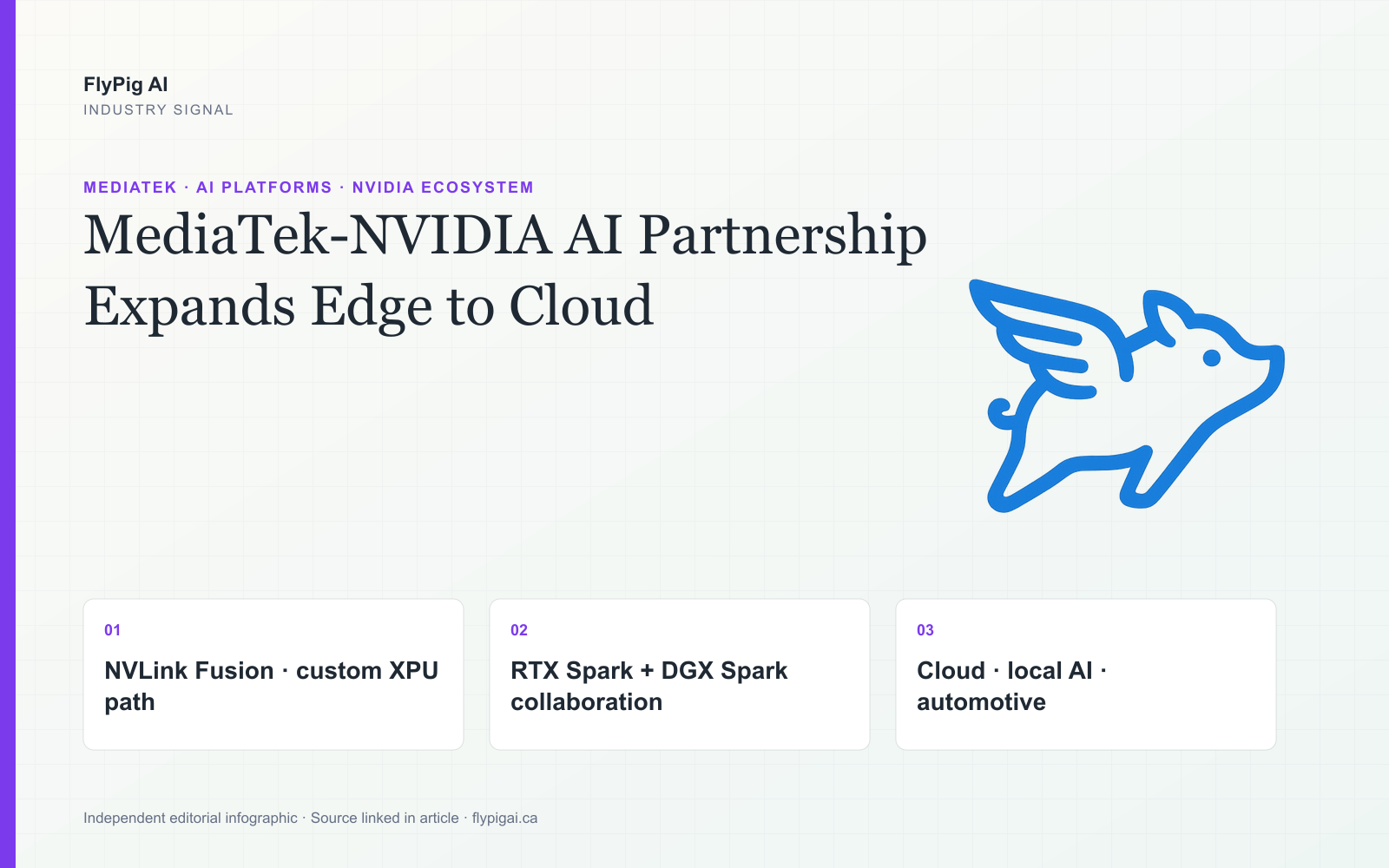
- NVLink Fusion gives MediaTek a route to participate deeper in custom accelerator and rack-scale system design, where packaging, memory, high-speed interconnect and manufacturability can matter as much as the accelerator die itself.
- The continued RTX Spark and DGX Spark work extends MediaTek's role in local AI computing, creating a bridge between its power-efficient SoC capabilities and NVIDIA's GPU and software ecosystem for PCs and developer systems.
- The automotive collaboration keeps MediaTek connected to Physical AI at the vehicle level, but product teams should distinguish a multigenerational platform commitment from any specific future design win or shipping vehicle program.
The partnership now spans more of the computing stack
MediaTek's August 31 announcement says it will adopt NVIDIA NVLink Fusion as a foundation for customers developing custom XPUs that can connect into NVIDIA NVLink-based rack-scale systems. That moves the relationship into the infrastructure design layer, where an accelerator must be integrated with memory, packaging, interconnect and system architecture before it becomes a deployable platform.
The same announcement also extends the companies' work in local AI computing and automotive. MediaTek and NVIDIA say they will continue collaborating across multiple generations of RTX Spark and DGX Spark PC chips, while their automotive work continues around AI-powered and software-defined vehicles. The result is a broader architecture relationship rather than a single-product launch.
The commercial signal is stronger than the product-availability signal
NVIDIA also disclosed a US$3.5 billion investment in convertible bonds issued by MediaTek. That is a concrete financial commitment and strengthens the strategic significance of the collaboration, but it should not be read as evidence that every announced technical path has reached production.
For OEMs and system builders, the near-term implication is optionality. A supplier with experience spanning custom silicon, connectivity, packaging and edge SoCs could become relevant to more NVIDIA-centered programs. The official announcement does not identify new MediaTek ordering codes, customer names, sample dates, pricing, lead times or qualification milestones for the NVLink Fusion work, so those remain outside the evidence.
Design teams should watch the interfaces between the three domains
The most important engineering questions sit at the boundaries: which NVLink Fusion building blocks MediaTek will productize for custom XPU customers, how software and memory architecture carry across RTX Spark-class local systems, and what parts of the automotive stack remain MediaTek-owned versus NVIDIA-dependent.
Those details will determine whether the expanded partnership creates reusable design leverage or simply a collection of separate programs under one strategic umbrella. Until controlled product documents and program-specific support terms appear, the announcement is best treated as an ecosystem and roadmap signal.
FlyPig AI interpretationThis matters because MediaTek is moving closer to the architectural center of NVIDIA's ecosystem instead of participating only at the component edge. The opportunity is potentially broad, from custom AI infrastructure to local AI PCs and vehicles, but the announcement is still more informative about strategic direction than about purchasable products. The next useful evidence will be specific MediaTek design offerings, qualification paths and production commitments tied to each domain.
Status, open questions and Canada relevance
Current product status
MediaTek and NVIDIA announced an expanded strategic collaboration on August 31, 2026. MediaTek will adopt NVIDIA NVLink Fusion and the companies say they will continue multigenerational work in local AI computing and automotive. The reviewed official source does not announce a new MediaTek product SKU, sample availability, pricing, lead time or customer deployment for the custom-XPU program.
What remains open
- Which MediaTek custom-XPU services, chiplets, packaging options or reference architectures will be offered as concrete design-in deliverables around NVLink Fusion?
- How will software, memory architecture and developer tooling differ between future RTX Spark, DGX Spark and custom infrastructure programs?
- What production qualification, lifecycle and automotive safety-support commitments will apply to the next generation of joint platforms?
Why Canadian teams may care
Canadian AI infrastructure developers, PC software teams, automotive suppliers and Physical AI startups may encounter more NVIDIA-centered platforms in which MediaTek contributes custom silicon or system-level integration. The practical value will depend on whether those programs expose accessible development hardware, software support and commercial engagement routes for North American teams.