Why it matters
- Larger local models raise pressure on memory bandwidth, storage throughput, sustained thermals and power delivery, so the AI roadmap increasingly affects the full smartphone hardware stack rather than only the NPU.
- The 9600 Pro combines CPU and NPU resources through MediaTek's AI Computing Fusion architecture, pointing toward tighter heterogeneous scheduling for always-on and interactive on-device agents.
- The 9600M broadens the product strategy, but MediaTek calls it upcoming. Product planners should separate that roadmap signal from the already announced 9600 Pro.
What changed
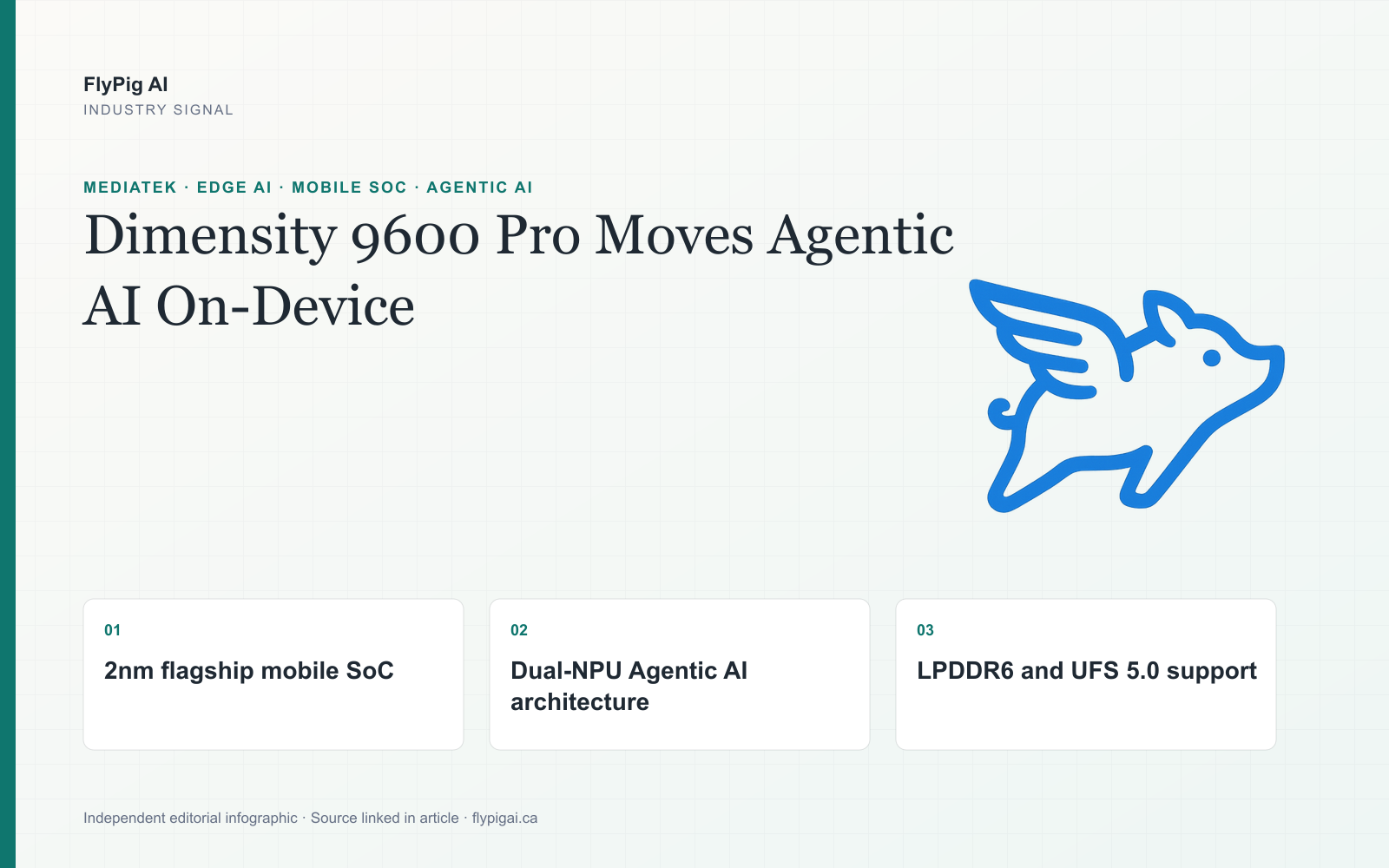
MediaTek's September 15 announcement moves its flagship smartphone platform to a 2nm process and pairs a 2+3+3 all-big-core CPU with dual NPUs. The company lists NPU 1090, an Agentic AI Engine, 34.5MB of cache, and first-time Dimensity support for LPDDR6 and UFS 5.0.
MediaTek says the platform can support on-device models up to 30B parameters. That is a vendor capability statement, not an independent workload benchmark, and actual usable model size will depend on quantization, memory capacity, runtime, context length and thermal limits in the final handset.
Commercial implications
For OEMs, the shift increases the value of coordinated memory, storage, thermal and power design. The SoC may enable more local inference, but it also creates a larger validation surface around sustained performance and AI responsiveness under realistic battery and temperature constraints.
MediaTek says the first smartphones based on the 9600 Pro and 9600M are expected this quarter. It does not name those phone programs in the reviewed source, and that forecast should not be read as confirmation of general chip sampling, standalone procurement or volume shipment.
Design-in questions
The biggest open questions are the real memory footprint and latency of representative agentic workloads, the practical limits of always-on perception, and how OEM thermal designs affect sustained CPU, GPU and NPU behavior.
The 9600M also needs a clearer public specification set. Its process, CPU and NPU configuration, memory interfaces and exact commercialization timing remain unresolved in the reviewed announcement.
FlyPig AI interpretationThe signal is not simply that a flagship phone SoC got faster. MediaTek is making large local models, always-on perception and agent-style workloads a first-class system-design problem. The interesting design battle now moves into memory, storage, thermals and sustained power, where headline AI capability either becomes a usable product feature or does not.
Status, open questions and Canada relevance
Current product status
Dimensity 9600 Pro was formally launched on September 15, 2026. MediaTek describes Dimensity 9600M as an upcoming chipset and says first smartphones using the two platforms are expected this quarter. The reviewed source does not establish standalone silicon pricing, MOQ, lead time, module availability, named handset customers or shipment volume.
What remains open
- What memory capacity, quantization and runtime configurations are required for the claimed support of on-device models up to 30B parameters?
- How do sustained CPU, GPU and NPU performance and power behave inside shipping handset thermal envelopes rather than MediaTek demo devices?
- What are the final process, CPU, NPU, memory and launch specifications for Dimensity 9600M?
Why Canadian teams may care
North American mobile, AI application and device teams evaluating local-agent experiences should watch how quickly this class of architecture turns into shipping phones and whether large on-device models produce enough privacy, latency or cloud-cost advantage to justify the added memory and thermal budget.