Why it matters
- Axiom lowers the hardware barrier for teams that want to work on humanoid-style manipulation without buying a full bipedal platform. That can expand the installed base for Physical AI data collection, imitation learning and manipulation research.
- The architecture is modular at several commercially important interfaces. InDro says customers can select robotic arms and end effectors, use their existing computer workflow, add Cortex and Controller, or integrate Axiom onto an AMR base. Those interfaces can become repeatable design-in points if the platform is adopted across multiple research programs.
- The current product page exposes an unusually concrete research BOM, including dual arms, grippers, multimodal data-collection devices, UWB positioning and stereo depth vision. That makes Axiom useful as a demand map even though it does not establish a sourcing opportunity for any specific Taiwan supplier.
- For Canadian robotics, Axiom adds a domestically integrated research platform between component-level developer kits and far more expensive full humanoid systems. Its value to the supply chain will depend on whether InDro standardizes configurations and moves from early shipments into repeatable institutional or industrial purchases.
What changed: InDro productized a humanoid-style manipulation stack rather than another full humanoid
InDro's July 23 launch describes Axiom as a human-height, humanoid-style platform built around a telescoping torso, caster-wheel base, two shoulder-mounted robot arms and a top-mounted depth camera. The form factor is intentionally simpler than a bipedal humanoid: researchers get human-relevant reach and two-arm manipulation without paying for legged locomotion that may not be necessary for manipulation, teleoperation or data-collection work.
The platform is also designed to be configurable. InDro says customers can choose their own arms and end effectors, use Axiom with an existing computer workflow, add the company's Cortex hardware and Controller software, or integrate the torso and arm system onto an autonomous mobile robot base. That modularity is the more important product signal because it separates manipulation research from one fixed robot configuration.
The commercial signal is real, but still early
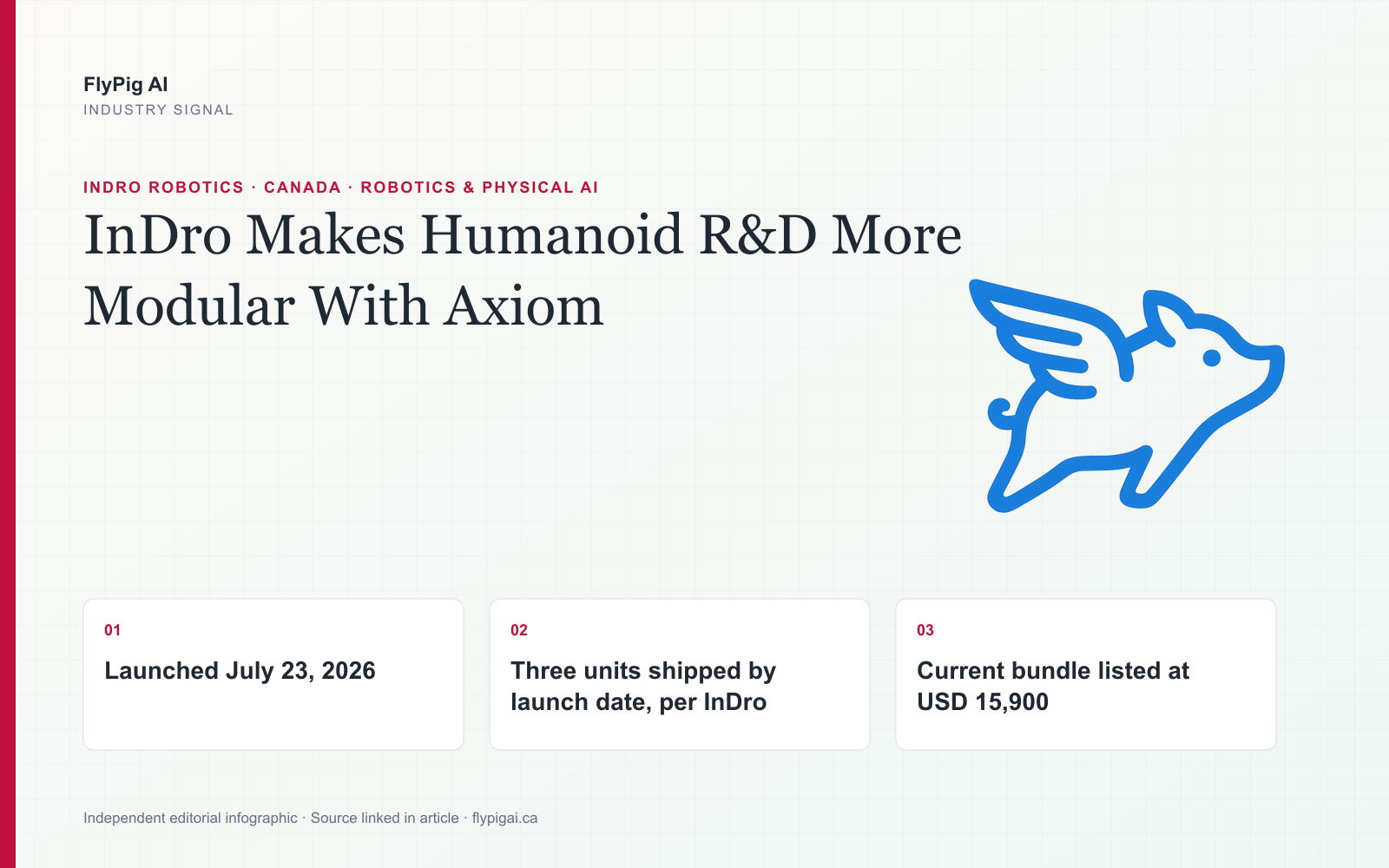
InDro said three Axiom units had already shipped when it announced the product. That is stronger evidence than a concept render or trade-show preview, but it is still an early commercialization signal. The company has not identified the buyers, disclosed whether those shipments were paid production units, published repeat orders, or provided a production capacity or annual-volume target.
The company's current Axiom page lists the product as available by contacting InDro to purchase. It describes a USD 15,900 configuration containing two AgileX NERO arms, two PiKA Sense units, two PiKA grippers, two PiKA positioning stations and one Stereolabs ZED 2i camera. That page gives procurement teams a tangible baseline, but it should not be confused with a fixed long-term BOM or a volume-production standard.
Pricing already shows why configuration control matters
InDro's launch article and current product page do not present one identical configuration or price. At launch, the company said a base platform with depth camera could be purchased for USD 4,000, a typical dual-arm system ran about USD 19,000, and a system equipped with Cortex and Controller cost about USD 28,000. The current Axiom product page instead lists a USD 15,900 bundle with named arms, grippers, sensing and positioning hardware.
The safest interpretation is that Axiom is sold as a configurable research solution and that packaging or pricing has evolved. Buyers should confirm the current quote, included compute, arm and gripper configuration, support terms, warranty, lead time and software package rather than relying on any historical headline price.
Why it matters for Physical AI development
Axiom targets the part of humanoid research where much of the useful training data is created: perception, reach, grasping, two-arm coordination and teleoperation. The current bundle combines robot arms with RGB and depth sensing, IMU data, gripper state and UWB-based spatial positioning. InDro positions that data stack for reinforcement learning and model training rather than presenting the robot as a finished autonomous worker.
That distinction is commercially important. Research platforms can become upstream demand generators when universities and industrial R&D teams standardize around a repeatable data-collection and manipulation environment. The public record does not yet show whether Axiom will reach that scale, but the platform is now a purchasable system rather than a laboratory-only concept.
Taiwan intersection: modular interfaces are the opportunity, not the currently named BOM
The disclosed Axiom configuration already names core components from AgileX, PiKA and Stereolabs, so there is no evidence that a Taiwan supplier is present in the current standard bundle. The more credible Taiwan intersection is at interfaces that InDro explicitly keeps configurable or expandable: embedded Edge AI compute, cameras and sensing, connectivity, power, carrier-board integration, custom electronics, mechanical integration and ODM or EMS support.
Axiom is especially relevant to suppliers if InDro begins standardizing optional compute, mobile-base, camera or end-effector packages across repeated orders. Today, however, no RFQ, approved-vendor list, Taiwan design win, component qualification or sourcing requirement is public. The appropriate conclusion is capability overlap, not an active procurement relationship.
What procurement teams still need before treating Axiom as a scalable design-in target
The next useful disclosure is a stable configuration matrix. Procurement teams need to know which arms, grippers, cameras, positioning devices, compute modules and mobile bases are standard, which are optional, and which can be customer-nominated without changing software support. Environmental ratings, safety functions, lifecycle commitments and integration responsibility will also matter if Axiom moves beyond lab research into industrial pilots.
Commercially, a named university or industrial deployment, repeat order, larger shipment milestone, lead-time commitment, standardized support package or supplier qualification program would materially strengthen the signal. Until then, Axiom is best understood as an early but real Canadian Physical AI research product with a modular architecture and visible procurement interfaces, not as evidence of scaled humanoid production.
FlyPig AI interpretationAxiom is useful because it separates the economically valuable part of humanoid R&D from the expensive spectacle of a full biped. Two-arm manipulation, perception and training-data capture can be developed on a simpler platform, and InDro has now packaged that workflow into something customers can actually buy. For Taiwan, the opportunity is not to assume that existing Axiom components will be displaced. It is to watch whether InDro standardizes new compute, sensing, connectivity, power or mobile-base options as orders grow. A published configuration matrix, repeat institutional deployment or qualified-supplier requirement would be the point where this shifts from an interesting capability match into a real design-in prospect.
Status, open questions and Canada relevance
Current product status
InDro launched Axiom on July 23, 2026 and reported that three units had already shipped. The current Axiom product page lists a USD 15,900 configuration available through direct purchase inquiry and specifies two AgileX NERO arms, PiKA Sense and gripper hardware, PiKA positioning stations and a Stereolabs ZED 2i camera. The launch article also described lower and higher configurations, including a USD 4,000 base and an approximately USD 28,000 Cortex-and-Controller-equipped build. Because configuration and pricing differ across first-party pages, buyers should treat Axiom as a configurable purchasable research platform rather than assume one universal BOM or price. Public sources do not establish mass-production volume, lead time, MOQ, safety certification, industrial deployment scale or any Taiwan sourcing award.
What remains open
- What is the current standard Axiom configuration, and which arms, grippers, cameras, positioning devices, compute modules and software licenses are customer-selectable?
- How should buyers reconcile the launch article's base, typical and Cortex-equipped pricing with the current USD 15,900 product-page bundle, and what support or integration services are included in each configuration?
- What production capacity, typical lead time, warranty, lifecycle commitment and spare-parts policy does InDro offer for Axiom institutional deployments?
- Which safety, electrical, environmental or functional certifications apply if Axiom is moved from research laboratories into industrial pilot environments?
- Will InDro publish a qualified component or compatibility matrix for third-party compute, cameras, end effectors and mobile bases, creating a formal design-in path for external suppliers?
Why Canadian teams may care
InDro Robotics operates in British Columbia and Ontario, with its current contact page listing headquarters in Sidney, BC and Ottawa-area engineering and fabrication locations including Area X.O and InDro Forge. Axiom therefore sits inside a Canadian robotics integration ecosystem rather than being only a resold catalog robot. If the platform gains adoption among Canadian universities, research institutes or industrial R&D teams, it could create recurring demand for manipulation, perception, compute and integration subsystems. That outcome is plausible but not yet demonstrated by the three shipments disclosed at launch.