Why it matters
- The funding is tied to a concrete commercialization program rather than a general research grant: AI integration, IP protection and manufacturing scale-up are all named workstreams.
- Moving an exoskeleton from controlled clinical environments toward home and community use raises the bar for repeatable manufacturing, reliability, serviceability, battery management, sensing and embedded control.
- Human in Motion Robotics is headquartered in Vancouver, making the project a direct Canadian Physical AI commercialization signal with potential downstream demand for electromechanical and embedded subsystems.
- For Taiwan, the opportunity is capability-level rather than account-level today. The reviewed sources support relevance for actuators and motorized joints, sensors, control electronics, batteries and power systems, but do not identify any Taiwan supplier or procurement process.
What changed: public funding is now tied to a commercialization program
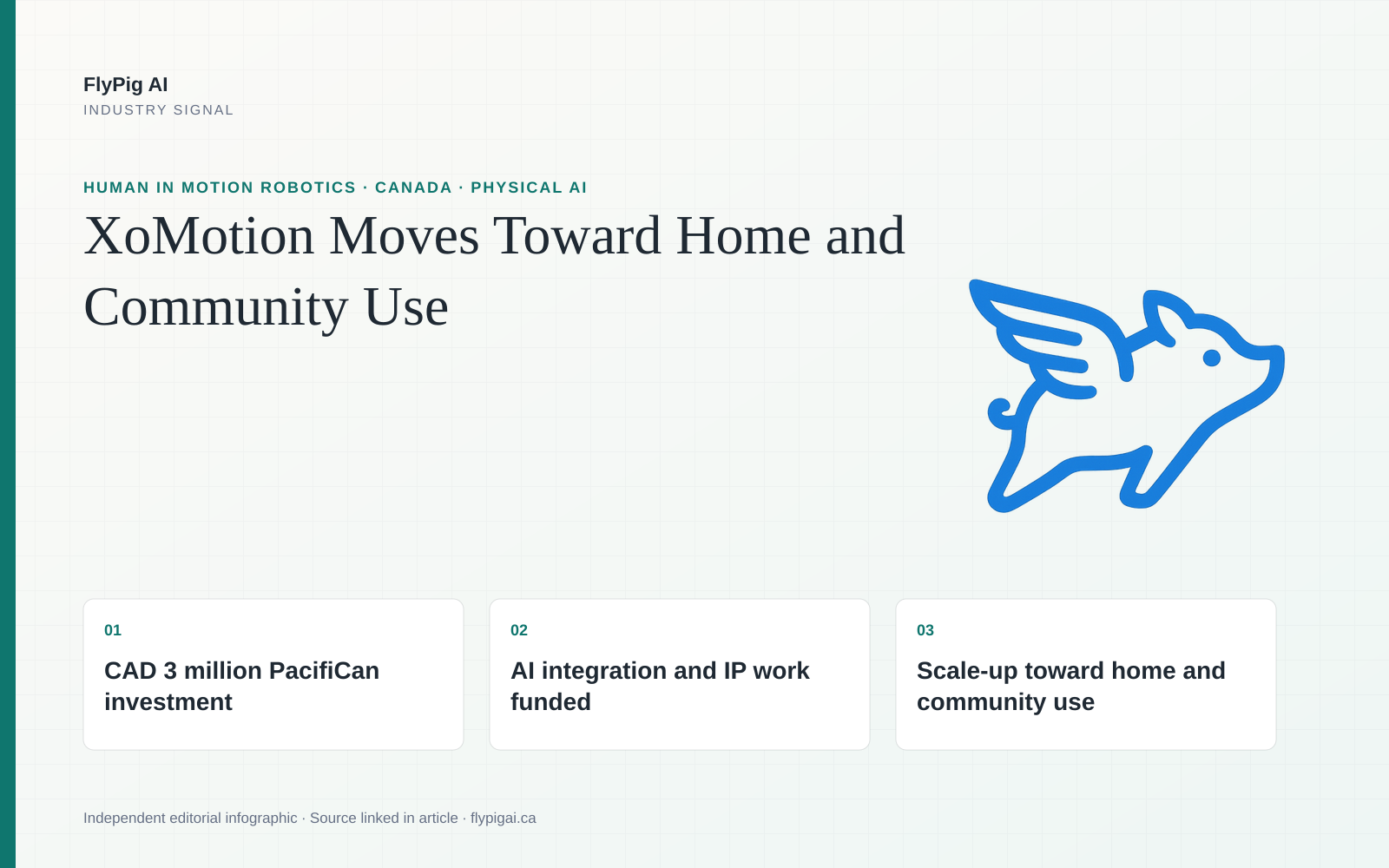
PacifiCan's May 11 announcement assigns CAD 3 million to Human in Motion Robotics with three specific objectives: integrate AI into the company's core technology, protect intellectual property and scale manufacturing beyond clinical settings toward home and community environments. That is a more commercially meaningful signal than a general robotics grant because the funded work connects software capability with manufacturability and market expansion.
The event also clarifies where XoMotion is headed. Human in Motion Robotics already has a clinical product path, but the government-backed project is aimed at broadening the platform into personal mobility. The commercial question is therefore not whether the company can demonstrate an exoskeleton, but whether it can convert a specialized clinical system into a repeatable product architecture suitable for less controlled environments and a larger installed base.
Availability needs a careful distinction
Human in Motion Robotics' current website says XoMotion-R is available for clinical use in Canada and describes rehabilitation-centre use as the present product context. On the same site, personal mobility is presented as a future version of the platform intended for daily use at home and in the community.
That distinction matters. PacifiCan's funding should not be read as evidence that a consumer-style or home-use XoMotion is already generally available. The supported project is a commercialization and manufacturing-scale-up effort toward that broader use case. The company's site also states that XoMotion is not yet cleared by the U.S. FDA, underscoring that regulatory status is market-specific and remains part of the commercialization pathway.
Why this is a Physical AI hardware signal
The official product material describes an exoskeleton built around motorized joints, advanced sensor systems, multi-modal controllers and a hot-swappable battery architecture. That makes the AI work inseparable from electromechanical hardware: software has to operate through a safety-critical, body-worn system with tight constraints on motion control, sensing, power, ergonomics and reliability.
As HMR pushes the platform toward everyday environments, system-level requirements are likely to matter more than laboratory capability alone. Repeatable joint actuation, sensor calibration, controller robustness, battery runtime, thermal behaviour, fault handling and serviceability all become manufacturing and procurement questions even if the company does not publicly expose its bill of materials.
Taiwan's overlap is in subsystems, not a disclosed supplier win
The credible Taiwan intersection is at the capability level: precision actuation and motor control, encoders and motion sensing, force or inertial sensing, embedded control electronics, battery packs and BMS, power conversion, cabling and contract manufacturing. These are categories that map directly to the architecture Human in Motion Robotics publicly describes for XoMotion.
There is no public evidence in the reviewed sources that HMR has selected a Taiwan supplier, issued an RFQ, awarded a design win or committed manufacturing volume. For a Taiwan vendor, the practical next step would be qualification against HMR's mechanical envelope, safety requirements, lifecycle expectations and regulatory documentation rather than assuming that a general robotics capability automatically translates into a medical-device supply opportunity.
The next useful signals are design-in and manufacturing details
The most important follow-on disclosures would be the AI and embedded-compute architecture, joint and actuator sourcing, sensor stack, battery and power specifications, manufacturing capacity, home-use regulatory milestones and the timing of a commercial personal-mobility launch. Those details would convert a broad Physical AI opportunity into a more actionable supply-chain map.
A second signal to watch is whether HMR expands its supplier base as manufacturing moves beyond clinical volumes. Named manufacturing partners, component qualifications, long-term supply agreements or additional production sites would be materially stronger evidence of cross-border sourcing opportunity than the funding announcement alone.
FlyPig AI interpretationThis is a useful Physical AI signal because the funding is aimed at the hard transition from a specialized clinical robot to a broader manufactured product. AI is only one part of that transition. The commercial bottlenecks will also sit in reliable joints, sensing, controllers, batteries, power electronics, qualification and repeatable production. Taiwan has real capability in those layers, but the opportunity is still pre-design-win: the next decisive evidence will be named suppliers, subsystem specifications or manufacturing partnerships, not another demonstration video.
Status, open questions and Canada relevance
Current product status
PacifiCan announced a CAD 3 million commercialization program on May 11, 2026. Human in Motion Robotics' current first-party materials indicate that XoMotion-R is available for clinical use in Canada, while personal mobility for daily home and community use remains a future version of the platform. The reviewed sources do not disclose pricing, MOQ, lead time, planned home-use launch date, manufacturing volume, detailed BOM, named external suppliers or Taiwan sourcing relationships.
What remains open
- What embedded compute, AI runtime and sensor-fusion architecture will HMR use as XoMotion expands from clinical use toward personal mobility?
- Which joint, motor, encoder, force or inertial sensors, battery, BMS and power components are fixed in the production architecture, and which remain open to qualification or second sourcing?
- What regulatory milestones, manufacturing-capacity targets and service model must be reached before a personal-mobility version is commercially available for home and community use?
Why Canadian teams may care
Human in Motion Robotics is headquartered in Vancouver, and PacifiCan's CAD 3 million investment directly targets commercialization, AI integration and manufacturing scale-up in British Columbia. The project therefore represents a Canadian Physical AI company moving from clinical robotics toward a broader manufactured mobility platform, with potential downstream demand for electromechanical, sensing, control and power subsystems.