Why it matters
- KIMA is positioned as a subsystem for medical-device OEMs, so its commercial path depends on repeatable integration, qualification and lifecycle support rather than one-off robotics demonstrations.
- Kinova exposes a clear hardware and software integration surface: joints with redundant torque sensors, EtherCAT communication, a Robot Control Library and instrument-drive interfaces.
- The platform is designed and assembled in Canada, adding a domestic Physical AI hardware node to a market often dominated by imported industrial arms adapted for medical development.
- The opportunity remains pre-BOM from a supplier perspective because Kinova has not disclosed component vendors, production volumes, sourcing windows or procurement specifications for KIMA.
What changed: Kinova is productizing a medical-specific robotics platform
Kinova's launch announcement, dated June 4, 2026 and published on June 8, introduces KIMA as a robotic arm designed specifically for clinical environments. The company said the platform would receive its official public unveiling at the Society of Robotic Surgery annual meeting in July, making the June announcement a product launch followed by a later live showcase rather than evidence of broad clinical deployment.
That distinction matters commercially. KIMA is not presented as a complete surgical system sold directly for a single procedure. Kinova is targeting medical-device OEMs that need a robotic motion platform they can integrate with instruments, imaging, control software, AI modules and other application-specific subsystems.
The design exposes interfaces that matter to system builders
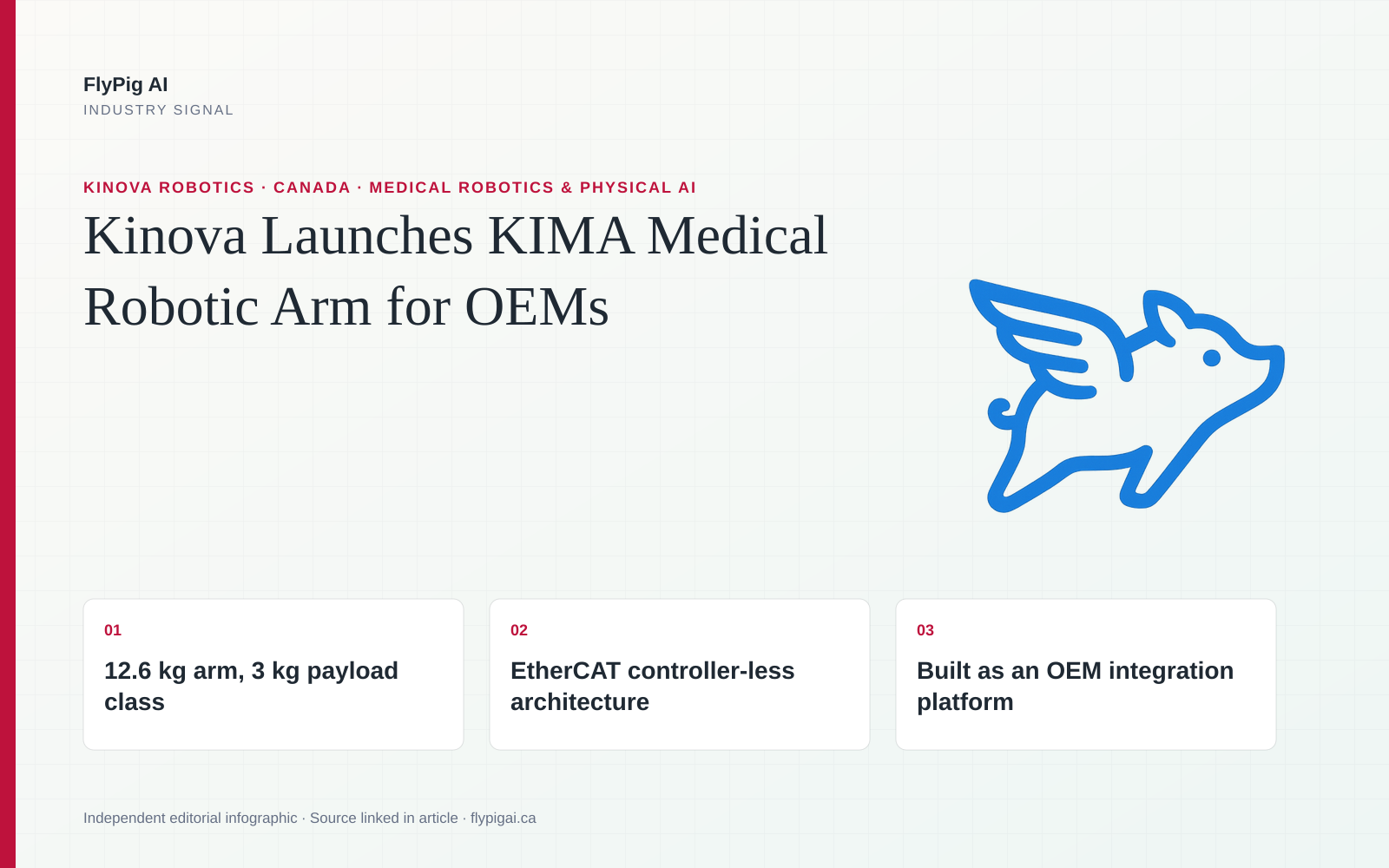
Kinova's current product page lists a 12.6 kg arm, a 3 kg payload capacity, 750 mm reach and a controller-less architecture built around EtherCAT communication and a Robot Control Library. The company also says every joint includes redundant torque sensors and that instrument-drive interfaces provide power and passthrough I/O. These are Kinova-published specifications, not independent performance benchmarks.
For an OEM, those details shift engineering work toward integration rather than building a motion stack from scratch. Real-time control, joint sensing, instrument connectivity, software interfaces and mechanical packaging become design-in questions that have to survive verification, documentation and long medical-product lifecycles.
Regulatory language requires a careful boundary
Kinova markets KIMA as engineered for compliance and certifiability with standards including IEC 60601-1 and IEC 62304 Class C. A June 11 Kinova article also describes its Robot Control Library as developed in accordance with IEC 62304 Class C and highlights compatibility with QNX OS 8.0.
Those statements should not be read as regulatory clearance for a finished medical device. OEMs integrating KIMA into diagnostic, therapeutic or surgical systems still face product-specific risk management, verification, validation and regulatory obligations. The reviewed first-party material does not establish a blanket clinical authorization, customer approval or procedure-specific clearance for KIMA itself.
Canadian commercial context: an OEM platform can create a longer-lived hardware node
Kinova is headquartered in Boisbriand, Quebec, and says its products are designed, developed and assembled in Canada. That makes KIMA relevant to Canada's Physical AI and advanced-manufacturing ecosystem because the value is not limited to robotics software: the platform contains precision mechanics, sensing, real-time control, communications and instrument interfaces that must be manufactured and supported over time.
Medical OEM programs typically expose commercial milestones gradually. The near-term signals to watch are evaluation programs, named OEM integrations, production qualification, manufacturing-capacity disclosures, platform revisions and lifecycle commitments. None of those should be inferred from the launch alone.
Taiwan overlap is strongest at the subsystem level
Taiwan's relevant capability pools include precision motor and joint assemblies, torque and position sensing, embedded real-time controllers, EtherCAT networking, cable assemblies, connectors, power electronics and contract manufacturing. Those categories map functionally to the architecture Kinova has disclosed for KIMA and to the kinds of interfaces medical OEMs must integrate around a robotic arm.
The public evidence does not support naming a Taiwan company as a KIMA supplier. A credible cross-border match would require a disclosed component specification, supplier-development request, second-source program, production ramp, RFQ or named technology partnership. Medical-grade documentation, traceability, reliability and change-control requirements would also need to be verified for any candidate supplier.
What to watch next
The highest-value follow-on signals are named OEM design-ins, evaluation or development kits with defined commercial terms, manufacturing-volume milestones, supplier or technology partnerships, regulatory documentation tied to specific configurations, and software or controller releases that broaden supported architectures.
For procurement teams, unresolved questions include actuator and sensor sourcing, controller hardware, cable and connector qualification, component lifecycle guarantees, production capacity, serviceability, change-control procedures, cybersecurity responsibilities, supported real-time operating systems and whether Kinova will qualify alternate subsystem suppliers as KIMA moves into customer programs.
FlyPig AI interpretationKIMA matters less as another robotic-arm launch than as a Canadian OEM platform with exposed motion, sensing and real-time-control interfaces. If Kinova converts KIMA into repeat medical-device design-ins, the supply-chain value will be in qualified subsystems and lifecycle support, not commodity component substitution. Taiwan has relevant robotics and electronics capabilities, but the next actionable trigger is a sourcing, qualification or named OEM-integration disclosure that shows where the platform is open to external suppliers.
Status, open questions and Canada relevance
Current product status
Kinova announced KIMA in a June 4, 2026 datelined release published June 8 and subsequently maintains an active product page with specifications and OEM contact pathways. The platform has been demonstrated publicly, but the reviewed sources do not disclose list pricing, MOQ, lead time, shipment volume, named OEM customers or component suppliers. Kinova describes KIMA as engineered for compliance or certifiability with medical standards; this article does not treat that language as blanket regulatory clearance or certification of a finished clinical device.
What remains open
- Which KIMA subsystems are manufactured in-house versus sourced from external actuator, sensor, controller, power and connectivity suppliers?
- What qualification and lifecycle requirements will Kinova apply to alternate or second-source components used in medical OEM programs?
- When will Kinova disclose named OEM design-ins, production-volume milestones or commercially deployed KIMA-based systems?
- Which real-time operating systems, instrument interfaces and safety architectures will be formally supported across production KIMA configurations?
Why Canadian teams may care
Kinova is headquartered in Boisbriand, Quebec, and states that its products are designed, developed and assembled in Canada. KIMA adds a Canadian-made medical-robotics platform to the country's Physical AI ecosystem and creates a potential domestic demand node for precision motion, sensing, embedded control, connectivity and manufacturing capabilities as OEM programs mature.