Why it matters
- A platform-agnostic compute and control layer can create repeatable design-in points across multiple robots instead of tying component demand to a single vehicle SKU. That is commercially more interesting to module suppliers if the architecture is reused across customer programs.
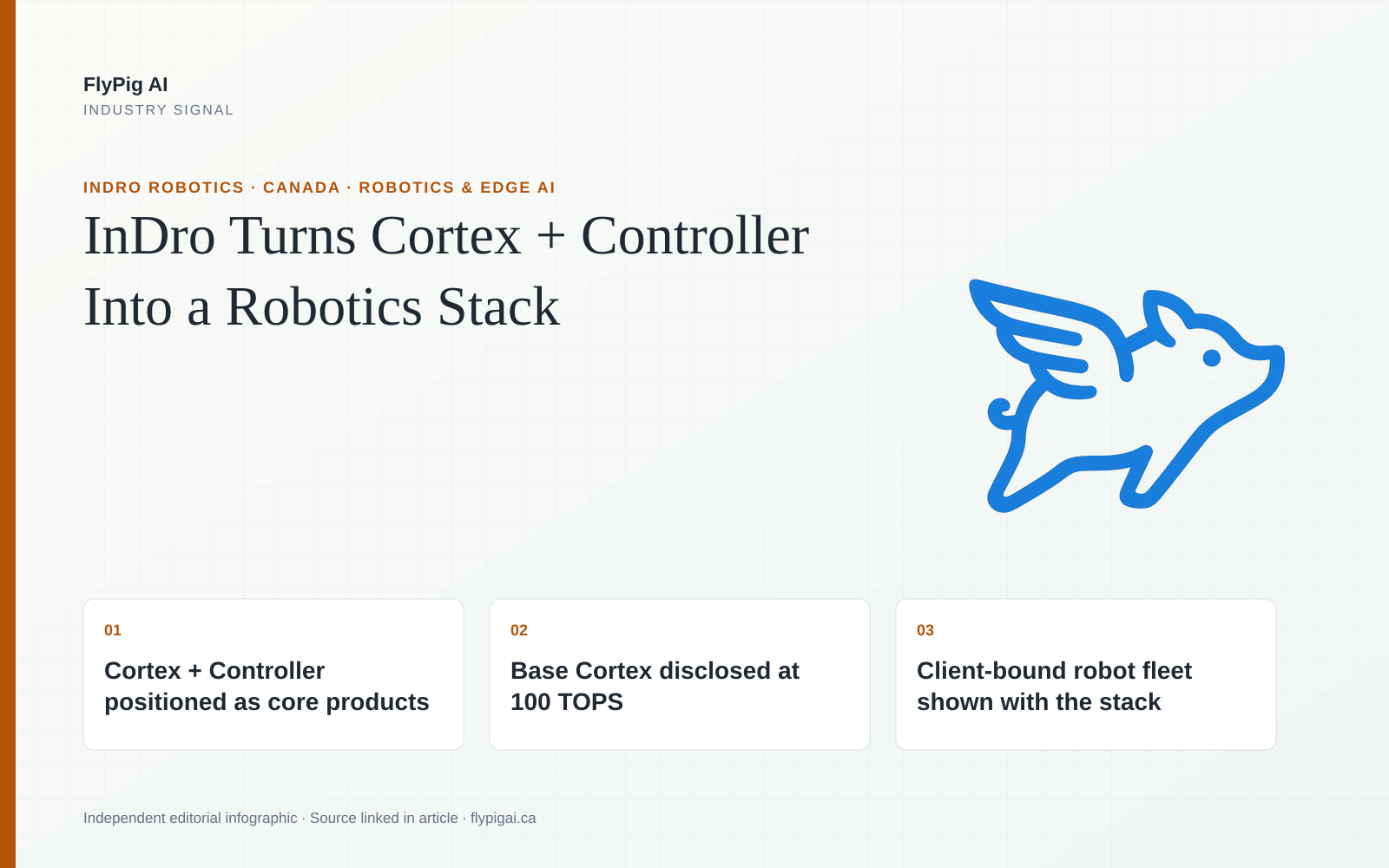
- InDro says Cortex combines Edge AI compute, ROS 2, sensor I/O, power distribution and 5G or Wi-Fi connectivity, while Controller handles teleoperation, mission planning and sensor visualization. Those interfaces concentrate several subsystem decisions where external modules may need qualification.
- The 2026 evidence moves Cortex beyond an R&D concept: InDro describes standalone sales, integrated custom packages and a client-bound fleet. It still does not disclose production volumes, qualified vendor lists or long-term sourcing commitments, so the signal is deployment progress rather than proof of scale.
- For Taiwan suppliers, the relevant opening is not a generic claim that robotics demand is growing. It is whether InDro standardizes compute, cameras, LiDAR, radar, GNSS, connectivity, power and carrier-board interfaces across repeated builds, which could convert a flexible architecture into recurring component demand.
What changed: Cortex moved from product roadmap to repeatable deployment stack
InDro first unveiled Cortex in June 2024 as a compact successor to its Commander module, designed to add compute, connectivity and sensor integration to ROS-based robotic platforms. The June 10, 2026 update should therefore not be read as a fresh hardware launch. The stronger commercial signal is that InDro now describes Cortex and Controller as core products used across its own integrations and available to customers as a standalone pair.
The same 2026 article shows a fleet of AgileX platforms equipped with Cortex, Controller and multiple sensors before shipment to a client. That is first-party evidence of deployment, not independent verification of fleet scale or repeat business. It nevertheless indicates that the architecture is being used on more than a lab demonstration and is intended to be reused across different robotic form factors.
Why the architecture matters for Physical AI integration
Cortex is described as a platform-agnostic brain box and sensor interface measuring 11 by 14 by 10 centimetres and weighing 679 grams. InDro says the base configuration contains a processor capable of 100 TOPS, ships with a 5G modem, runs Ubuntu 22.04 LTS with ROS 2 Humble, and exposes multiple I/O and power options for sensors. The 100-TOPS figure is a vendor-disclosed processor capability and should not be treated as a workload benchmark.
Controller sits on top of that hardware as the operational layer. InDro describes browser-based access, manual and autonomous mission modes, waypoint planning, sensor-data visualization and SLAM support, while its current Controller product page also highlights camera feeds, ROS-topic access, console access and remote operation. In practical procurement terms, the value proposition is reduced integration work rather than a single robot specification.
Canadian commercial context: integration, fabrication and limited production are converging
InDro maintains operations in British Columbia and Ontario, including its Area X.O engineering presence and InDro Forge fabrication facility in Ottawa. The company has described Forge as a prototyping and limited-production operation that designs, develops and produces hardware for InDro products and client projects. This gives the Cortex and Controller stack a Canadian integration context that spans engineering, custom electronics, fabrication and final system assembly.
That context matters because modular robotics products only become durable supply-chain opportunities when integrators reuse interfaces and purchasing patterns across projects. InDro's own disclosures point in that direction, but they do not establish mass-production capacity for Cortex, annual unit volume, standard lead times or a stable production BOM. Those are the data points that would determine whether the opportunity is repeatable for upstream suppliers.
Taiwan intersection: attractive at the module layer, unproven at the supplier layer
The architecture maps naturally to capabilities already strong in Taiwan: embedded and Edge AI compute modules, custom carrier boards and PCBs, camera and machine-vision modules, LiDAR and radar interfaces, GNSS, 5G and Wi-Fi connectivity, power management, thermal hardware and electronics manufacturing services. The fit is especially relevant because InDro is explicitly selling flexibility across sensors and robotic platforms rather than locking the product to one fixed payload.
The reviewed sources do not identify a Taiwan supplier, approved-vendor list, RFQ, purchase order or design win. They also do not disclose the current base processor model, modem vendor, camera stack, sensor qualification matrix or sourcing ownership for customer-specific builds. A credible cross-border match therefore remains a capability-level hypothesis until InDro or a program partner publishes qualification requirements or procurement details.
What procurement teams still need before treating this as a scalable design-in opportunity
The most important unresolved issue is configuration control. InDro's older disclosures referenced different compute options than the June 2026 article's 100-TOPS base configuration, suggesting Cortex can evolve with available processors and customer requirements. That flexibility is useful for engineering but means suppliers need to know which hardware baseline is being standardized for production programs.
Commercial teams should also separate software support from hardware availability. InDro says Ubuntu LTS, ROS 2 and its own software updates provide a maintained stack, but the public material does not specify lifecycle commitments, software support terms, security certification, carrier certification, environmental qualification, pricing, MOQ or delivery lead time. Those details will determine whether Cortex behaves more like a configurable engineering platform or a standardized volume product.
FlyPig AI interpretationThe important signal is architectural. InDro is trying to make the compute, connectivity, sensor-integration and control layer reusable across robots instead of rebuilding that layer for every platform. If Cortex and Controller become the default backbone for repeated customer programs, the supply-chain value could be larger than any single InDro robot because modules can be qualified once and reused. For Taiwan, the next evidence to watch is concrete: a standardized hardware revision, a published sensor or compute compatibility list, production-volume guidance, supplier qualification, or a named procurement requirement. Until then, this is a strong cross-border match candidate, not a disclosed sourcing deal.
Status, open questions and Canada relevance
Current product status
InDro's June 10, 2026 first-party article presents Cortex and Controller as core products that can be purchased standalone or integrated into custom robotic packages, and shows a client-bound fleet equipped with the stack. Cortex itself was introduced earlier, in June 2024, so this event is classified as productization and deployment maturity rather than a first launch. Public sources do not establish mass-production volume, a fixed current processor SKU across all configurations, pricing, MOQ, lead time, security certification, carrier certification, a qualified vendor list or any Taiwan sourcing award.
What remains open
- Which processor, memory, modem, storage and carrier-board configurations are standardized for the current base Cortex, and which remain customer-selectable?
- What camera, LiDAR, radar, GNSS and other sensor interfaces have completed formal compatibility or environmental qualification rather than one-off integration?
- What annual or program-level production volumes, MOQ, lead times and lifecycle commitments can InDro support through InDro Forge and external suppliers?
- Which cybersecurity, cellular, functional-safety or environmental certifications apply to Cortex and Controller for industrial, public-safety or defence deployments?
- Does InDro control component sourcing centrally for Cortex-based builds, or can customer and platform partners nominate compute, sensor, connectivity and power suppliers?
Why Canadian teams may care
InDro Robotics has a Canadian operating footprint spanning British Columbia and Ontario, including engineering activity at Area X.O and prototyping and limited-production capability at InDro Forge in Ottawa. A reusable Canadian-developed robotics integration stack is commercially relevant because it can sit between global component suppliers and multiple downstream robot programs. The opportunity becomes materially stronger if InDro standardizes common hardware and supplier requirements across those programs rather than treating every build as a bespoke integration.