Why it matters
- An eDP-capable TDDI can reduce the number of interface-conversion devices between the cockpit SoC and the panel, potentially simplifying BOM, layout and failure analysis in large-format displays.
- The cascaded architecture gives panel and HMI teams a route to scale from a single-chip 17-inch design to a two-chip configuration for much wider, higher-resolution displays without treating every cockpit layout as a completely different controller architecture.
- Himax says the family is already in design-in with multiple panel makers, which makes the announcement more commercially meaningful than a lab concept, but it still does not establish mass production, named customers, regional availability or shipment volume.
The architectural change is moving eDP into the TDDI
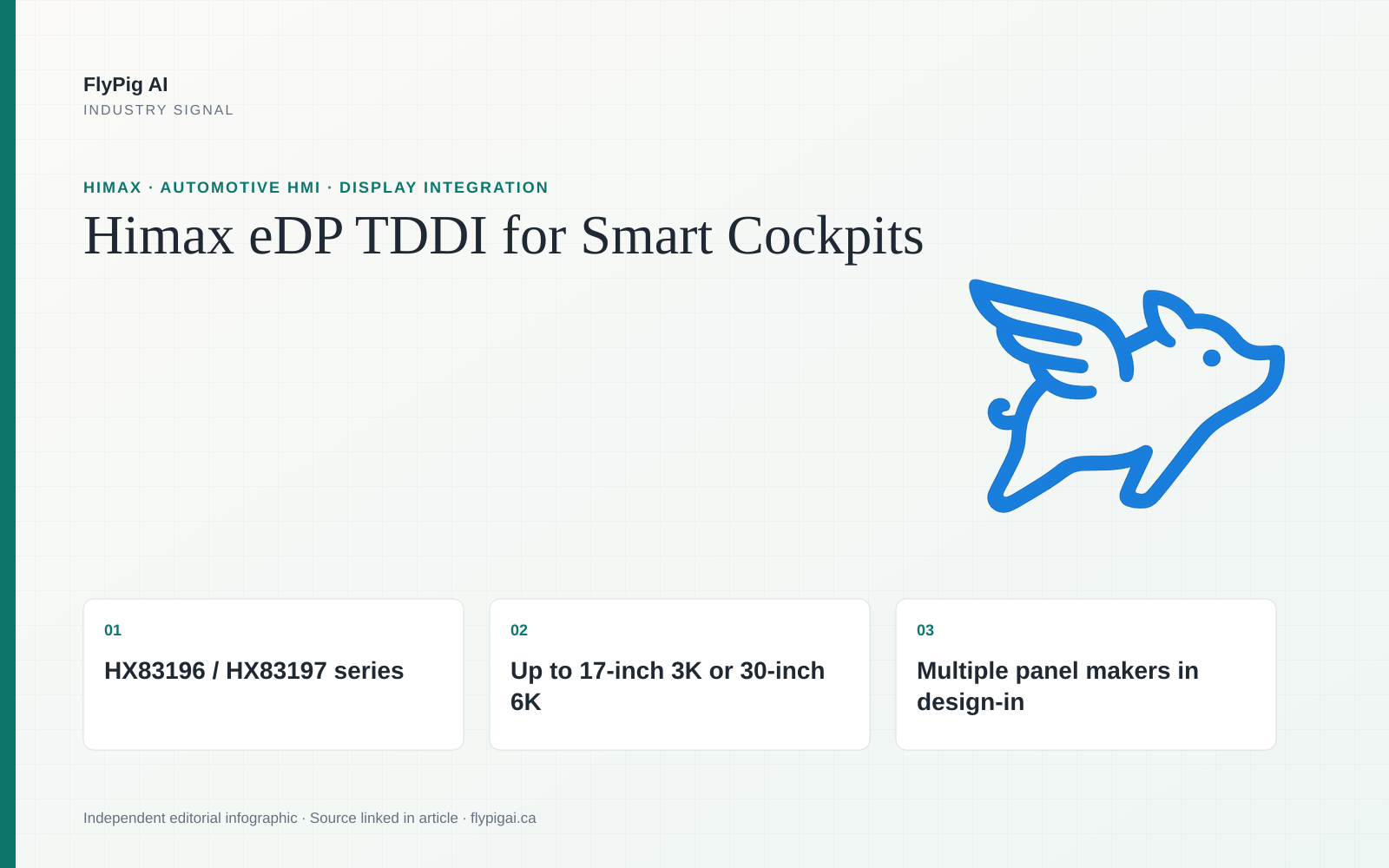
Himax announced the HX83196/HX83197 automotive TDDI family on September 8. The company says the devices combine a high-speed eDP interface, touch control and display driving in a single chip using its eSRE architecture, with the ability to receive and retransmit eDP signals for cascaded designs.
That matters because conventional cockpit displays may require an additional bridge device when the source and panel interfaces do not line up. Himax says its integrated approach can remove the eDP-to-OLDI bridge in supported architectures, while a direct-display configuration can also reduce the need for an additional SerDes path in some single-display systems. Product teams should still validate the exact vehicle network, cable length, EMC and functional-safety requirements rather than assuming those external devices disappear in every design.
One family is intended to span very different cockpit sizes
According to Himax, one device can support displays up to 17 inches at 3K resolution, while a two-chip cascaded configuration can extend to displays up to 30 inches at 6K. The company also lists 2,560 source channels, 1,280 touch channels and 60Hz or 90Hz operation.
For a cockpit platform team, the strategic value is reuse. If the same controller family can cover a centre display, passenger display or a much wider surface, software, touch tuning and panel-interface work may be reusable across vehicle trims. The practical limit will depend on panel electrical characteristics, display timing, thermal conditions and the final automotive qualification package.
HX83197 adds local dimming, but integration needs validation
Himax says HX83197 adds local-dimming functionality inside the TDDI, reducing the need for a separate timing-controller function in supported designs. The release also cites DSC support, HDR10+ and an interface for an on-panel ambient-light sensor.
Those functions can reduce component count, but they also concentrate more responsibility in one device. Before design freeze, engineers need controlled documentation for eDP link modes, DSC implementation, panel compatibility, local-dimming zones, diagnostics, safety mechanisms, package options, power consumption and software or calibration tooling.
FlyPig AI interpretationThis is not an Edge AI accelerator story, but it is relevant to Physical AI and smart-cockpit product architecture because the human interface is becoming a larger, more integrated sensing-and-display subsystem. The design opportunity is fewer interface components and more controller reuse. The risk is assuming design-in equals production readiness before Himax publishes qualification, sample and supply details.
Status, open questions and Canada relevance
Current product status
Himax states that the HX83196/HX83197 family is currently in design-in with multiple panel makers and was scheduled for demonstration at the SID Vehicle Displays and Interfaces Symposium in Detroit. The reviewed official source does not establish mass production, named customers, sample pricing, MOQ, lead time or shipment volume.
What remains open
- What are the final automotive qualification, functional-safety, package, power and thermal specifications for HX83196 and HX83197, and when will controlled datasheets be available to external design teams?
- Which eDP link modes, DSC configurations, panel architectures and local-dimming implementations are validated, and what external SerDes or bridge components remain necessary across realistic vehicle cable lengths?
Why Canadian teams may care
Canadian automotive software, cockpit-integration and mobility teams working with North American OEM programs may care less about the IC as a standalone component than about the architecture it enables: fewer display-interface devices, wider touch surfaces and a more consolidated path between the vehicle compute domain and the panel.