Why it matters
- A dedicated depth-decoding path can reduce the amount of custom processing needed around an iToF sensor stack.
- Robotics, access control, gesture interfaces and spatial-awareness products all benefit from lower-friction depth integration.
- The design-in question is no longer only whether the silicon exists, but which parts, modules, optics and reference designs are actually available.
Depth processing is becoming a product block, not a research project
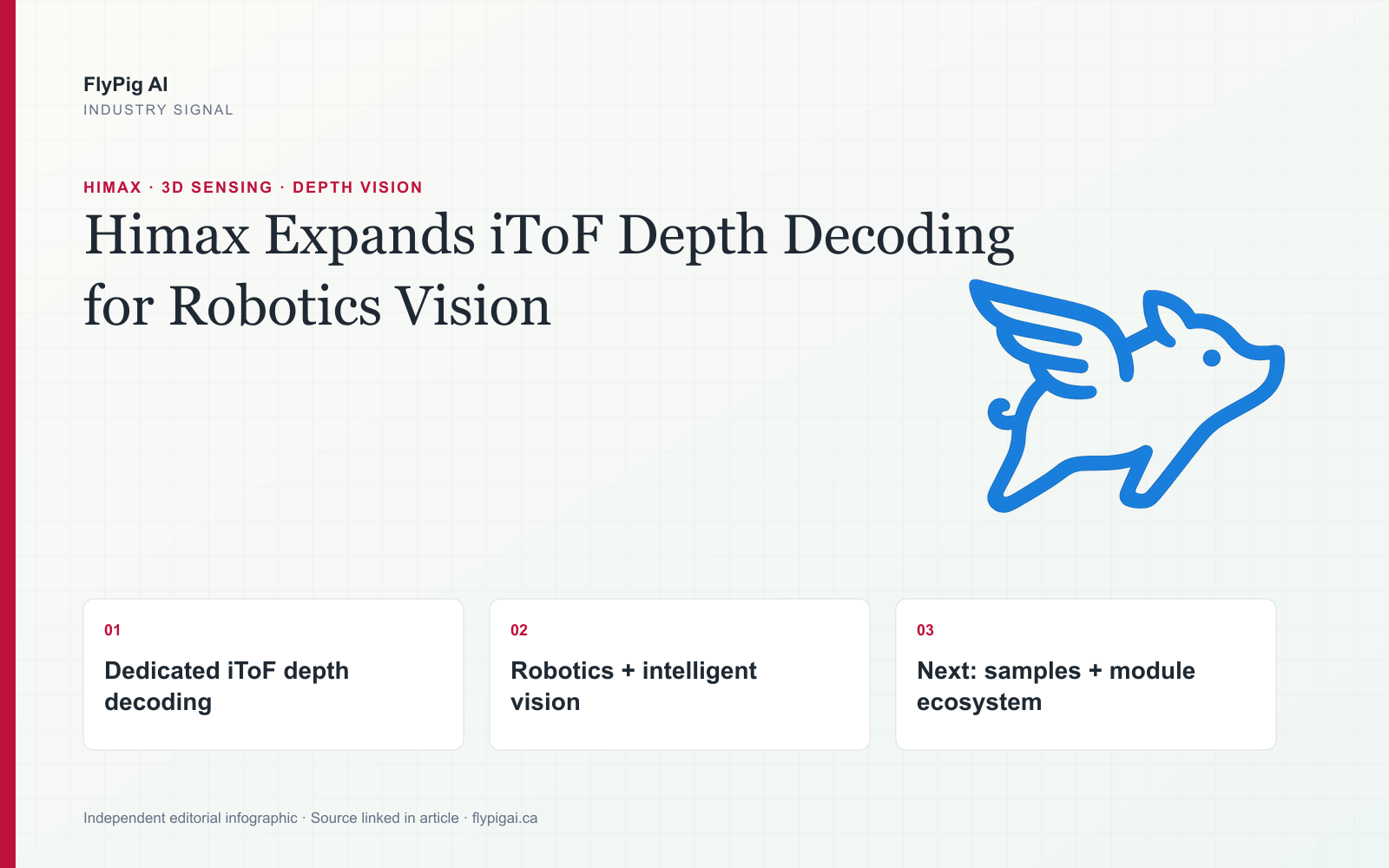
Himax’s June 30 update expands its iToF depth-decoder offering for robotics and intelligent vision. The strategic value is packaging depth processing as a more defined semiconductor function rather than leaving every product team to assemble the full pipeline from scratch.
For North American developers, that can matter most in projects where 3D sensing is useful but the team does not want to build deep optics and depth-processing expertise internally.
The ecosystem will decide how quickly the parts move into real products
A depth decoder is only one layer of a working iToF system. Sensor compatibility, illumination, optics, power, calibration, module availability and software support determine whether the architecture is practical.
FlyPig is therefore treating the announcement as an ecosystem signal rather than assuming immediate off-the-shelf availability. Samples, power figures, module partners and reference designs remain the important follow-up questions.
The opportunity sits beyond industrial robots
Although robotics is an obvious target, the same depth capability can fit smart locks, gesture interfaces, spatial sensing and other local-vision products where privacy or latency favour on-device processing.
That broader application range is what makes the update worth tracking inside Taiwan’s edge-AI supply chain.
FlyPig AI interpretationHimax’s iToF expansion matters if it turns depth sensing into a repeatable design route. The strongest signal will be a validated stack of decoder, sensor, optics, software and module partners that lowers the integration burden for smaller product teams.
Status, open questions and Canada relevance
Current product status
Himax officially announced the HE-1 and HE-2 decoder ICs and reported sensor validation and initial machine-vision adoption. General sample, ordering and volume-production terms were not published in the cited release.
What remains open
- Which iToF sensors, illumination modules and optics have production-ready reference designs?
- What are the sample schedule, power envelope, pricing and software-support terms for HE-1 and HE-2?
Why Canadian teams may care
Canadian robotics, access-control and industrial-vision teams could use a validated decoder stack to reduce custom depth-processing work, provided modules, calibration support and regional supply are available.