Why it matters
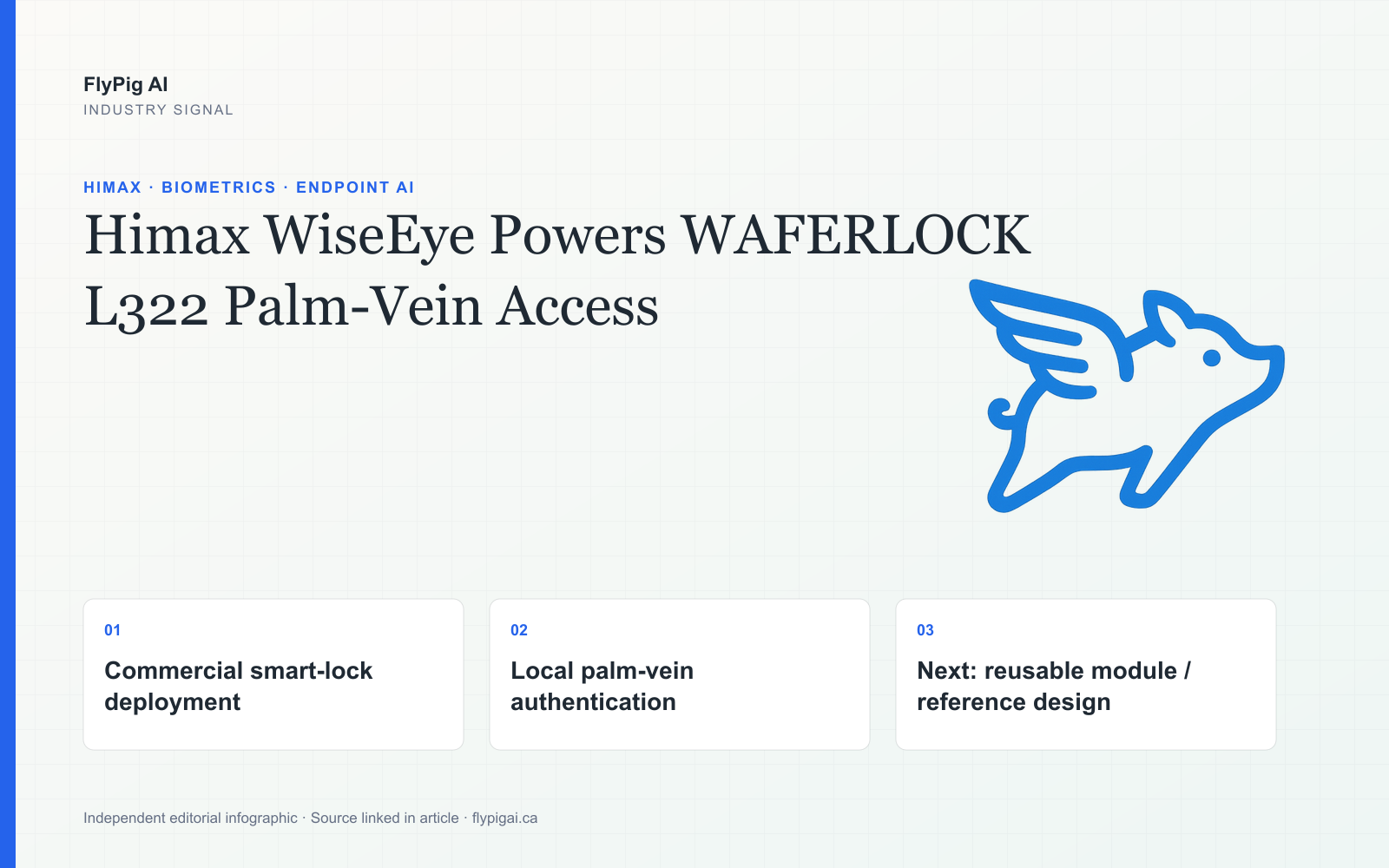
- The L322 moves WiseEye palm-vein recognition from a technology showcase into a purchasable consumer security product.
- Local image capture, feature matching and authentication reduce dependence on cloud connectivity for an identity-sensitive workflow.
- The next design-in question is whether Himax exposes the capability as an IC, module or reference design that other device makers can adopt.
Commercial deployment is stronger evidence than a demo
Himax says its WiseEye palm-vein biometric technology powers WAFERLOCK’s L322 smart lock, which is commercially available. The system integrates an ultra-low-power AI processor, image sensing and the authentication algorithm at the endpoint.
That is important because it demonstrates the technology inside a battery-conscious consumer product rather than only on an evaluation board.
Keeping biometrics local changes the privacy and latency model
Palm-vein authentication depends on sensitive biometric information. Performing capture, feature extraction and matching on the device can reduce the need to transmit raw biometric data to a cloud service.
Local processing can also make the lock less dependent on network availability and help keep authentication latency predictable.
The platform opportunity is broader than one lock
If the WiseEye palm-vein stack is available in a reusable module or reference design, the same approach could extend to access control, smart-home devices and other identity-sensitive terminals.
That depends on details not yet established publicly for third-party design-in: module form, power, recognition distance, liveness performance, SDK terms, MOQ and sample availability.
FlyPig AI interpretationThe WAFERLOCK deployment is exactly the kind of signal FlyPig values: it proves a Taiwan endpoint-AI technology can survive inside a commercial product. The next step is to learn whether that implementation can be productized for other OEMs, not simply celebrate the design win.
Status, open questions and Canada relevance
Current product status
Himax and WAFERLOCK publicly announced commercial use of WiseEye palm-vein authentication in the L322 smart lock. Availability of the reusable module and integration package is separate from availability of the lock.
What remains open
- Is the palm-vein sensing module available to third-party OEMs, and under what integration terms?
- What performance, spoof resistance, environmental limits and certification evidence apply beyond the L322 implementation?
Why Canadian teams may care
Canadian access-control and smart-building teams may view the L322 as evidence of local biometric deployment, while requiring privacy, security and environmental review before reuse.