Why it matters
- The standardized SMARC form factor separates the compute module from the carrier board, helping OEMs preserve I/O and mechanical work across processor changes.
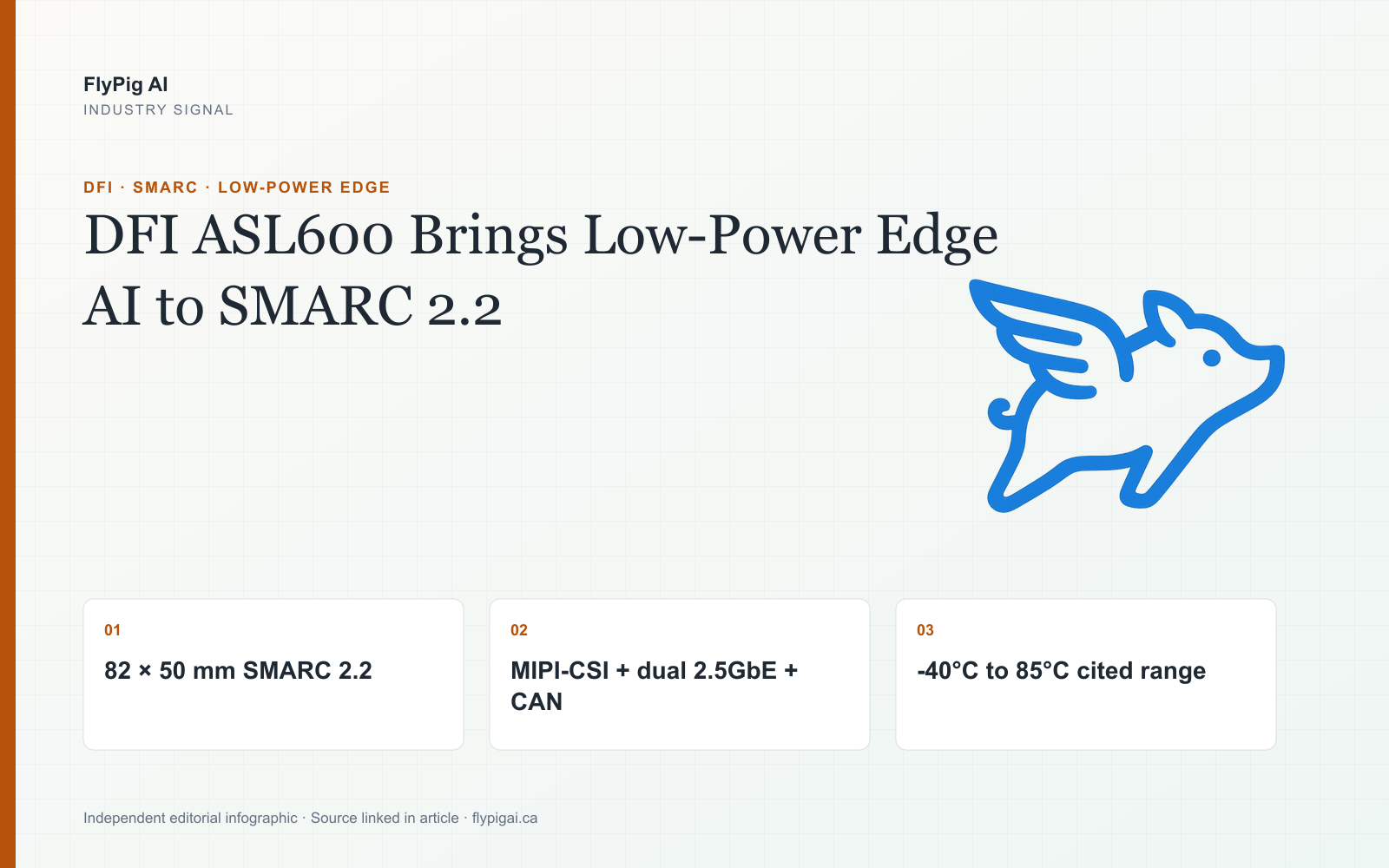
- MIPI-CSI, dual 2.5GbE and dual CAN make the module relevant to vision, HMI and compact robot-control designs.
- A -40°C to 85°C operating range and fanless orientation target harsh embedded deployments rather than consumer notebooks.
SMARC shifts the redesign boundary
Instead of integrating the processor directly onto a custom motherboard, the ASL600 packages Intel Atom x7000RE, Processor N or Core 3 N options on an 82 × 50 mm SMARC 2.2 module.
This lets an OEM invest in a carrier board for product-specific I/O while keeping a more replaceable compute core, which can be useful for long-lived industrial products.
The I/O mix is unusually relevant to compact vision systems
DFI routes MIPI-CSI, dual Intel I226 2.5GbE, dual CAN and multiple display interfaces through the module. That combination maps well to compact machine-vision, HMI and AGV/AMR controller designs.
The value is not high-end NPU performance; it is integration density, low-power operation and a standardized upgrade path.
Thermal and lifecycle claims need SKU-level validation
DFI highlights fanless use and operation from -40°C to 85°C, but final thermal behaviour depends on processor SKU, enclosure and sustained workload.
For design-in, buyers still need module pricing, carrier availability, exact AI capability by CPU option and the support horizon of the selected configuration.
FlyPig AI interpretationASL600 is attractive when mechanical stability and carrier-board reuse matter more than peak AI TOPS. FlyPig would position it as a compact embedded-compute route that can pair with external accelerators if the application later needs more inference performance.
Status, open questions and Canada relevance
Current product status
DFI has published the ASL600 module and its core SMARC 2.2 specifications, including industrial temperature claims. Processor variant, carrier and software support determine production readiness.
What remains open
- Which processor, memory and software configurations are available with long-term supply commitments?
- Which carrier boards, camera modules and environmental validations are offered for evaluation?
Why Canadian teams may care
Canadian industrial, transportation and compact-robotics teams may value a replaceable SMARC module with camera and industrial networking when power and enclosure space are constrained.