Why it matters
- The memory interface and controller can consume a material portion of an always-on Edge AI device's energy, making bandwidth per watt a system-level design issue.
- A semi-custom interface may reduce controller overhead, but requires processor-side integration and cannot be equated with a normal LPDDR4x component swap.
- The published performance values and manufacturing target are not a verified production-device benchmark or current commercial offer.
A memory system designed for constrained AI hardware
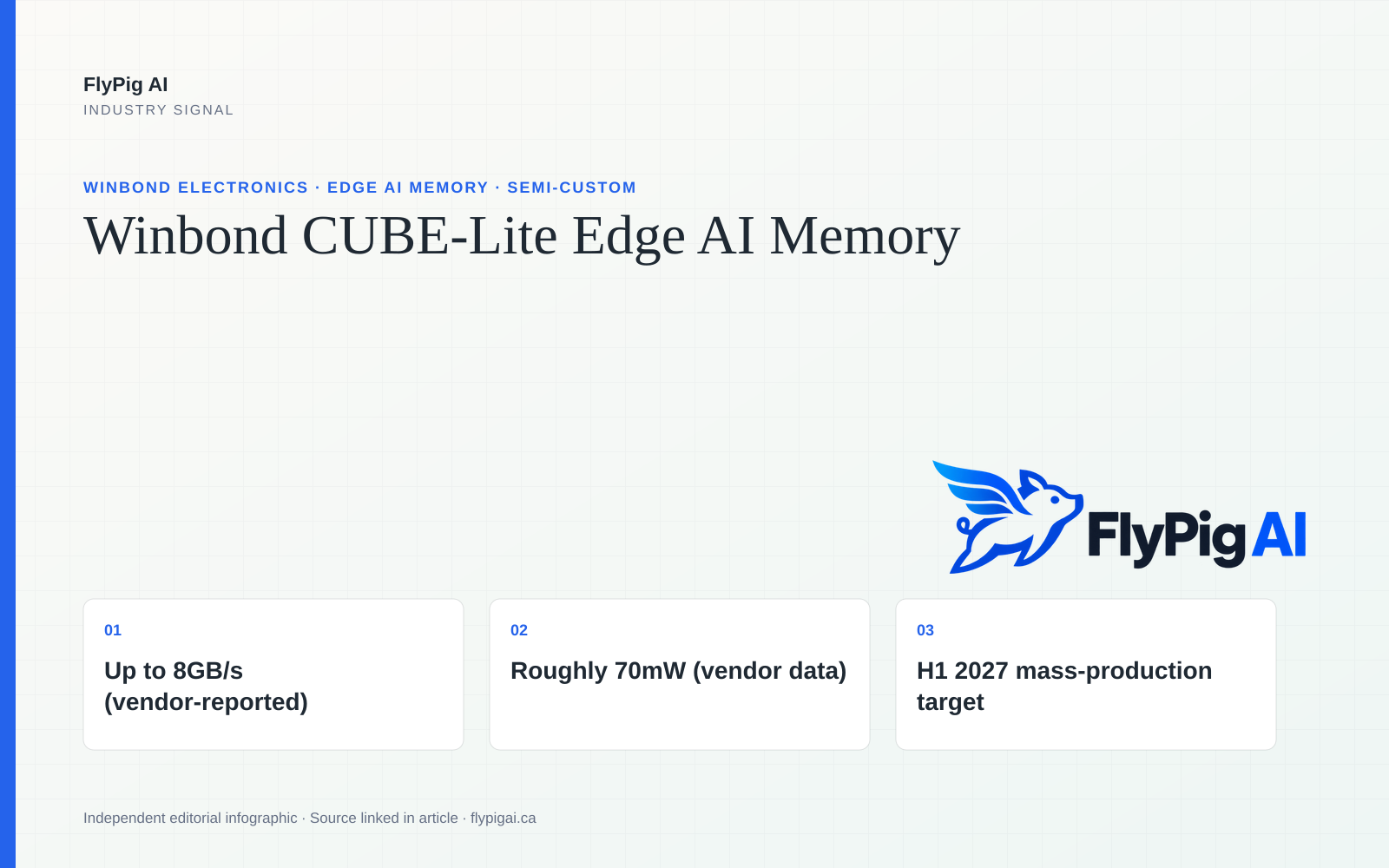
Winbond introduced CUBE-Lite on November 4 as a semi-custom extension of its CUBE architecture for AI image-signal processing, wearables, MCUs and other embedded AI designs. Unlike a generic DRAM density addition, this approach makes the interface and memory-controller implementation part of the engineering discussion. The advantage claimed by the supplier depends on how compute silicon communicates with memory.
Winbond reports bandwidth up to 8GB/s at approximately 70mW, about 1pJ/bit and access latency around 20ns. It also attributes more than tenfold lower SoC controller power than an LPDDR4x implementation to its own engineering data. Those are vendor-reported numbers with comparison conditions not independently reproduced for this report, not proof of a universal system-power saving.
The co-design trade-off matters more than the headline number
High camera throughput and repeated model operations can stress an endpoint's memory subsystem even when the NPU itself is efficient. If a simplified interface reduces PHY and controller overhead, the potential benefit may include both lower operating power and smaller silicon area. However, a semi-custom design typically involves engineering commitments that do not apply to a commodity memory replacement.
Teams need to establish supported controller implementations, integration documentation, package options, supply voltages, memory transaction patterns and the workload used in comparative testing. The supplier cites VDD1 at 1.8V, VDD2 at 1.1V and VDDQ down to 0.75V, but those electrical specifications alone do not establish energy per inference or end-product battery life.
Validation status limits near-term design choices
Winbond explicitly places CUBE-Lite in product validation and targets mass production in the first half of 2027. The official announcement does not independently establish evaluation-kit access, production ordering codes, quotes, lead times, module partners or firm shipment commitments for Canadian buyers.
For an OEM revising a low-power camera or wearable product today, it is sensible to keep qualified memory as the baseline and monitor CUBE-Lite reference design availability. The first decisive milestone will be accessible samples and a reproducible power comparison on the actual processor, rather than another top-line memory efficiency figure.
FlyPig AI interpretationCUBE-Lite is an architectural signal: efficient Edge AI may depend as much on memory-controller design as on accelerator TOPS. FlyPig would monitor reference platforms and matched measurements before turning this into a product recommendation.
Status, open questions and Canada relevance
Current product status
Winbond announced CUBE-Lite on November 4, 2026. It is in product validation and targets H1 2027 mass production; samples, pricing and shipment commitments remain unverified.
What remains open
- Which MCU and SoC partners support its semi-custom interface, and what integration and IP terms apply?
- What workloads, baseline and measurement conditions support Winbond's 8GB/s, 70mW and controller-power comparison?
Why Canadian teams may care
Canadian smart-camera, wearable and low-power robotics teams may track CUBE-Lite for future silicon projects but should not assume it is an orderable board-level memory replacement.