Why it matters
- Completed vehicle integration is a materially stronger signal than an announced partnership because it means software, compute and vehicle systems have progressed through enough engineering work to operate as one platform.
- Waabi's disclosure of NVIDIA DRIVE AGX Thor and Hyperion 10 places accelerated compute inside the joint architecture, while Volvo's platform design emphasizes redundant braking, steering and communication. The commercial challenge therefore extends beyond AI models into automotive-grade systems integration and validation.
- For Canadian Physical AI, the milestone shows a Toronto-based autonomy company moving deeper into a global OEM stack. For suppliers, however, the opportunity remains indirect until the program discloses qualification windows, production plans or subsystem sourcing.
The partnership moved from planned integration to a completed vehicle milestone
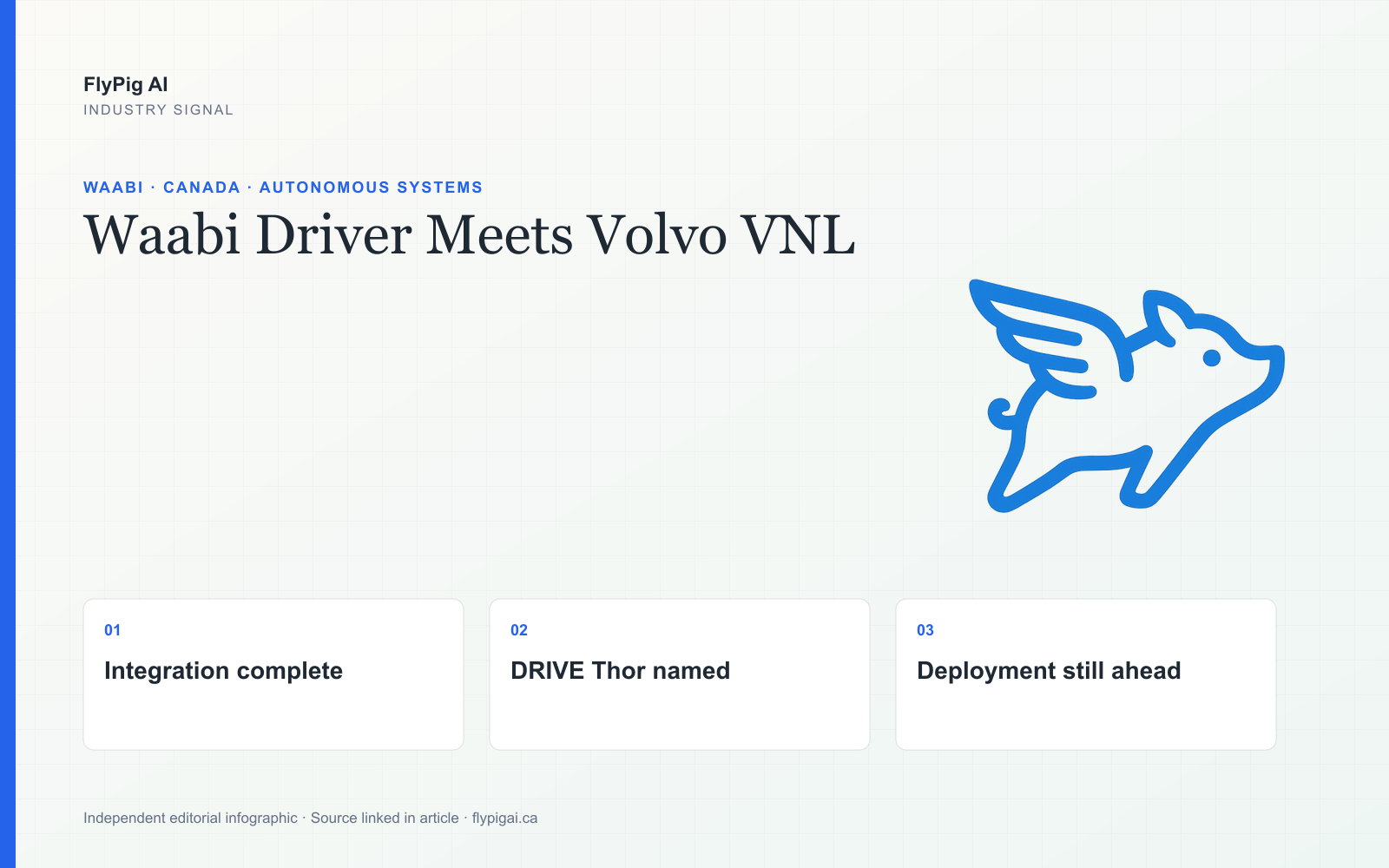
Waabi and Volvo Autonomous Solutions announced their strategic partnership in February 2025 with a clear engineering objective: integrate the Waabi Driver into the Volvo VNL Autonomous and prepare for testing. The October update changed the status of that work. Waabi said the integration had been successfully completed, and Volvo's own first-party story repeated that the Waabi Driver and Volvo VNL Autonomous had been integrated.
That is a meaningful maturity step, but it should not be collapsed into commercial availability. Both companies said they were now focused on delivering an autonomous solution that could support broad commercial deployment. The wording points forward. Neither October source gives a fleet count, customer launch, route availability, production volume or commercial start date for the Waabi-powered configuration.
The hardware signal is accelerated compute inside a redundant truck architecture
Waabi said the joint solution integrates NVIDIA DRIVE AGX Thor and NVIDIA DRIVE AGX Hyperion 10 architecture. That makes the compute layer a named part of the integration story rather than an inferred dependency. At the same time, Volvo describes the VNL Autonomous as purpose-built for autonomy with backup systems for safety-critical functions including braking, steering and communication.
For design-in and procurement teams, the important point is not a vendor marketing claim about Level 4 leadership. It is the engineering surface created when a virtual driver, high-performance automotive compute and a redundant heavy-vehicle platform have to operate together. That surface can include sensing, networking, power delivery, thermal management, harnessing, diagnostics and lifecycle support, even though the reviewed sources do not disclose the actual supplier list.
Canada's commercial signal is stronger, but the near-term market remains North American freight
Waabi was founded in 2021 and today lists Toronto among its operating locations alongside several U.S. cities. The Volvo integration therefore links a Canadian Physical AI company to a major global truck OEM while the commercial use case remains centered on autonomous freight in North America.
The milestone also clarifies where future evidence needs to come from. Integration completion demonstrates technical progress, but supply-chain value appears only when engineering choices harden into qualification and production decisions. The next meaningful signals would include a named commercial deployment using the Waabi configuration, production-line integration details, supplier qualification, homologation or safety-case milestones, and disclosed service or fleet expansion.
Taiwan intersects at the component-category level, not yet at the awarded-supplier level
The disclosed architecture implicates component categories where Taiwan has deep manufacturing capability: embedded and automotive compute, camera and perception electronics, networking, power electronics, thermal design and electronics manufacturing. Those are reasonable capability intersections because the official sources identify accelerated compute and redundant vehicle systems, while Waabi's broader autonomous-driving stack uses multiple sensor modalities.
What is missing is just as important. No reviewed source names a Taiwan supplier, RFQ, approved vendor list, purchase order, design win, sourcing geography, MOQ or lead time. FlyPig therefore treats Taiwan as a monitoring and supplier-mapping opportunity, not as evidence of an existing cross-border deal. A credible match would require platform-specific automotive qualification, functional-safety requirements, environmental specifications and a disclosed procurement path.
FlyPig AI interpretationThis is the point where an autonomy partnership starts to become an OEM engineering program. Waabi and Volvo had already announced the relationship; the October 2025 signal is that the Waabi Driver was now integrated with the VNL Autonomous, with NVIDIA DRIVE Thor named in the joint architecture. That materially improves the credibility of the platform path, but it still does not reveal the commercial bill of materials. For Taiwan, the opportunity is to watch where compute, sensing, networking, power and thermal requirements become formal qualification or sourcing decisions. Until then, supplier mapping should remain capability-based rather than deal-based.
Status, open questions and Canada relevance
Current product status
As of the October 28–30, 2025 first-party updates, Waabi and Volvo Autonomous Solutions described the Waabi Driver and Volvo VNL Autonomous integration as complete and said the companies were focused on delivering a solution that could support broad commercial deployment. The reviewed sources do not establish commercial fleet availability, production volume, a named customer using the Waabi-powered configuration, a public launch schedule, component supplier awards, pricing, MOQ, lead time or Taiwan sourcing. Any later deployment milestone should be evaluated as a separate Industry Signal.
What remains open
- When will Volvo and Waabi disclose a commercial deployment using the Waabi-powered VNL Autonomous, including route, customer, fleet size or operational mode?
- Which sensing, compute, networking, power, thermal and vehicle-electronics components are controlled by Volvo, Waabi or NVIDIA, and when do supplier-qualification windows open?
- What automotive safety, environmental, cybersecurity and lifecycle-support requirements would an external subsystem supplier need to satisfy before entering the platform?
Why Canadian teams may care
Waabi lists Toronto among its operating locations and is a prominent Canadian Physical AI company. Completing integration with Volvo's purpose-built autonomous truck moves Canadian autonomy technology deeper into an OEM vehicle platform and gives Canada's AI ecosystem a more concrete path toward industrial commercialization, even though the near-term freight market and deployment activity are primarily in the United States.