Why it matters
- OEM integration changes the commercial problem from demonstrating autonomous-driving capability to satisfying vehicle-platform requirements for safety, redundancy, validation, manufacturing and lifecycle support.
- Volvo says the VNL Autonomous includes redundant communication, computing, power, energy storage and motion-control systems, making the partnership relevant to a broader electronics and systems supply chain than the AI software layer alone.
- Taiwan's overlap is plausible at the capability level in vehicle-grade compute, connectivity, power electronics, thermal design, sensing and electronics manufacturing, but the reviewed disclosures do not identify Taiwan vendors or external component awards.
The signal is vertical integration, not just another autonomy partnership
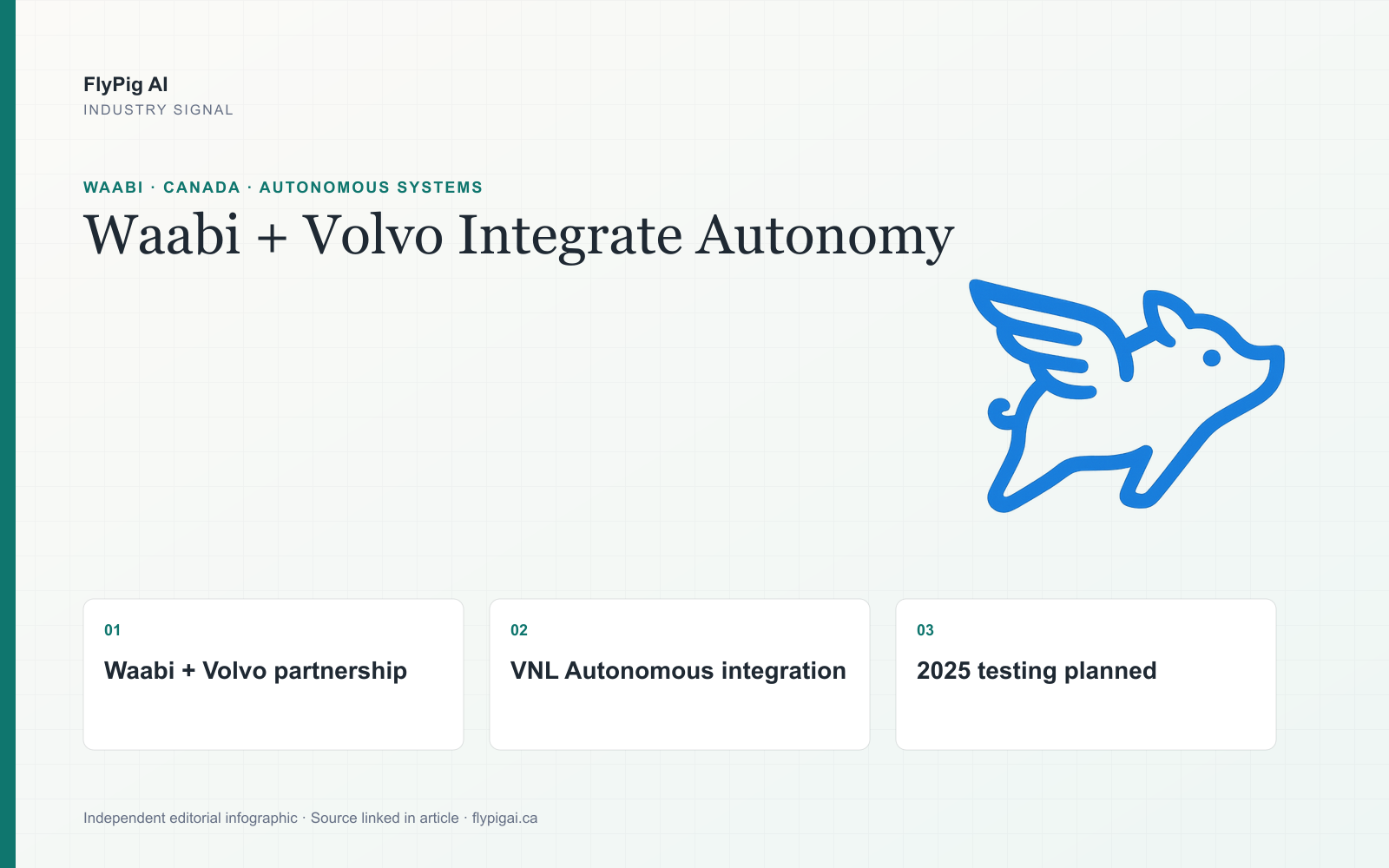
Waabi said on February 4, 2025 that it had entered a long-term strategic partnership with Volvo Autonomous Solutions for the joint development and deployment of autonomous trucks. The technical centerpiece is the planned integration of the Waabi Driver, Waabi's virtual driver system, into the Volvo VNL Autonomous. Volvo Autonomous Solutions published its own account on February 3 and described the same integration path.
That distinction matters. A software or autonomy supplier can prove algorithms on test vehicles without ever becoming part of an OEM production architecture. Here, both companies framed the work around integrating Waabi's technology directly into Volvo's purpose-built autonomous truck platform. Waabi also said the Volvo VNL Autonomous would be produced at Volvo's New River Valley assembly plant.
A purpose-built autonomous truck creates system-level design constraints
Volvo describes the VNL Autonomous as a truck built for autonomy with redundant systems spanning braking, steering, communication, computing, power, energy storage and motion control. That architecture shifts attention from AI model performance alone to the reliability, safety and integration burden around the complete vehicle system.
For component and subsystem suppliers, this is the useful part of the signal. OEM integration can create long qualification cycles around compute, networking, power, thermal management, sensing, functional safety and vehicle electronics. The February announcements, however, do not identify the detailed sensor stack, compute vendor, bill of materials, procurement process or supplier-selection timeline. Those remain open design-in questions rather than confirmed opportunities.
Taiwan fit exists, but only at the capability level for now
The Canadian Industry Signals Sheet flags camera and radar, onboard compute, connectivity, power and vehicle-grade electronics as the relevant supply-chain intersection. Volvo's own architecture disclosure independently supports several adjacent system categories, including communication, computing, power, energy storage and motion control.
That is enough to justify monitoring Taiwan's vehicle-electronics and embedded-hardware ecosystem, but not enough to name a supplier match. No reviewed source discloses a Taiwan vendor, RFQ, design win, purchase order or sourcing geography. A genuine cross-border opportunity would require later evidence such as platform supplier qualification, procurement documentation, named hardware partners or a disclosed subsystem architecture.
FlyPig AI interpretationThe partnership is strategically important because it places a Canadian Physical AI company on an OEM integration path rather than leaving it as an external autonomy stack. That can widen the eventual hardware and systems opportunity, but the February 2025 evidence is still pre-deployment. The commercial watchpoint is not whether Waabi and Volvo can demonstrate the technology; it is when the integrated platform begins revealing qualification, procurement and production decisions that expose real design-in windows.
Status, open questions and Canada relevance
Current product status
At the February 2025 announcement, Waabi and Volvo Autonomous Solutions had established a strategic development and deployment partnership and were preparing for testing in 2025. The reviewed announcement-stage sources do not establish completed integration, broad commercial deployment, production volume, customer awards, component suppliers, RFQs or a Taiwan sourcing relationship. Later integration and deployment milestones should be treated as separate Industry Signals rather than retroactively attributed to this event.
What remains open
- Which compute, sensing, networking, power and thermal subsystems will be standardized as the Waabi Driver moves deeper into the Volvo VNL Autonomous architecture?
- When do platform-level supplier qualification and procurement windows open for electronics or subsystems affected by the autonomous integration?
- Which hardware requirements are controlled by Volvo's vehicle platform versus Waabi's virtual-driver stack, and where can external suppliers realistically enter the design chain?
Why Canadian teams may care
Waabi is a Toronto-founded Physical AI company, and this partnership links Canadian autonomous-driving technology directly to a global truck OEM's purpose-built autonomous vehicle platform. The event is therefore a meaningful Canadian technology-commercialization signal even though the initial deployment focus is the United States freight market.