Why it matters
- Capital is being committed to product development and the installation and commissioning of new manufacturing equipment, making this a capacity signal rather than a one-off technology demonstration.
- The federal project description explicitly includes semiconductor packaging methods for EV batteries, widening the relevance from conventional auto parts into electronics, packaging, test and power-system engineering.
- Taiwan's relevance is capability-based at this stage. Motion control, industrial vision, power electronics, sensors, automation hardware and semiconductor packaging are plausible intersections, but no Taiwan supplier relationship or procurement award is disclosed in the reviewed sources.
This is a capacity signal, not a product launch
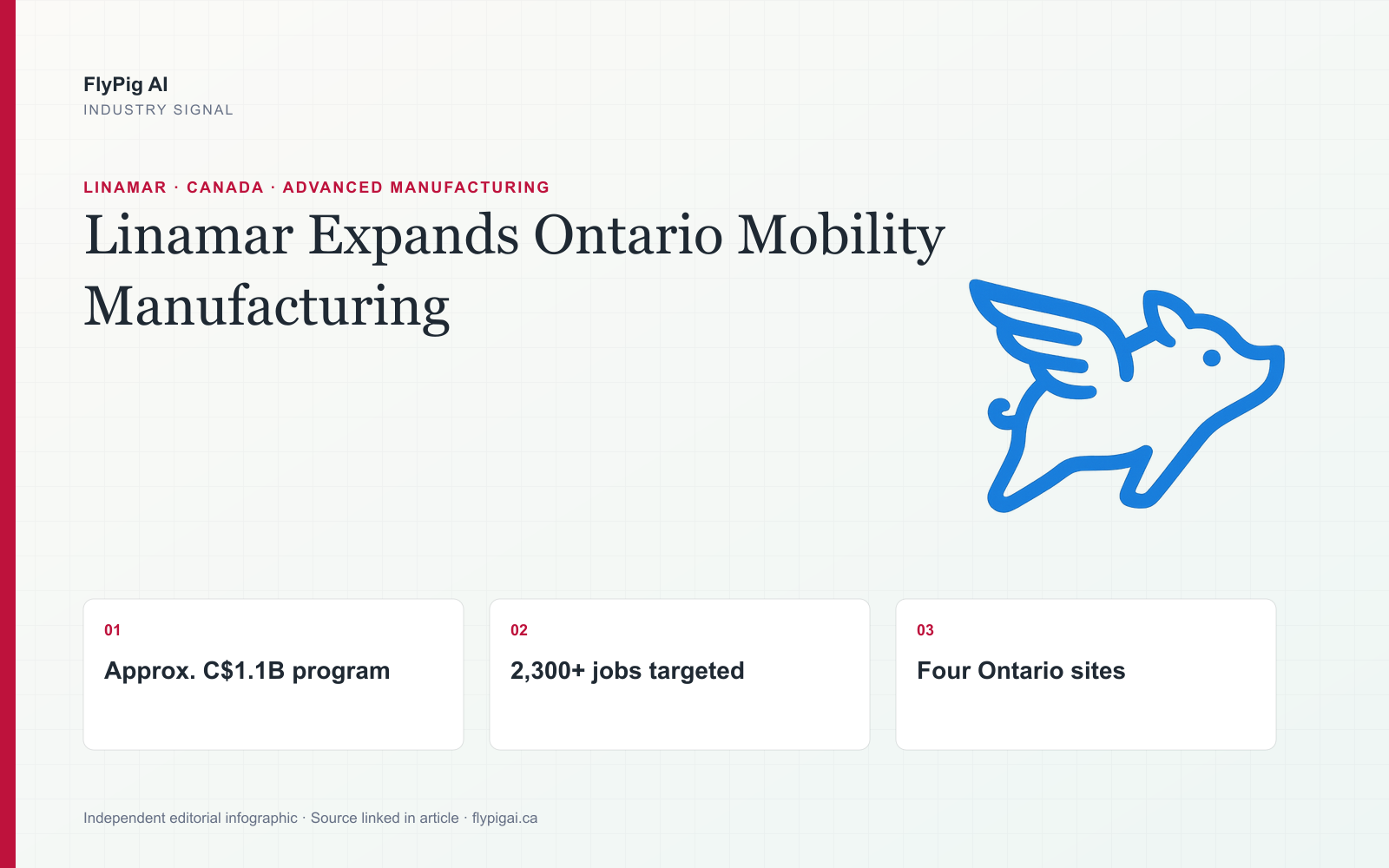
On January 28, 2025, Linamar said it had reached agreements with the Canadian and Ontario governments on an investment program of approximately C$1.1 billion. The company said the program was intended to protect nearly 10,000 existing jobs and create more than 2,300 new jobs in Ontario's automotive manufacturing sector. Ottawa separately announced up to C$169.4 million through the Strategic Innovation Fund, while Ontario said it would provide more than C$100 million through Invest Ontario.
The program spans hybrid propulsion, battery-electric eAxle systems, propulsion-agnostic products, inverter and semiconductor research, energy storage, fuel-cell systems and lightweight structural casting. Linamar also said the investment covers both research and development and the installation and commissioning of new manufacturing equipment for program launches. That combination matters because it links technology development to physical production capacity.
The semiconductor element broadens the supply-chain relevance
Innovation, Science and Economic Development Canada described Linamar's Innovation Driving Green Technology Project as including EV-parts manufacturing and a new semiconductor-packaging method for EV batteries. The federal release says work is planned at Guelph, Salford, Welland and Windsor, with more than C$800 million in private investment associated with the project. It also places the semiconductor activities under Canada's Strategic Innovation Fund Semiconductor Challenge Callout.
For suppliers, that makes the signal broader than an automotive powertrain expansion. New packaging processes and new production equipment can pull in test, thermal, interconnect, power-conversion, machine-vision and factory-automation requirements. The official releases, however, do not publish equipment lists, packaging architecture, bills of materials or supplier-selection timelines, so those demand categories should be treated as areas to investigate rather than confirmed purchase orders.
Taiwan relevance should be treated as a hypothesis to test
Taiwan has deep capability in industrial automation, motion control, machine vision, power electronics, sensors, embedded computing and semiconductor packaging. Those capabilities line up with the types of manufacturing and electronics work described in the Linamar program, which makes the event worth tracking from a cross-border supply-chain perspective.
The evidence stops there for now. Neither Linamar nor the two government releases identify Taiwan as a sourcing geography or name external suppliers for the program. The next meaningful signals would be plant-level equipment awards, RFQs, packaging-process disclosures, new manufacturing partners or product-launch details that reveal where outside technology is being integrated.
FlyPig AI interpretationThe useful signal is not the headline investment amount by itself. It is the combination of government-backed capital, new manufacturing equipment, EV power electronics and semiconductor-packaging work inside a major Canadian Tier 1. That creates a credible demand environment for automation and electronics suppliers, but it is too early to convert the overlap into a named cross-border match. The right next step is to watch for procurement and process details that turn broad capability fit into an identifiable design-in window.
Status, open questions and Canada relevance
Current product status
The investment program was announced on January 28, 2025 and is described by Linamar and government sources as a multi-site development and manufacturing initiative. The reviewed public sources do not provide a plant-by-plant procurement schedule, supplier list, RFQ calendar, equipment awards or evidence of a Taiwan sourcing relationship.
What remains open
- Which Linamar sites and launch programs will generate external procurement for semiconductor packaging, power electronics, test equipment, machine vision, motion control and factory automation?
- How are sourcing decisions for the new manufacturing equipment organized across Guelph, Salford, Welland and Windsor, and when do supplier qualification or RFQ windows open?
- What packaging architecture, materials, thermal requirements and test flows will be used for the new EV-battery semiconductor-packaging method?
Why Canadian teams may care
Linamar is a major Canadian Tier 1 manufacturer, and this program directs public and private capital into Ontario production capacity, electrified mobility and semiconductor-related work. For Canadian industry, it is a concrete example of advanced manufacturing policy becoming plant-level investment rather than remaining only a research or incentive announcement.