Why it matters
- A Thunderbolt-attached accelerator changes the integration model from opening a workstation or server for a PCIe card to connecting an external device, which can broaden evaluation access for mobile and desktop developers.
- The design partnership with Razer is commercially relevant because it combines Tenstorrent's accelerator and open-source software stack with a company experienced in laptop accessories and external hardware design, but the announcement does not establish a production-volume commitment.
- For Canada's AI-hardware ecosystem, a compact developer device could extend Tenstorrent's reach beyond rack and workstation deployments into edge prototyping and local AI workflows, provided the product progresses from showcase status to a defined order and support channel.
- For Taiwan, the opportunity is primarily at the subsystem and manufacturing layers: compact accelerator hardware can create demand for high-speed board integration, memory, power delivery, thermal design, enclosure engineering and ODM or EMS execution. No supplier selection has been disclosed.
The form factor is the signal
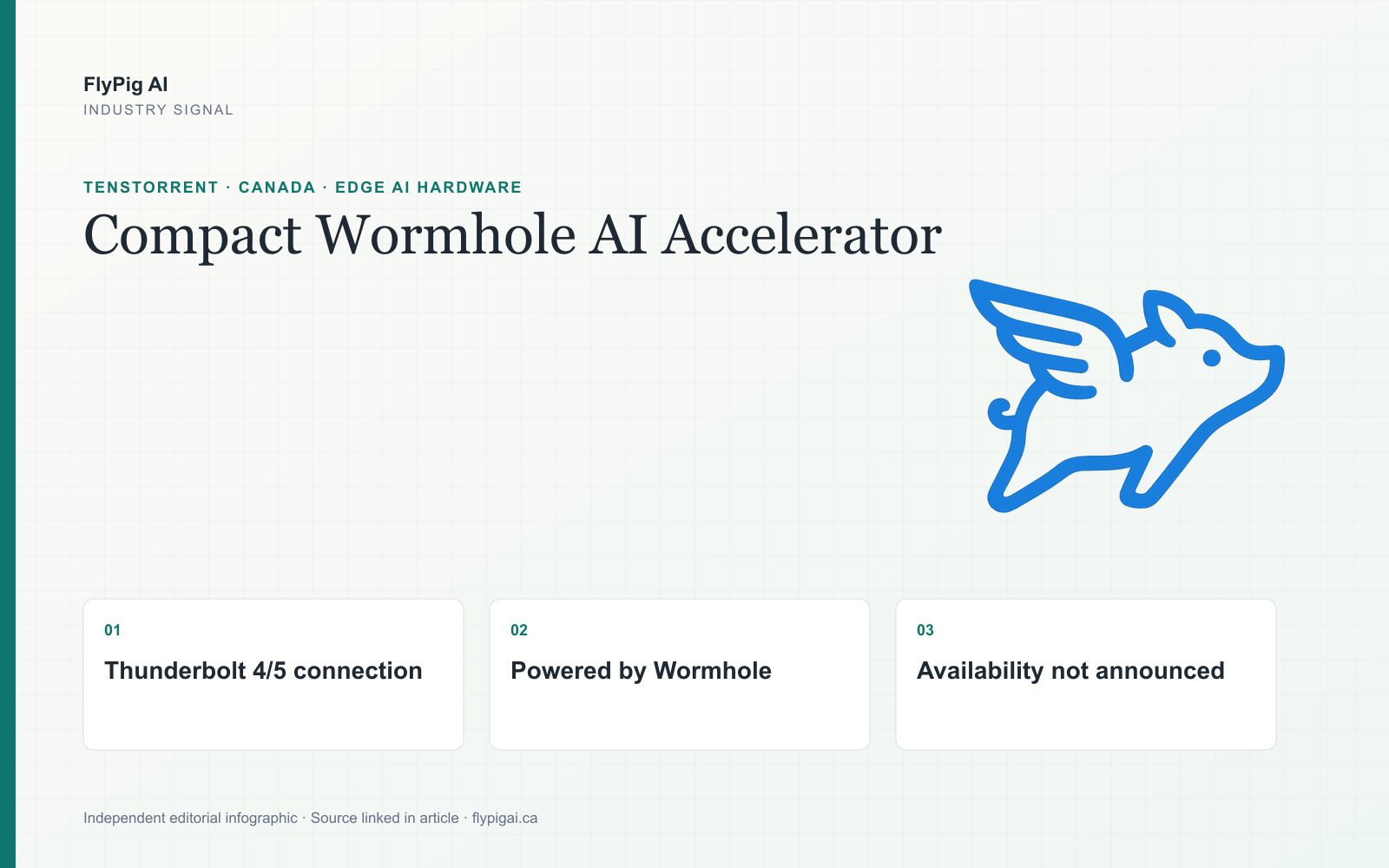
Tenstorrent already offered Wormhole-based PCIe accelerator cards and developer workstations before CES 2026. The January announcement introduced a different packaging direction: a compact external device designed to attach to Thunderbolt-equipped computers. That matters because the host no longer needs a free PCIe slot or a workstation chassis simply to begin hardware evaluation.
Tenstorrent said the device uses Wormhole technology and can be connected in groups of up to four units. Razer separately confirmed the collaboration in its CES materials. Those first-party sources support describing the project as a real joint hardware effort, not a speculative ecosystem association. They do not disclose the exact Wormhole configuration, memory capacity, power envelope, thermal limit or sustained workload performance of the compact device.
Commercial availability remains the key qualifier
The strongest reason to keep the maturity language conservative is in Tenstorrent's own launch notice: after describing the CES display, the company said more information on pricing and availability would come later. That separates the event from the company's established products that have explicit order, price or shipment information.
A current first-party hardware check also leaves the compact product's commercial status unresolved. Tenstorrent's hardware documentation and support pages describe generally supported Blackhole and Wormhole PCIe cards and TT-QuietBox or TT-LoudBox systems, while the CES compact Thunderbolt device is not presented there as a standard orderable system. Absence from those pages is not proof that the project was cancelled; it means buyers should verify availability directly rather than infer shipment from the CES unveiling.
Razer lowers enclosure risk, not market risk
Razer's role is more concrete than a logo on a partner slide. Its CES announcement says the compact accelerator was designed in partnership with Tenstorrent, while Tenstorrent identified Razer's experience in external enclosure design as part of the collaboration. That can reduce mechanical and user-experience execution risk around a laptop-attached accelerator.
The remaining commercial questions sit elsewhere: target price, host compatibility matrix, cable and power requirements, software release support, warranty ownership, distribution channel and whether developers will choose an external Wormhole device over internal PCIe cards or complete local-AI workstations. None of those procurement details can be filled in from the launch materials.
Taiwan's intersection is the hardware stack around the accelerator
The compact form factor creates a supply-chain profile that is familiar to Taiwan's electronics ecosystem even though no Taiwan supplier has been named. A production design would require some combination of high-speed PCB and I/O implementation, accelerator memory, power conversion, thermal management, connectors and cabling, enclosure manufacturing, final assembly and validation. Those are credible capability intersections, not evidence of awarded business.
The design-in questions therefore need to become specific before a cross-border match is actionable. A supplier would need the actual accelerator board architecture, memory topology, Thunderbolt controller and certification path, power budget, acoustic target, enclosure constraints and expected production volume. Without those parameters, naming individual Taiwanese vendors would overstate the evidence.
The next milestone is an orderable product, not another demo
For commercial tracking, the decisive follow-up would be a named SKU, technical datasheet, supported host list, price, order channel, shipment window or production announcement. Independent workload measurements would also be more useful than general claims about desktop-class performance because an external enclosure adds power, cooling and I/O constraints that can materially affect sustained use.
If Tenstorrent turns the CES concept into a supported product, it could create a lower-friction entry point into the company's software ecosystem and a more consumer-electronics-like hardware opportunity than its larger AI systems. Until that happens, the procurement posture should remain evaluate and monitor rather than assume general availability.
FlyPig AI interpretationThe important shift is not that Tenstorrent built another accelerator. It is that Wormhole moved into a form factor that looks more like an external computing accessory than a server component. That is strategically interesting for edge AI because easier physical integration can expand the developer funnel before production design-ins appear. It is also where Taiwan's hardware strengths become more relevant. But the supply-chain opportunity starts only after Tenstorrent defines a production configuration, availability and volume path. CES visibility alone is not a purchase signal.
Status, open questions and Canada relevance
Current product status
As of the January 6, 2026 announcement, the compact Wormhole AI accelerator had been unveiled and displayed at CES 2026, with Thunderbolt 5 or Thunderbolt 4 connectivity and support for linking up to four units. Tenstorrent explicitly said pricing and availability details would follow. A September 10, 2026 review of the first-party sources used for this report did not establish a standard order page, shipment date, production volume, MOQ or lead time for the compact device, so FlyPig AI treats it as announced hardware with commercial availability still to be confirmed.
What remains open
- What exact Wormhole configuration, memory capacity, power envelope, cooling design and Thunderbolt controller are used in the production-intent device?
- When will Tenstorrent or Razer publish a SKU, price, order channel, supported host list, shipment window and warranty or support model?
- If the device enters volume production, which board, memory, power, thermal, enclosure, connector and manufacturing functions will be sourced externally, and will any Taiwan-based suppliers participate?
Why Canadian teams may care
Tenstorrent maintains a Toronto location and develops AI processors, systems and software used by developers evaluating alternatives to conventional accelerator stacks. A laptop-attached Wormhole device would give Canadian AI and robotics teams a lower-friction hardware evaluation path than a rack system or internal accelerator card, particularly for local inference and edge prototyping. The commercial value depends on the device becoming orderable with a clear lifecycle and support model.