Why it matters
- Developer-order availability is a meaningful commercialization threshold because it lets software teams, system integrators and prospective customers begin real hardware evaluation instead of relying only on architecture disclosures or pre-silicon roadmaps.
- A PCIe accelerator card and a multi-processor workstation create a wider hardware ecosystem than the chip alone, touching host systems, board design, memory, power delivery, cooling, high-speed connectivity, enclosure engineering and manufacturing integration.
- For Taiwan's electronics ecosystem, the overlap is credible at the capability level across board and system integration, memory, power, thermal, connectors and ODM manufacturing, but Tenstorrent did not identify Taiwan suppliers or external component awards in the reviewed launch materials.
Blackhole crossed from architecture work into developer access
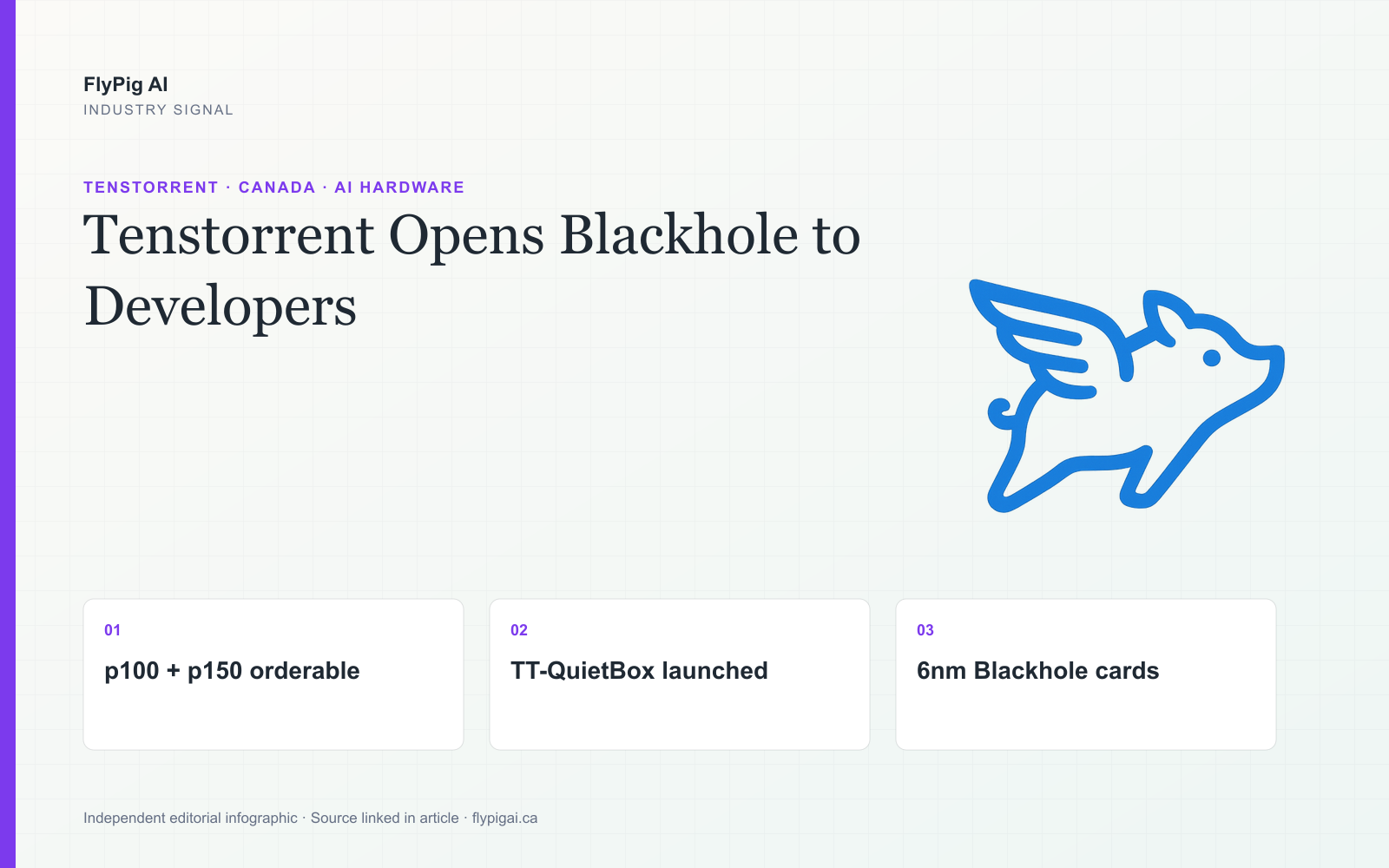
Tenstorrent's April 3, 2025 Dev Day announcement marked a concrete status change for Blackhole. The company introduced the p100 and p150 developer cards and the TT-QuietBox workstation and stated that the products were available for order. That matters because orderability is different from a roadmap reveal or a controlled demonstration: outside developers could begin acquiring hardware, bringing up software and evaluating how the architecture behaves inside real host systems.
The launch announcement described the Blackhole PCIe cards as updated to a 6nm manufacturing process with a faster Network-on-Chip, higher memory density and additional integrated RISC-V cores. It also differentiated the p100 as a single-processor card without Ethernet and the p150 as a network-capable product offered in multiple cooling configurations. FlyPig AI treats those as vendor product specifications from the launch, not as independent performance validation.
The software layer made the hardware more than a board launch
Tenstorrent paired the hardware release with a Developer Hub for model support, tutorials, bounties and developer resources. The company also said the Blackhole cards and TT-QuietBox were supported by its open-source software stack, including TT-Forge, TT-NN, TT-Metalium and TT-LLK. That combination is commercially relevant because a new accelerator is difficult to evaluate on silicon specifications alone; developers need compilers, kernels, libraries, debugging tools and model support before a platform can move into broader design consideration.
For North American buyers, the April 2025 signal was therefore an ecosystem-opening event rather than proof of production deployment. The reviewed source does not state shipment volume, broad customer adoption, production cluster deployment or enterprise design wins. Those are later maturity questions and should not be collapsed into the developer-product launch.
Canada gains a hardware platform, while Taiwan remains a capability hypothesis
Tenstorrent is headquartered in Toronto even though the Dev Day launch took place in San Francisco. That makes Blackhole commercially significant to Canada's AI-hardware sector: a Canadian-headquartered company was putting its own accelerator architecture into purchasable developer systems rather than participating only through software, research or cloud services. It also creates a useful benchmark for how Canadian AI compute companies may progress from chip architecture to boards, workstations and eventually larger systems.
For Taiwan, the most defensible intersection is at the system-manufacturing layer. Accelerator cards and multi-processor workstations require board engineering, memory, power delivery, thermal hardware, connectors, mechanical integration and manufacturing capacity, all areas where Taiwan has deep industry capability. The launch source, however, does not disclose a board manufacturer, ODM, memory supplier, power supplier, thermal partner or assembly geography. The appropriate conclusion is that a supply-chain surface exists, not that a cross-border commercial relationship has been confirmed.
The procurement questions start after developer availability
Opening a product for order answers the first commercial question, but not the questions that matter to a component or manufacturing supplier. The launch materials do not disclose forecast volumes, lifecycle commitments, qualification requirements, contract manufacturers, regional fulfilment structure, bill-of-material ownership, sourcing policy, MOQ or lead times. They also do not clarify which subsystems are designed internally by Tenstorrent and which may be open to external partners.
Those missing details define the real design-in window. A future supplier signal would be stronger if Tenstorrent names manufacturing partners, expands qualified system configurations, publishes subsystem requirements, announces volume-production status or identifies customers deploying Blackhole-based systems. Until then, the April 2025 event is best read as the moment Blackhole became accessible developer hardware and began generating evidence that could support later commercial scale.
FlyPig AI interpretationBlackhole's April 2025 launch is important because it converted a Canadian AI architecture into hardware developers could order and integrate. That is the point where software maturity, host compatibility, thermals, power, networking and manufacturability begin to matter together. For Taiwan, this is a credible capability intersection but not yet a deal signal. The next high-value evidence would be named manufacturing relationships, production-volume milestones, qualified system partners or procurement disclosures that reveal where external suppliers can enter the stack.
Status, open questions and Canada relevance
Current product status
At the April 3, 2025 launch, Tenstorrent stated that Blackhole p100 and p150 cards and the TT-QuietBox workstation were available for order. The reviewed launch announcement does not establish volume-production scale, shipment volume, enterprise customer deployments, MOQ, lead time or supplier assignments. Tenstorrent's current hardware pages show that the Blackhole product family has continued to evolve, so present-day configurations and availability should be checked separately rather than assumed from the 2025 launch record.
What remains open
- Which board, memory, power-delivery, cooling, connector and system-integration components are designed or sourced externally across Blackhole cards and workstations?
- Has Tenstorrent qualified any Taiwan-based ODM, board, memory, power or thermal suppliers for Blackhole products, and if so at what product or production stage?
- What production-volume, lifecycle-support and lead-time commitments apply as Blackhole moves from developer hardware into larger commercial deployments?
Why Canadian teams may care
Tenstorrent is headquartered in Toronto and is one of Canada's most visible AI-compute hardware companies. Blackhole developer availability demonstrated a Canadian-headquartered company moving proprietary AI silicon into orderable cards and workstations, strengthening the country's position in the physical compute layer of the AI stack rather than only in software and research.