Why it matters
- Commercial availability of CPU IP is a different maturity threshold from a roadmap disclosure: architecture teams can begin licensing discussions, toolchain evaluation, emulation and integration planning for custom silicon.
- Upstream GCC, LLVM and Qemu support reduces one early adoption barrier for an RVA23-class CPU core because prospective customers can evaluate software compatibility before committing to a physical implementation.
- For Canada's AI-hardware ecosystem, TT-Ascalon extends Tenstorrent beyond accelerator systems into licensable general-purpose CPU IP that can target infrastructure, automotive and robotics designs, while the actual customer silicon and production pipeline remains undisclosed.
- For Taiwan, the strongest evidenced intersection is RISC-V IP and downstream SoC implementation capability rather than a confirmed supplier relationship. Andes Technology's RVA23-capable high-performance CPU IP demonstrates a local comparison set, while foundry, packaging, board validation and system integration opportunities depend on each licensee's implementation choices.
The signal is licensing access, not a finished processor shipment
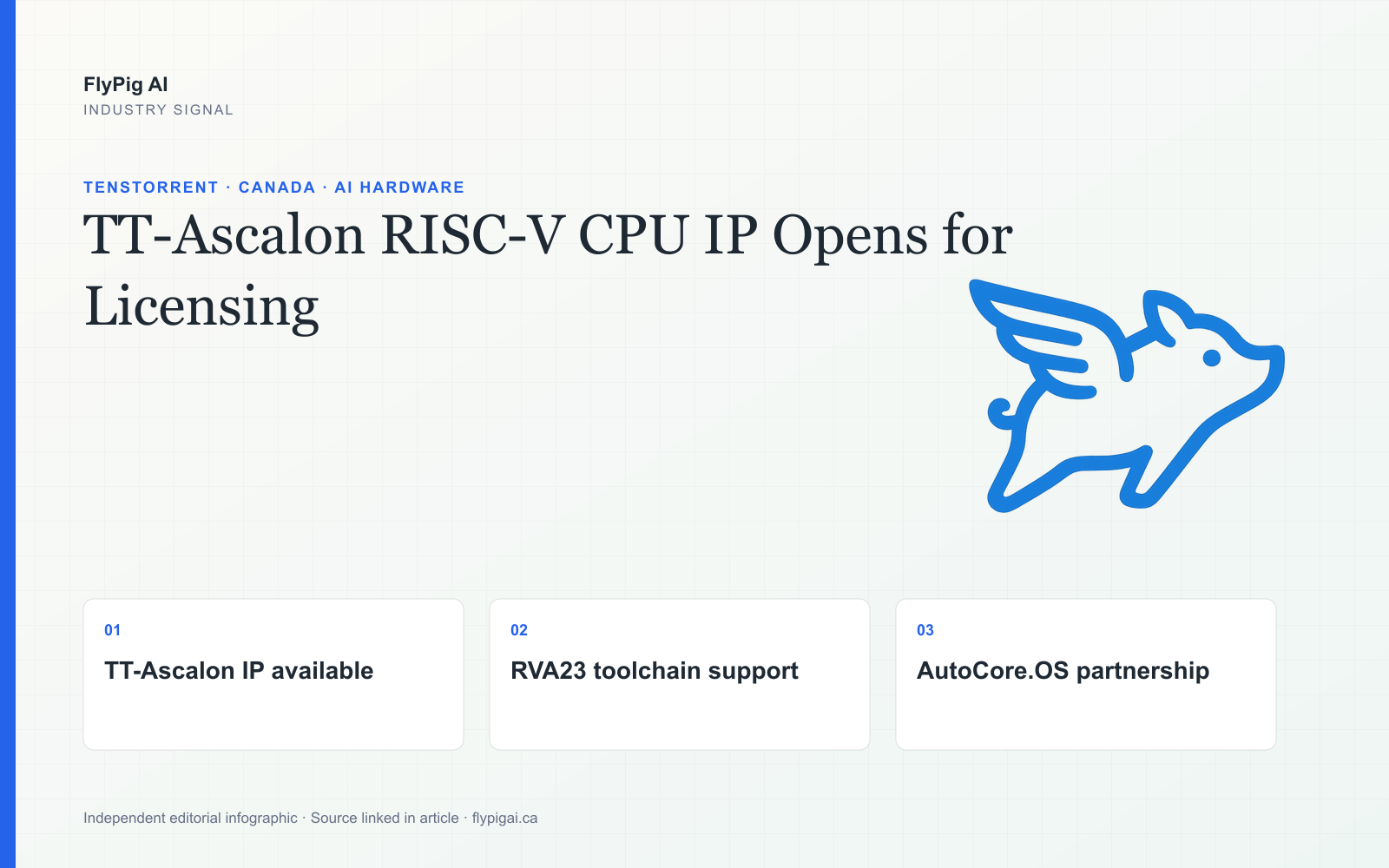
Tenstorrent's December 2025 announcement changed the commercial status of TT-Ascalon by describing the RISC-V CPU IP as available immediately. The company also pointed customers to evaluation and emulation platforms. For a CPU-IP business, that matters because the product being sold is the core design and associated enablement rather than a boxed processor that can be counted in channel inventory.
That distinction is important for procurement language. The announcement does not identify a customer tape-out, a wafer-start schedule, qualified package, production board, shipment volume, MOQ or lead time. It therefore supports saying the IP became commercially accessible, but not that Ascalon-based silicon was already in volume production.
Software readiness strengthens the evaluation path
Tenstorrent said Ascalon supports the RVA23 profile and that GCC, LLVM and Qemu support was upstreamed and available. For SoC architects, that software layer is part of the buying decision because a CPU core without compiler, emulator and operating-system readiness can add significant integration risk even when the microarchitecture itself is compelling.
The company also published SPEC CPU and frequency results in the launch material. FlyPig AI treats those numbers as vendor-reported claims and does not use them here as independently verified benchmarks. Commercial teams still need workload-specific validation, process assumptions, power and area data, safety requirements and implementation constraints before comparing Ascalon with alternative CPU IP.
Automotive software support is a partnership signal, not a design win
On the same date, AutoCore.ai independently announced a strategic partnership to enable TT-Ascalon with AutoCore.OS for software-defined vehicle computing. That gives the CPU IP a concrete automotive software integration path and is more meaningful than a generic ecosystem logo because both parties publicly described the intended technical combination.
The evidence stops short of a production award. AutoCore's existing mass-production software experience does not establish that TT-Ascalon itself had entered a mass-production vehicle, and the reviewed announcements do not name an automaker, Tier 1 purchase order, vehicle program, production volume or start-of-production date. Those details remain the milestones that would convert an ecosystem partnership into a stronger commercial deployment signal.
Taiwan is a credible RISC-V implementation ecosystem, but no deal is disclosed
The Taiwan intersection is clearest at the CPU-IP and SoC implementation layers. Andes Technology, headquartered in Hsinchu, publicly offers high-performance RISC-V processor IP and announced its RVA23-capable AX66 before the Ascalon availability event. That makes Taiwan relevant as an established RISC-V IP ecosystem and competitive reference point for customers evaluating open-ISA CPU cores.
Beyond CPU IP, a licensed Ascalon design could eventually touch foundry services, advanced packaging, memory, power delivery, high-speed interfaces, board validation and ODM engineering. None of those supply-chain roles can be assigned from the launch announcement, however. The actual manufacturing intersection will depend on who licenses the core, which process and packaging path they choose, and how much of the SoC and system design they retain internally.
The next useful signals are implementation milestones
Tenstorrent expanded the family in June 2026 with TT-Ascalon S, showing that the portfolio continued to evolve after the original availability announcement. That later launch should not be used to retroactively change the December 2025 status, but it does show that buyers now need to confirm which Ascalon variant, collateral and implementation targets apply to a new engagement.
For commercial tracking, the strongest next evidence would be named licensees, customer silicon tape-outs, process-node commitments tied to a customer program, functional-safety qualification, production software stacks, board-level validation or disclosed volume deployments. Until those appear, TT-Ascalon is best understood as commercially available CPU IP with a developing ecosystem rather than a proven mass-production silicon platform.
FlyPig AI interpretationTT-Ascalon matters because CPU-IP availability opens a design window before a physical product reaches the market. That is where architecture selection, software portability, process choice and downstream manufacturing decisions begin to form. For Canada, it broadens Tenstorrent's commercial surface from AI accelerators into licensable CPU technology. For Taiwan, the near-term opportunity is not a presumed component order; it is the combination of RISC-V IP expertise, SoC implementation and manufacturing infrastructure that could become relevant once specific Ascalon licensees disclose how they will build their chips.
Status, open questions and Canada relevance
Current product status
As of the December 4, 2025 announcement, Tenstorrent described TT-Ascalon as immediately available CPU IP and said evaluation and emulation platforms were available through the company. The reviewed evidence does not establish a shipping standalone processor, customer silicon tape-out, volume production, MOQ, lead time or production deployment. Tenstorrent later expanded the portfolio with TT-Ascalon S in June 2026, so current licensing scope and implementation collateral should be confirmed against the latest product documentation.
What remains open
- Which customers have licensed TT-Ascalon, and have any disclosed customer SoCs reached tape-out, qualification or volume production?
- What implementation collateral, safety packages, power and area targets, process-porting options and lifecycle commitments are available for automotive, robotics and infrastructure programs?
- Will any Ascalon licensee use Taiwan-based foundry, packaging, validation, board or ODM resources, and which parts of that downstream stack remain open to external suppliers?
Why Canadian teams may care
Tenstorrent maintains a Toronto engineering presence and has described itself as a Toronto-headquartered AI-compute company in prior first-party materials. Making a proprietary RISC-V CPU core commercially licensable adds an IP layer to Canada's AI-hardware footprint: Canadian engineering can participate not only through complete accelerator systems but also through CPU technology that external SoC teams may integrate into infrastructure, automotive and robotics products.