Why it matters
- Flexible wire insertion is a contact-rich manipulation problem that is difficult to solve with fixed automation because the part can move and deform. A system that can meet both success-rate and cycle-time thresholds on a live production benchmark is therefore more commercially relevant than a slow demonstration, even though the published numbers remain vendor-reported.
- Sanctuary's strategy reduces dependence on waiting for a fully mature humanoid platform. By deploying its Physical AI on existing industrial robots, the company can pursue production tasks with hardware that manufacturers already understand, service and qualify.
- The company's current milestones page says the 2026 work led to a purchase order. That moves the signal closer to paid deployment, but without contract value, unit count, site count or rollout timing it should not be treated as evidence of scaled production demand.
- For suppliers, the most important question is whether Sanctuary begins to standardize the surrounding hardware stack: robot arms, end effectors, vision, force or tactile sensing, edge compute, safety control and industrial networking. Standardization would create repeatable design-in points; a project-by-project architecture would create a smaller opportunity.
What changed: Physical AI was measured against a factory production benchmark
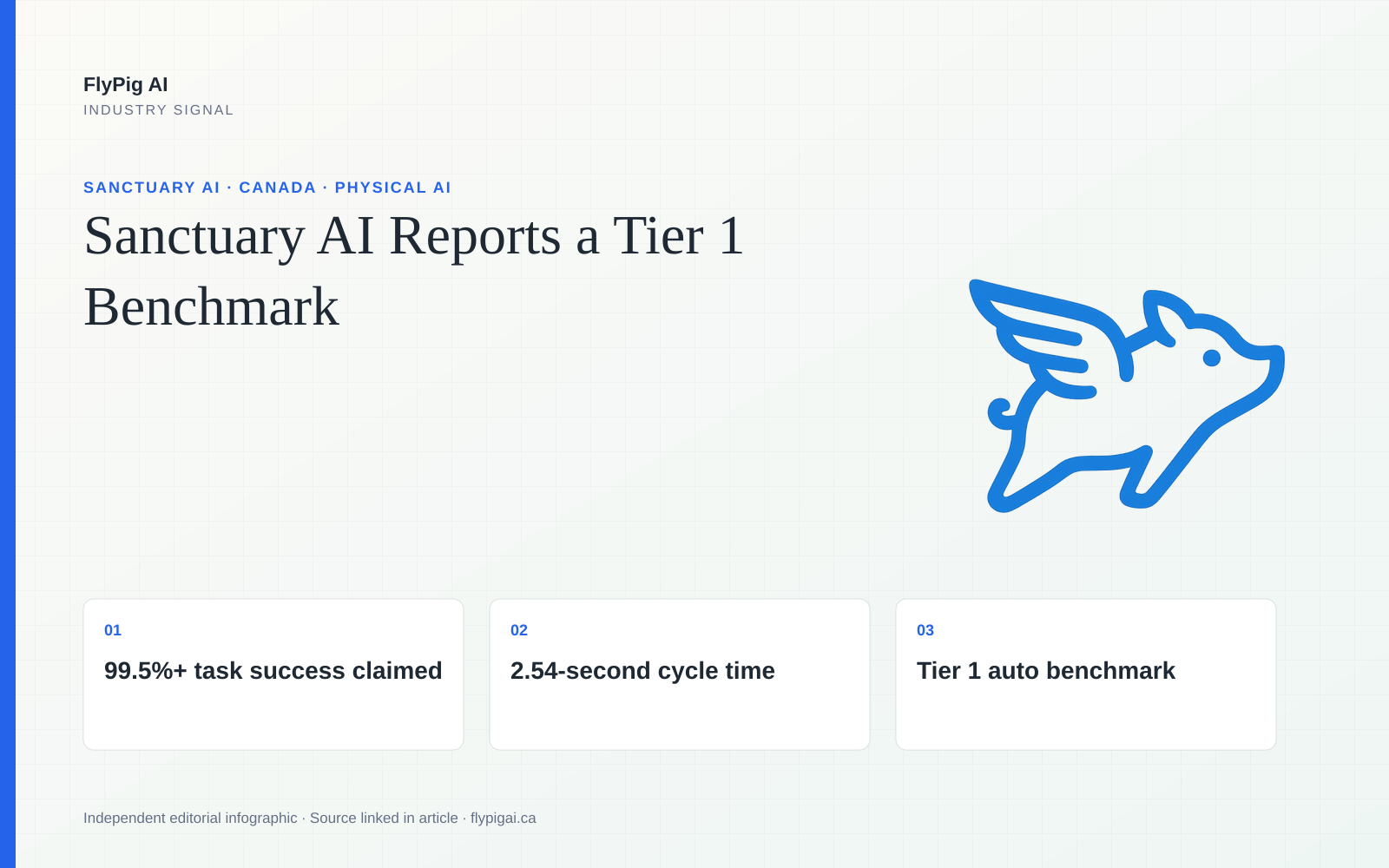
Sanctuary AI's June 17 announcement described a proof-of-concept at an unnamed global Tier 1 automotive supplier involving plug insertion on a moving production line. The task required manipulating a flexible wire while the target position changed with conveyor motion. Sanctuary reported a 99.5%+ task success rate and a 2.54-second cycle time, and said the system matched the throughput of the customer's live production line.
Those figures matter because industrial automation buyers usually care about repeatability and takt time at least as much as a visually impressive demo. They should still be read as first-party claims. Sanctuary has not published the customer's identity, number of test cycles, failure categories, statistical treatment or an independent validation report, so FlyPig AI does not treat the 99.5%+ figure as an independently benchmarked industry record.
The strategic shift is hardware-agnostic deployment, not a new humanoid
The June update also marked a change in commercialization strategy. Sanctuary said it was deploying its Physical AI on existing and next-generation industrial robotic systems rather than waiting for humanoid hardware to reach mass commercialization. Its current solution page describes Physical AI-enabled automation as deploying now and names FANUC and Universal Robots among supported industrial integrations.
That distinction is important for procurement. A software and controls layer that can operate across established robotic arms can enter factories through existing automation budgets, installed-base service practices and familiar safety workflows. Sanctuary's proprietary hydraulic hands remain a separate roadmap item, and its current site lists those hands as in development while AMR-based mobility is described as piloting soon. The reviewed sources therefore do not support describing a Sanctuary humanoid or proprietary hand as the production platform behind this benchmark.
Canadian commercial context: the signal has moved beyond a demo, but scale is still opaque
Sanctuary AI is headquartered in Vancouver, making the event a direct Canadian Physical AI commercialization signal rather than a foreign deployment story. The June release framed the automotive work as a proof-of-concept. Sanctuary's current milestones page goes further, saying the 2026 wire-harness result led to a purchase order and separately listing a first commercial purchase order with a global Tier 1 automotive supplier.
That is meaningful progress, but the public record stops short of a scalable demand forecast. Sanctuary does not disclose the buyer, purchase-order value, number of robotic cells, hardware count, factory location, acceptance criteria, service model or rollout schedule. Until those details emerge, the appropriate maturity label is paid industrial deployment evidence, not mass deployment or volume production.
Taiwan intersection: credible capabilities, no disclosed Sanctuary sourcing
The clearest Taiwan intersection sits around the physical automation stack rather than the AI model itself. Delta's August 2026 Automation Taipei disclosure shows integrated humanoid joint modules with built-in torque sensing, robot control software, collaborative robots and grippers. Advantech separately markets industrial Edge AI systems for robotics with high-speed sensor processing, rugged connectivity and functional-safety integration. These are concrete examples of Taiwan-side capabilities relevant to future Physical AI cells.
None of the reviewed Sanctuary sources identifies Delta, Advantech or another Taiwan company as a supplier. They also do not disclose the compute platform, camera system, force or tactile sensors, safety controller, industrial network, end-effector supplier or bill of materials used in the automotive benchmark. The cross-border opportunity therefore remains a capability-level match: useful for qualification research, but not evidence of an active RFQ, design win or purchasing relationship.
What procurement teams should ask before treating this as a repeatable design-in opportunity
The first question is hardware configuration. Sanctuary's current solution page names multiple industrial robot brands and custom or off-the-shelf end effectors, but it does not say which arm, controller or end-effector produced the June result. Procurement teams also need to know whether perception and force feedback run through standardized modules or vary by customer cell.
The second question is validation breadth. One successful task can establish technical feasibility without proving transfer across connector types, line speeds, lighting conditions, cable geometries or safety cases. Commercial scale will depend on how much new data collection, tuning and fixture engineering is required for each task and site.
The third question is the purchase-order conversion path. Public evidence now supports a paid commercial step, but not price, margin, system quantity, lead time or follow-on volume. A named rollout, multi-site expansion, repeat order, disclosed hardware baseline or supplier qualification program would materially strengthen the supply-chain signal.
FlyPig AI interpretationThe important change is that Sanctuary is trying to monetize Physical AI before humanoids are fully mature by putting learned manipulation onto industrial robots that factories can deploy today. The vendor-reported benchmark is strong enough to deserve attention because it combines task success with cycle time and now has first-party evidence of a purchase order. But the supply-chain case is still early. The next decisive signal is not another demo; it is a standardized cell architecture, a repeat order or a disclosed hardware and supplier qualification path that shows which components repeat from one deployment to the next.
Status, open questions and Canada relevance
Current product status
Sanctuary AI says its Physical AI-enabled automation is deployable on existing commercial robotic hardware and reports a 99.5%+ success rate with a 2.54-second cycle time on the June 2026 automotive wire-plugging task. Its current milestones page says the work resulted in a purchase order. These are first-party claims, and public sources do not disclose the customer identity, benchmark methodology, robot model used for the test, order value, system quantity, rollout schedule, pricing, MOQ, lead time or production capacity. Sanctuary's proprietary robotic hands remain in development, and AMR mobility is listed as piloting soon.
What remains open
- Which robot arm, controller, end effector, vision system, force or tactile sensors and compute platform were used in the Tier 1 automotive benchmark?
- What test population, failure taxonomy and acceptance criteria sit behind the reported 99.5%+ success rate and 2.54-second cycle time?
- What does the first commercial purchase order cover in terms of cells, sites, services, support period and rollout milestones?
- How much task-specific data collection, model tuning and tooling engineering is required to transfer the Physical AI stack to a new connector, line or customer?
- Which safety, cybersecurity, functional-safety and industrial network requirements govern production deployments, and which hardware components are standardized across projects?
- Does Sanctuary maintain an approved-vendor or preferred-supplier process that could allow qualified Taiwan motion, sensing, edge-compute or power suppliers to enter repeated deployments?
Why Canadian teams may care
Sanctuary AI is headquartered in Vancouver and is positioning a Canadian-developed Physical AI stack for production work at industrial customers. The 2026 automotive benchmark is commercially important because it links Canadian robotics software and manipulation research to the performance metrics used on a Tier 1 manufacturing line, while Sanctuary's current milestones page indicates that the work converted into a purchase order. For Canadian advanced manufacturing, the more consequential follow-on question is whether this becomes a repeatable deployment model across multiple plants and tasks. For Taiwan suppliers, a credible route would require disclosed or discoverable qualification points around motion control, sensing, edge compute, safety, power and system integration rather than assuming participation from the benchmark alone.