Why it matters
- The funding is tied to development, validation and commercialization of a specific manufacturing system, not to a general AI research program. That makes the event relevant to industrial productization and future equipment sourcing.
- Huys already designs, manufactures and supports ESD equipment. Adding AI to an existing equipment family can create a more credible path to deployment than an AI concept that lacks a hardware and service base.
- The event is an advanced-manufacturing signal rather than proof of a new Edge AI design win. If the AI functions are ultimately implemented locally in the machine, compute, sensing, control and power choices could become repeatable design-in points, but those architecture details are not yet public.
- For Taiwan suppliers, the near-term value is qualification intelligence. Public evidence supports Huys' welding and automation baseline, but not a current RFQ or a named opening for Taiwan components.
What changed: Huys now has a funded AI commercialization program around ESD
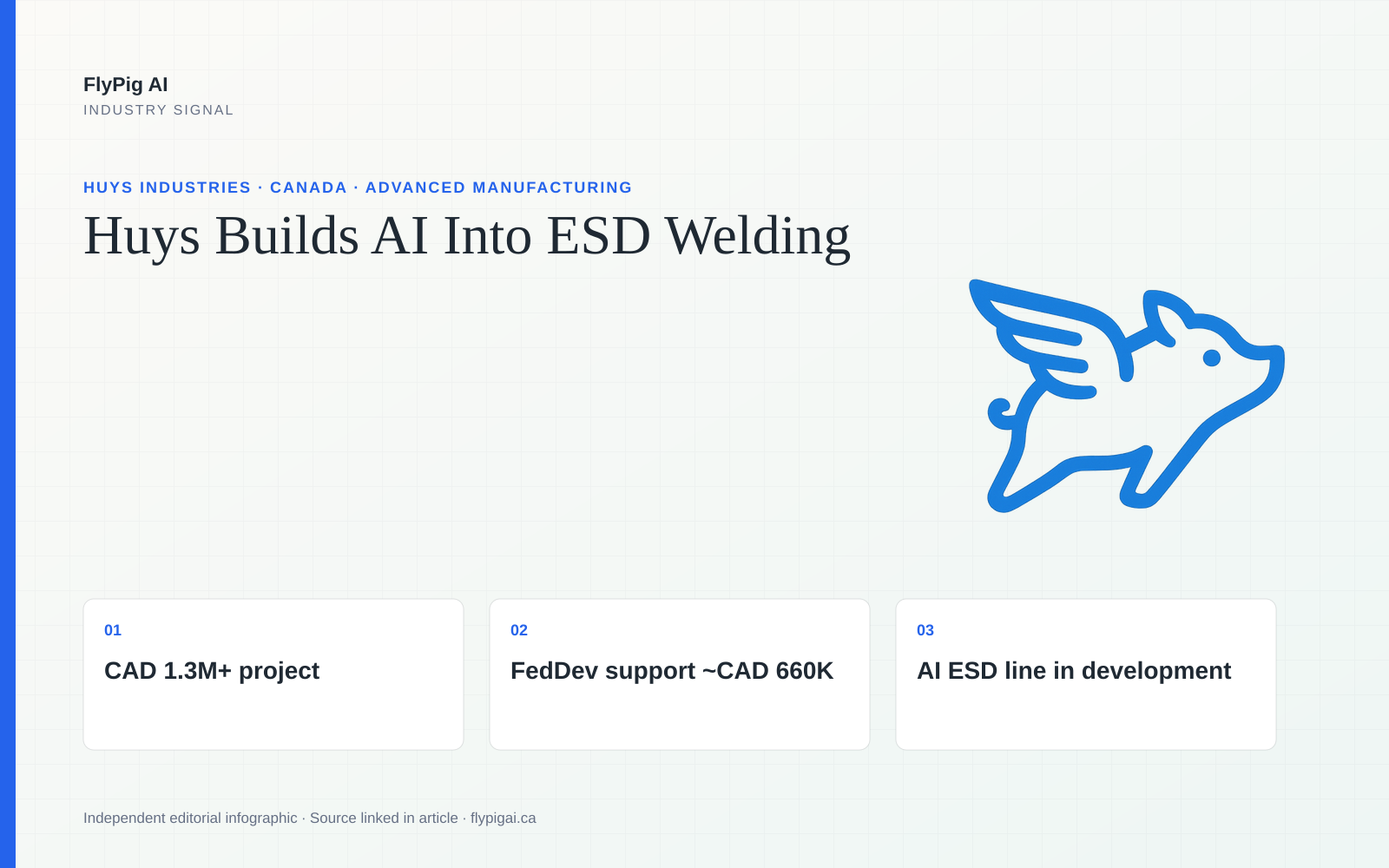
FedDev Ontario said on July 9 that Huys Industries is undertaking a project worth more than CAD 1.3 million, supported by approximately CAD 660,000 through the Regional Artificial Intelligence Initiative. The stated objective is to develop and commercialize an AI-powered welding system by integrating AI into Huys' existing electric spark deposition equipment. The funded scope includes AI integration, validation of the advanced ESD system and commercialization activity.
Huys followed with its own August 5 announcement, saying it will build on its automation work by integrating AI into a new line of ESD equipment and services. That first-party confirmation matters because it frames the project as a future product and service line, not simply an internal process-improvement exercise.
The baseline is real welding equipment, but the AI product is not yet a released model
Huys already sells and supports Low Energy Welding equipment based on electrospark deposition. Its current product page lists standard power-supply and coating-machine models 6300, 6310 and 6320, while other company material shows automated ESD configurations including a four-axis coating station. The AI project therefore starts from an existing equipment and automation base.
What is not public is equally important. Neither FedDev Ontario nor Huys identifies the AI-enabled model, production launch date, inference architecture, sensors, controller, compute hardware, software stack, pricing, lead time or manufacturing volume. The appropriate maturity label is development, validation and commercialization in progress, not generally available production hardware.
Why it matters for Canadian advanced manufacturing
ESD is used to coat and repair metallic components, including high-value parts where controlled deposition and repair can extend usable life. Huys has an established business in resistance-welding consumables and equipment as well as ESD systems, giving the AI project a direct manufacturing context rather than a laboratory-only setting.
The government release says the AI-driven system is intended to reduce costs, improve efficiency and expand market opportunities. Those outcomes should be treated as project goals until Huys publishes measured production data. The more useful commercial signal today is that a Canadian equipment maker has funding to take intelligent automation through validation and into a new product line.
Taiwan intersection: wait for the architecture before calling it a design-in opportunity
The possible Taiwan intersection is most credible at the industrial-automation subsystem level: control electronics, power electronics, motion interfaces, rugged embedded hardware and, depending on the final AI architecture, potentially machine sensing or local compute. Huys' existing automated ESD equipment makes the automation layer tangible, but the reviewed sources do not reveal which of these functions will change in the AI-enabled line.
That distinction prevents a common sourcing error. It would be premature to name a Taiwan camera, edge-compute module or controller as a fit when Huys has not disclosed whether the AI system uses vision, force or electrical-process sensing, where inference runs, or whether the controller architecture is being redesigned. No Taiwan supplier, RFQ, approved-vendor relationship or design win is public.
The next procurement signals are architecture, validation results and supplier qualification
The highest-value follow-up will be technical disclosure: what data the AI system consumes, whether inference occurs on-machine or off-machine, what latency and safety boundaries apply, and how the AI layer interfaces with the existing ESD power supply, applicator and motion system. Those details would reveal whether the opportunity sits primarily in software, sensing, embedded compute, industrial control or a combination of them.
Commercially, a named AI-enabled model, validation result, pilot customer, release date, supplier qualification program or production order would materially strengthen the signal. Until then, the CAD 1.3M-plus program is best read as funded product development with a credible manufacturing base, not evidence of scaled deployment.
FlyPig AI interpretationHuys is interesting because the AI is being added to a real Canadian manufacturing-equipment business rather than introduced as a standalone software concept. That gives the project a plausible path from validation to repeatable machine sales. The supply-chain case, however, is not mature enough to chase specific components yet. The next decisive evidence is the machine architecture: once Huys discloses how it senses the weld process, where inference runs and which controls are standardized, the Canada-Taiwan design-in map can move from category-level speculation to qualified supplier work.
Status, open questions and Canada relevance
Current product status
FedDev Ontario announced the AI-powered ESD project on July 9, 2026, and Huys confirmed on August 5 that it plans a new line of AI-enabled ESD equipment and services. Huys currently sells conventional Low Energy Welding equipment, including models 6300, 6310 and 6320, but the reviewed sources do not identify a model number, release date, production volume, customer deployment, pricing, MOQ, lead time, compute platform, sensor architecture or component suppliers for the AI-enabled line. The AI system should therefore be treated as under development and validation for commercialization.
What remains open
- What process data will the AI system use, and will it rely on vision, electrical waveforms, force, motion or other sensors to make welding decisions?
- Will inference run locally in the ESD machine, on an industrial PC or controller, or through a remote service, and what latency, safety and cybersecurity constraints apply?
- Will the AI-enabled product reuse Huys' current power supplies and automation hardware or introduce a new controller, motion, sensing and power architecture?
- When will Huys disclose validation metrics, a commercial model number, pilot customers, supplier qualification requirements or a production launch date?
Why Canadian teams may care
Huys Industries is an Etobicoke, Ontario manufacturer with an established welding-equipment business, and the federal Regional Artificial Intelligence Initiative is directly funding development, validation and commercialization of its AI-enabled ESD system. The project is therefore a concrete Canadian advanced-manufacturing commercialization signal. Its future supply-chain significance will depend on whether Huys standardizes a repeatable hardware architecture as the new AI product line moves from validation into customer deployment.