Why it matters
- A major Canadian-headquartered Tier 1 is describing AI as part of routine factory workflows across material movement, quality inspection, planning and maintenance, which is more commercially relevant than a standalone technology demonstration.
- Those workloads create recurring integration surfaces for industrial cameras, edge compute, AMR subsystems, sensors, networking, motion control and power electronics even though Magna does not identify the suppliers used in the reviewed source.
- The strongest Taiwan intersection is therefore capability-level rather than deal-level: Taiwan suppliers have relevant industrial vision, embedded compute, motion, connectivity and power capabilities, but no Taiwan sourcing decision, design win or procurement relationship is disclosed.
Magna is describing AI as factory infrastructure, not a lab project
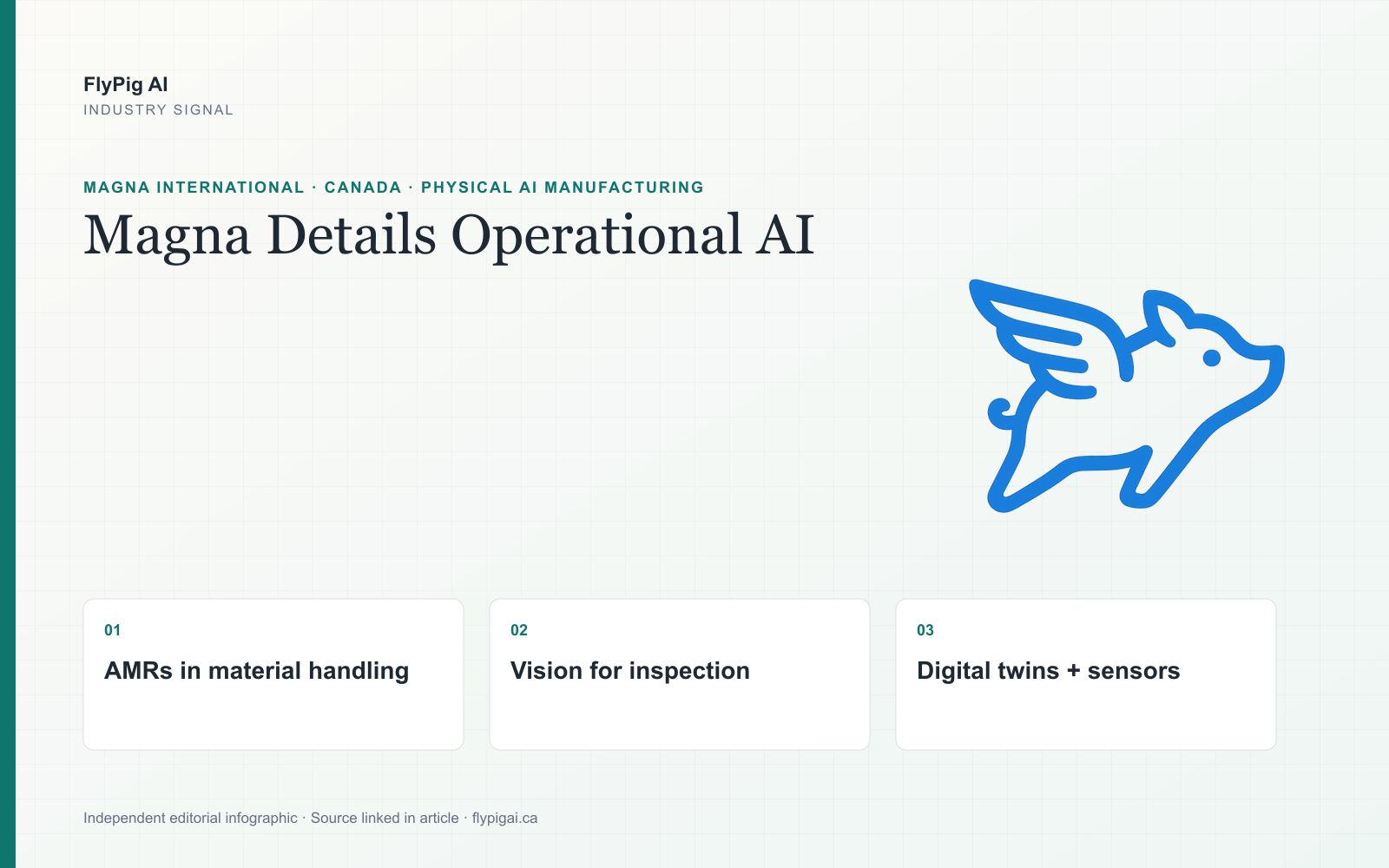
In an August 11, 2025 company article, Magna said it is deploying industrial automation and using robotics and AI across its global manufacturing footprint. It listed autonomous mobile robots for material handling and logistics, computer vision for quality inspection and pick-and-place automation, digital twins and simulation for factory layout and workflow optimization, and predictive maintenance driven by sensor data and machine learning.
The important status change is operational framing. Magna is not presenting those categories only as research themes; it says they are being integrated across its operations. At the same time, the public article does not provide plant counts, robot fleet sizes, camera quantities, equipment vendors, deployment dates or procurement values. FlyPig AI therefore treats this as a credible first-party adoption signal without converting it into an unsupported measure of deployment scale.
The NVIDIA connection is real, but it should not be stretched across every factory claim
Magna's same-day article places NVIDIA Omniverse and Cosmos inside a broader Physical AI ecosystem, but its most specific Cosmos statement concerns the City Delivery autonomous vehicle platform. Magna said it was exploring how Cosmos Reason could help the vehicle adapt to new cities and complex environments. NVIDIA's August 11 SIGGRAPH release separately confirms that Magna was developing with Cosmos Reason for City Delivery and describes the model as contributing world understanding to the vehicle's long-term trajectory planning.
That evidence supports a named development relationship around the autonomous vehicle platform. It does not establish that Cosmos Reason, Omniverse or a particular NVIDIA compute platform is deployed in every Magna factory workflow listed in the article. Keeping the two tracks separate matters for procurement analysis because factory AMRs, inspection systems and predictive-maintenance stacks may use different hardware and software architectures.
For suppliers, the opportunity is in repeatable subsystem demand
AMRs, machine vision, digital twins and predictive maintenance all depend on physical infrastructure. Depending on the implementation, that can include cameras and optics, edge computers, motor and motion-control systems, wireless and industrial networking, safety sensors, power electronics and data-acquisition hardware. Magna does not publish the bill of materials or vendor roster for the deployments described, so none of those categories should be read as a confirmed sourcing requirement.
For Taiwan, the relevant comparison is with capabilities already visible in the local industrial ecosystem, including embedded Edge AI systems, industrial vision, motion and robot-control hardware, connectivity modules and power electronics. Existing FlyPig signals on Advantech edge AI systems and Delta embodied-AI hardware illustrate that capability base. They do not establish a Magna relationship, and any cross-border design-in would still require automotive or industrial qualification, lifecycle support, cybersecurity review and plant-level supplier approval.
The next useful signals will be plant and procurement details
The August 2025 disclosure answers the strategic question of whether Magna sees AI as part of factory operations. It does not answer the commercial questions a supplier needs for design-in. There is no public equipment list, RFQ schedule, preferred supplier list, standard AMR platform, camera specification, edge-compute architecture, networking requirement or rollout calendar in the reviewed article.
Future evidence becomes materially stronger if Magna names plants, production programs, automation partners, equipment platforms or supplier awards, or if it publishes deployment quantities and qualification requirements. Those details would allow the signal to move from broad operational adoption toward a measurable sourcing opportunity.
FlyPig AI interpretationMagna's signal matters because operational AI becomes commercially interesting when it is attached to repeatable factory workflows rather than a single showcase. AMRs, vision inspection, simulation and predictive maintenance all create hardware integration surfaces, but the current evidence stops before procurement. For Taiwan, this is a credible capability intersection, not a confirmed cross-border match. The high-value next step is to watch for plant-level equipment standards, named integrators, RFQs or supplier awards that reveal who owns the subsystem design decisions.
Status, open questions and Canada relevance
Current product status
As of Magna's August 11, 2025 first-party article, the company described AMRs, computer vision, digital twins and predictive maintenance as technologies being integrated across its operations. The reviewed source does not disclose deployment counts, specific plants, equipment vendors, procurement volumes or rollout schedules. Magna's exploration of NVIDIA Cosmos Reason is specifically tied to the City Delivery autonomous vehicle platform and should not be interpreted as proof that Cosmos is deployed across all factory AI workflows.
What remains open
- Which Magna plants and production programs have standardized AMR, machine-vision, edge-compute or predictive-maintenance platforms, and who controls supplier qualification for those systems?
- Which hardware and software vendors supply the cameras, embedded compute, networking, motion-control and power subsystems behind Magna's operational AI deployments?
- Will Magna publish plant-level rollout milestones, equipment standards or procurement programs that expose a repeatable design-in window for external suppliers?
Why Canadian teams may care
Magna is headquartered in Aurora, Ontario and operates as a major global automotive and mobility supplier. Its description of AI and robotics inside manufacturing operations is therefore a meaningful Canadian advanced-manufacturing signal: it shows a Canadian-headquartered Tier 1 treating Physical AI as part of industrial operations while also developing AI-enabled autonomous mobility applications.