Why it matters
- Ultra-wide and multi-display cockpits create a routing and synchronization problem before they create an AI problem. A multi-output Tcon can centralize more of that display fan-out and image-processing work behind a high-speed eDP input.
- Himax's SLiM 3D module adds head-orientation tracking to the interaction layer. If the vendor-stated 180Hz report rate holds under production conditions, it could support lower-latency gaze-adjacent or attention-aware HMI behaviors without requiring every interaction to be inferred by the main compute platform.
- The commercial gap remains large: the announcement does not provide new part numbers, sample status, power, field of view, host interfaces, SDK terms or production dates for the Tcon or 3D module.
A multi-output Tcon addresses the display fan-out problem
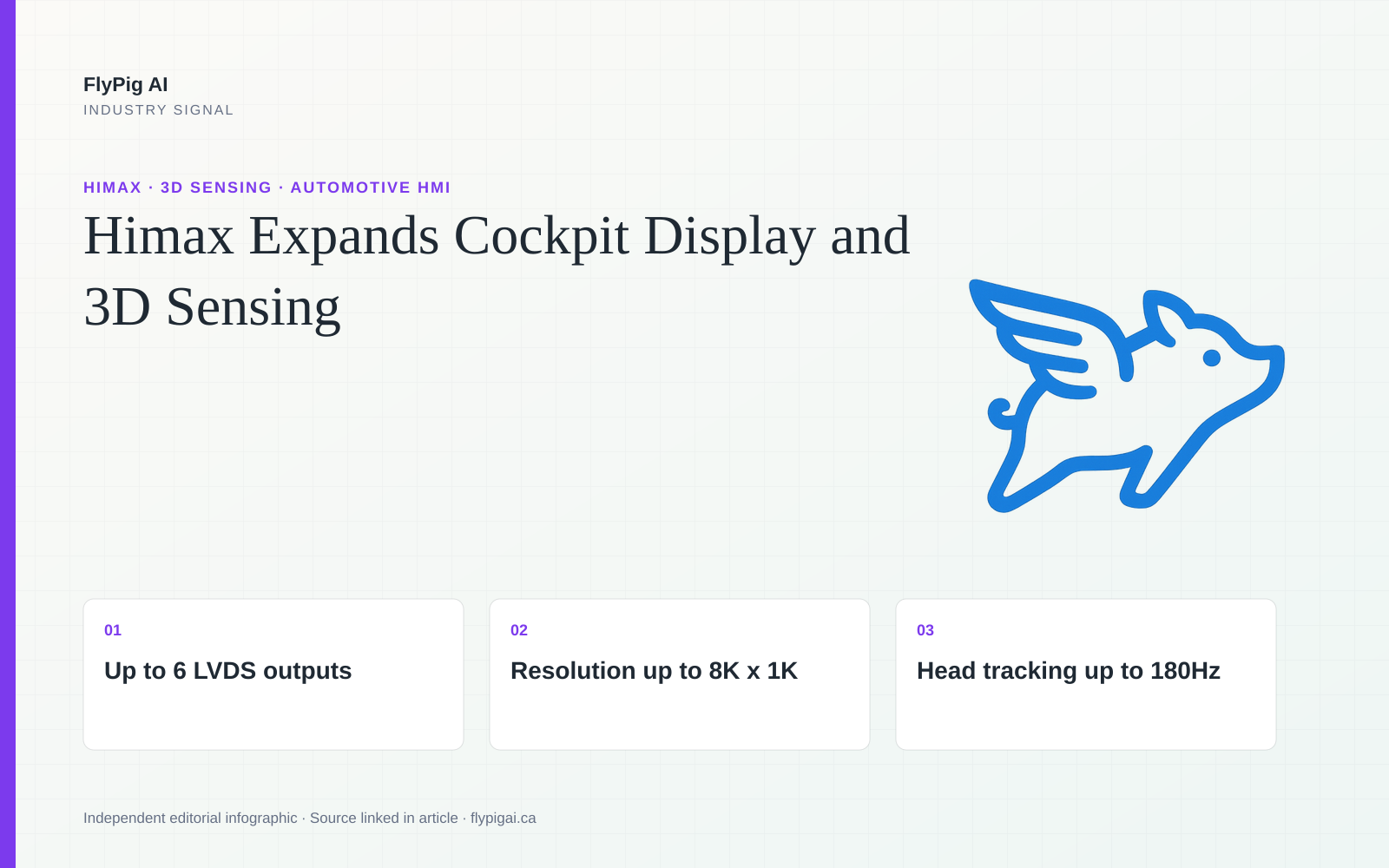
Himax says its new automotive Multi-Output Tcon accepts high-speed eDP input and supports up to six LVDS outputs with resolution up to 8K by 1K. The company also lists local dimming, edge sharpness, HDR, fail detection, CRC and on-screen display functions.
For product architects, the significance is not the headline resolution alone. A free-form or pillar-to-pillar display can require several timing, safety and signal-routing decisions across a very wide surface. Consolidating more of those functions into one Tcon may reduce controller count or simplify partitioning, but the design value depends on the exact output topology, redundancy model, startup behavior and failure containment.
The sensing side moves from presence toward interaction intent
The same SID preview describes a SLiM 3D Sensing Module with head-orientation tracking at a report rate of up to 180Hz, along with continuous 3D eye and hand tracking. Himax frames the capability as a way for an HMI system to identify which display or interaction zone a user is focused on.
That can matter in vehicle cabins, AR-adjacent displays and other spatial interfaces where the system needs context about a person's position and orientation. The 180Hz figure is a Himax specification in a pre-show announcement; FlyPig has not found an independent latency or accuracy benchmark, and the release does not disclose sensor architecture, field of view, range, host bandwidth or compute requirements.
Do not collapse a trade-show preview into product availability
The release says Himax will showcase these technologies at the September 15-16 SID Vehicle Displays and Interfaces Symposium in Detroit. As of the reviewed source, that is a demonstration commitment, not evidence of samples, production qualification or customer shipments.
Design teams should therefore separate architectural interest from sourcing readiness. The next useful evidence would be formal part numbers, controlled datasheets, SDK or API documentation, evaluation hardware, automotive qualification status and a sample-to-production timeline.
FlyPig AI interpretationHimax is building a credible bridge between the display pipeline and spatial sensing, which is exactly where many Physical AI interfaces become tangible to users. The concept is strategically interesting, but the sourcing signal is still weak. Treat the six-output Tcon and 180Hz SLiM tracking as architecture watch items until Himax exposes part numbers, interfaces, measured conditions and supply milestones.
Status, open questions and Canada relevance
Current product status
Himax announced that the Multi-Output Tcon and SLiM 3D head-orientation tracking would be demonstrated at SID Detroit on September 15-16, 2026. The reviewed source does not establish product part numbers, samples, pricing, MOQ, lead time or mass-production status for either technology. The 180Hz report rate is a vendor-stated capability.
What remains open
- What are the formal part numbers, electrical interfaces, power, output topology, safety architecture and production roadmap for the Multi-Output Tcon?
- What sensing modality, field of view, range, accuracy, end-to-end latency, host interface and SDK/API are used by the SLiM head-orientation, eye and hand tracking stack, and under what conditions is the stated 180Hz report rate achieved?
Why Canadian teams may care
The technologies are relevant to Canadian automotive HMI, simulation, AR/VR and mobility teams that need to connect spatial user sensing with wide or multi-zone displays. The near-term value is roadmap visibility rather than procurement because the source does not yet expose design-ready commercial details.