Why it matters
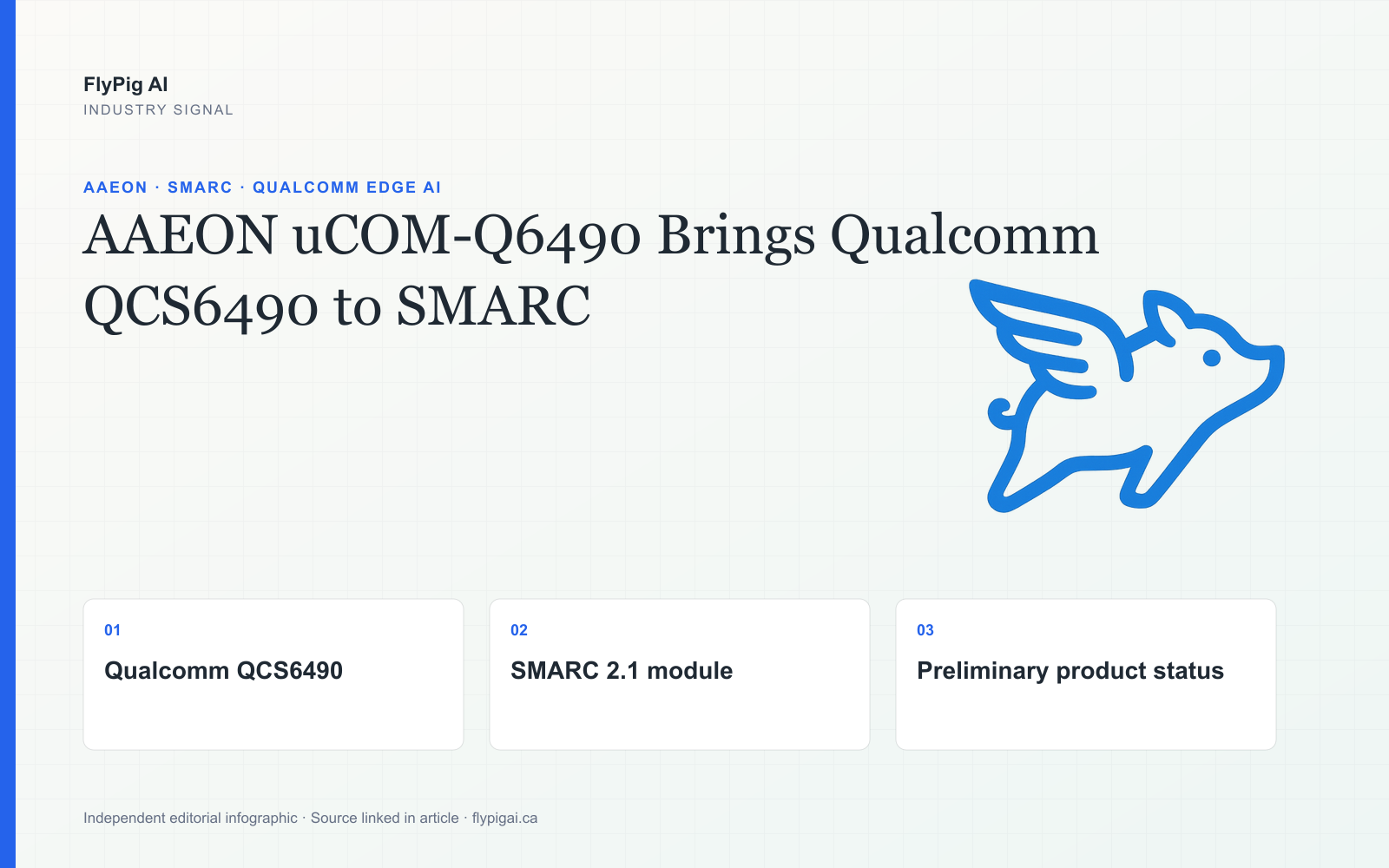
- AAEON cites an eight-core CPU up to 2.7GHz and up to 12 dense TOPS from the QCS6490 platform.
- SMARC 2.1 gives OEMs a standardized module-and-carrier architecture rather than requiring a custom QCS6490 motherboard.
- The product remains marked preliminary, so sample timing, production status, Linux roadmap, carrier options and pricing still need confirmation.
Qualcomm edge AI is becoming available through multiple Taiwan form factors
AAEON introduced uCOM-Q6490 at Embedded World 2026 as a SMARC 2.1 implementation of Qualcomm Dragonwing QCS6490. The platform combines an eight-core CPU, GPU and NPU with LPDDR5, UFS and camera/display interfaces.
That matters because North American product teams can evaluate the same SoC through different Taiwan module ecosystems rather than committing immediately to a custom Qualcomm board.
SMARC offers a different lifecycle trade-off from OSM
The module exposes MIPI-CSI, PCIe, GbE and display interfaces through a standardized carrier architecture. Compared with a solder-down OSM route, SMARC can make field replacement and platform migration easier at the cost of a larger connectorized module.
The right choice depends on enclosure size, shock requirements, carrier-board strategy and expected product lifetime.
Preliminary status should stay visible
AAEON’s public product information currently marks the module preliminary. That means FlyPig does not treat specifications as proof of immediate volume availability.
Sample timing, pricing, MOQ, thermal behaviour, carrier boards, AI SDK support and any Ubuntu roadmap are the critical follow-up items before recommending a design-in.
FlyPig AI interpretationuCOM-Q6490 gives FlyPig a useful comparison point against Advantech’s AOM-2721: same Qualcomm family, different module standard and software story. That is exactly the kind of cross-vendor trade-off a design-intelligence layer should make explicit.
Status, open questions and Canada relevance
Current product status
AAEON publicly demonstrated uCOM-Q6490 at Embedded World 2026 and now provides an official product page with configuration details. Regional availability, software support and lifecycle commitments still need confirmation.
What remains open
- Which Linux or Android images, Qualcomm AI SDK versions and carrier boards are production-supported?
- What are the sample, pricing, thermal and Canadian distribution terms for the 8GB and 16GB variants?
Why Canadian teams may care
Canadian OEMs can compare a connectorized SMARC route against solder-down QCS6490 modules when serviceability, carrier reuse and lifecycle flexibility matter.