Why it matters
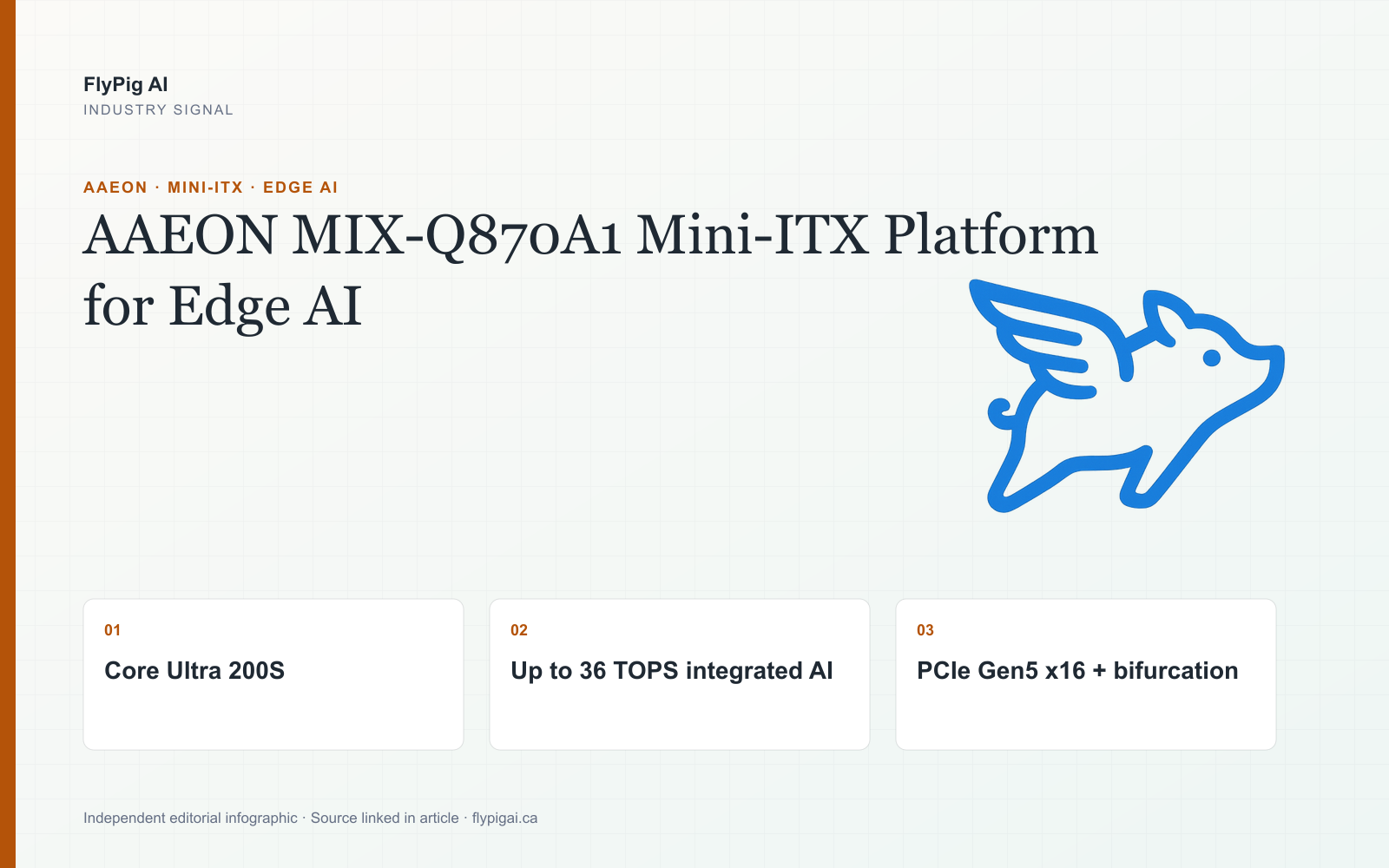
- AAEON cites up to 36 TOPS of integrated AI performance from Core Ultra 200S, combining CPU, GPU and NPU resources.
- A PCIe Gen5 x16 slot with bifurcation keeps room for discrete accelerators, storage, networking or capture hardware.
- The 65W-class platform fits fixed appliances and kiosks better than battery-powered devices, so power and enclosure assumptions matter.
Mini-ITX remains relevant when edge AI needs expansion
AAEON’s MIX-Q870A1 uses Intel Core Ultra 200S processors in a standard Mini-ITX footprint, with the company citing up to 36 TOPS of integrated AI performance.
That makes it a plausible base for AI kiosks, video analytics appliances and fixed edge systems where PCIe expansion and conventional storage are more important than ultra-low power.
PCIe Gen5 keeps the architecture open
The x16 Gen5 slot supports bifurcation, allowing designers to split lanes among accelerators, NVMe storage, network interfaces or capture cards.
The trade-off is that the board’s 65W processor class pushes the design toward mains-powered products with active thermal planning.
Integrated AI is only the starting point
Intel’s NPU and integrated graphics can cover a range of inference tasks, while the expansion slot leaves a path to heavier acceleration.
The practical design choice depends on sustained workload, thermals, software framework and the cost of any add-in card.
FlyPig AI interpretationThe MIX-Q870A1 is useful where a product needs a familiar Mini-ITX ecosystem and a lot of expansion headroom. Its strength is architectural flexibility; its weakness for smaller devices is the power and mechanical budget that comes with that flexibility.
Status, open questions and Canada relevance
Current product status
AAEON has published the MIX-Q870A1 product announcement and specifications for an industrial Mini-ITX platform. CPU choice, accelerator cards and production configuration determine the final AI capability.
What remains open
- Which Core Ultra 200S SKUs, memory configurations and PCIe accelerator combinations are validated?
- What are Canadian availability, lifecycle, thermal-design and pricing terms for production orders?
Why Canadian teams may care
The board may suit Canadian machine builders and vision-system OEMs that need desktop-class expansion in a standardized compact form factor instead of a proprietary carrier.