Why it matters
- Modular accelerators let teams add AI to an existing x86 platform instead of redesigning the entire compute board.
- Hailo and DEEPX provide different performance, memory and power trade-offs, making side-by-side tooling valuable.
- Host bandwidth, thermal design, model support and accelerator memory still need validation under the target workload.
The upgrade path is the product
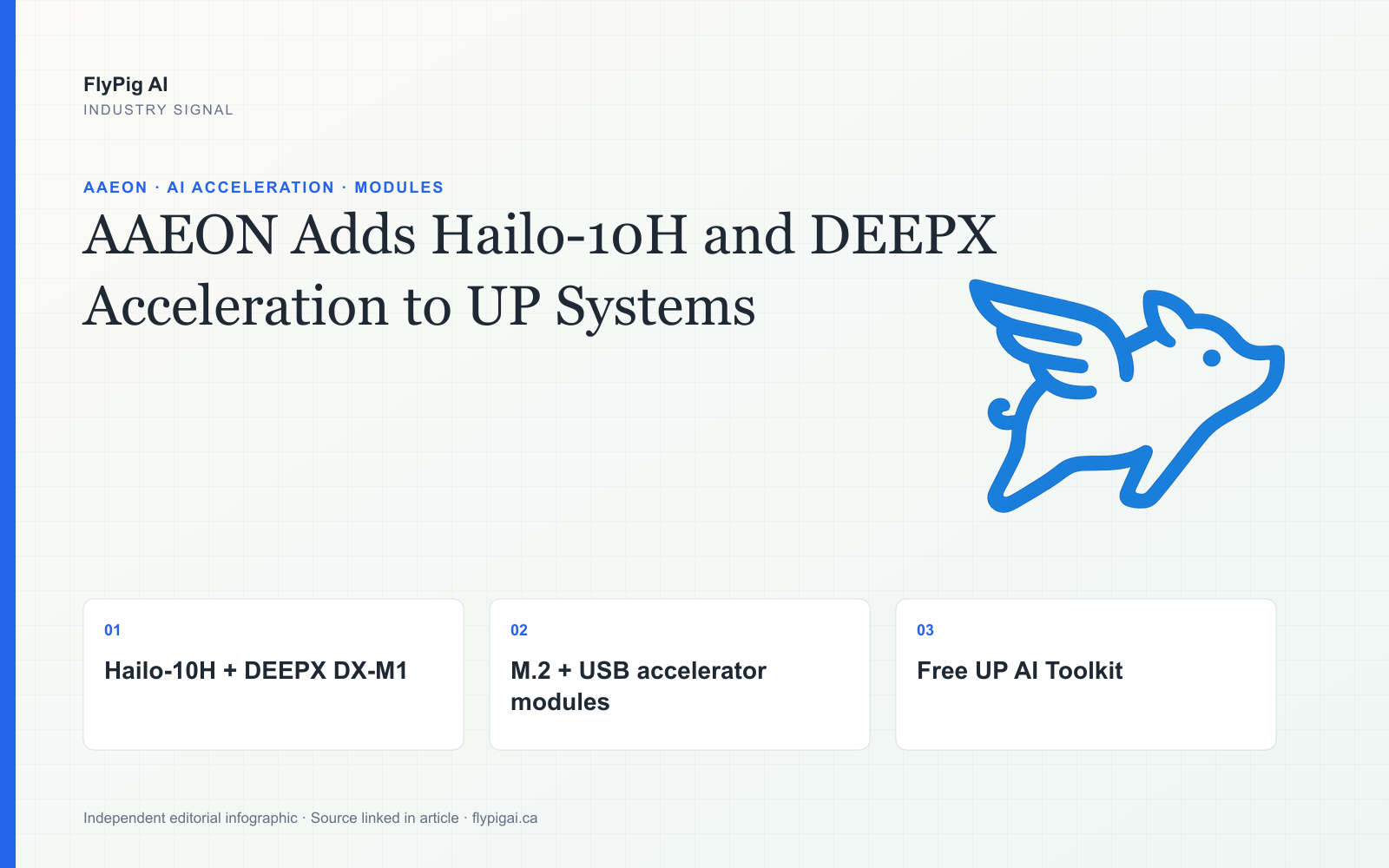
AAEON’s integration of Hailo-10H and DEEPX DX-M1 across UP platforms is notable because it treats AI acceleration as a module that can be added to an existing host architecture.
That can be attractive for teams with an x86 product already in development, since it avoids moving the operating system and application stack to an entirely different main processor.
Tooling can make heterogeneous accelerators easier to compare
The free UP AI Toolkit is positioned around runtime setup, model conversion and benchmarking. A common developer layer can reduce friction when teams are deciding whether an accelerator fits their model portfolio.
It does not remove hardware trade-offs. M.2 or USB bandwidth, memory capacity, cooling and concurrent camera pipelines still have to be tested in the final host.
This is a fast-prototype route for several edge categories
Modular acceleration is relevant to smart cameras, NVRs, retail terminals and compact AI boxes where the base system needs to remain general-purpose.
The strongest commercial signal will be module pricing, lead time and repeatable benchmark data on the UP systems customers can actually purchase.
FlyPig AI interpretationAAEON’s approach is valuable because it makes accelerator choice less coupled to the motherboard. For FlyPig, that creates a practical design route: keep the x86 host, benchmark Hailo and DEEPX against the real model, then choose based on power, memory and cost.
Status, open questions and Canada relevance
Current product status
AAEON officially announced Hailo-10H and DEEPX DX-M1 accelerator options and associated UP AI development resources. Module availability and supported host combinations vary across the UP portfolio.
What remains open
- Which host systems, module SKUs, drivers and model examples are validated together?
- What are the measured performance, power and pricing differences between the Hailo and DEEPX routes?
Why Canadian teams may care
Canadian developers can compare two accelerator ecosystems on accessible UP platforms before selecting a production compute architecture for vision or local GenAI workloads.