Why it matters
- Mini-ITX remains a useful standard form factor for fixed Edge AI systems that need more I/O, memory and thermal headroom than a module or small SBC can provide.
- Integrated CPU, GPU and NPU resources can consolidate conventional application processing and AI inference, while optional 10GbE expands the board's relevance to multi-camera aggregation and industrial vision.
- The unresolved issue is maturity: a public product page and shop link do not override AAEON's explicit Preliminary label.
What changed
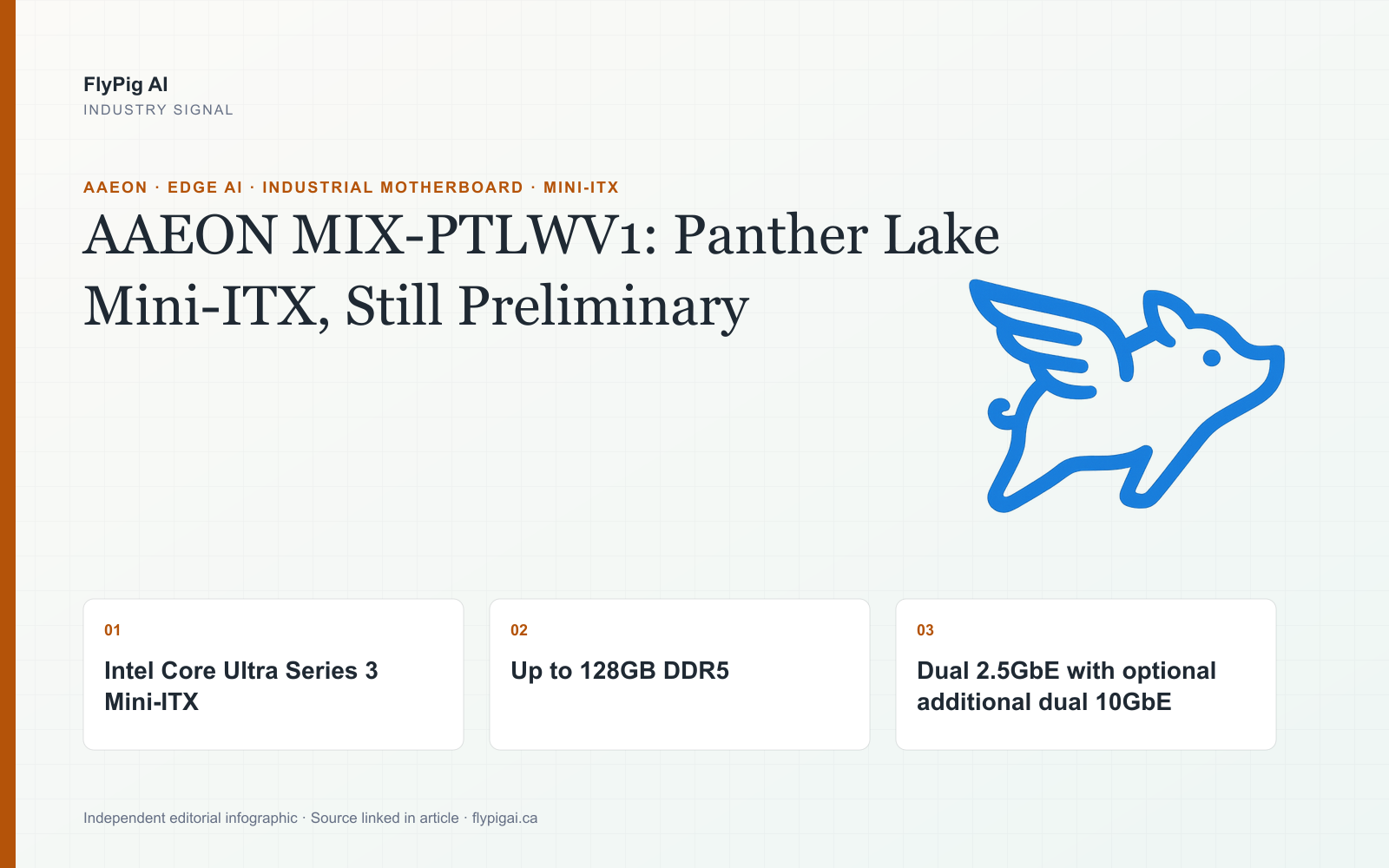
AAEON's September product update positions MIX-PTLWV1 around Intel Core Ultra Series 3 processors. The board combines the platform's CPU with integrated Intel Arc graphics and Intel AI Boost NPU 5.0 in a standard Mini-ITX format.
AAEON lists dual 2.5GbE as standard, optional additional dual 10GbE, up to 128GB DDR5 and NVMe support. Those interfaces make the board more interesting for data-heavy edge systems than a simple desktop refresh.
Where it fits
The most plausible design-ins are fixed systems such as machine-vision controllers, AI NVRs, industrial gateways and robot controllers where memory, networking and expansion matter alongside inference.
The value should be evaluated as a complete platform: thermal envelope, PCIe and M.2 topology, camera and frame-grabber compatibility, OS support, accelerator runtime and long-term industrial lifecycle can matter more than the NPU generation label.
Availability remains unresolved
AAEON's current product page explicitly labels MIX-PTLWV1 Preliminary. The same page also carries a Shop Online message that mentions three-working-day dispatch, but that generic commerce element is not sufficient evidence that this preliminary board or every configuration is stocked.
Before design freeze, teams should obtain final ordering codes, CPU support, production status, BIOS and BSP versions, thermal data, regional inventory and lead time directly from AAEON.
FlyPig AI interpretationThis is a useful Edge AI motherboard because it combines standard mechanics with higher memory and network density, but the most important word on the page is still Preliminary. Hardware teams should use the public specs to shortlist the board, not to assume a production BOM is ready.
Status, open questions and Canada relevance
Current product status
AAEON has published a product update and a detailed MIX-PTLWV1 product page, but the current official page explicitly marks the board Preliminary. A shop link is visible, yet the reviewed first-party evidence does not confirm mass production, regional inventory, pricing, MOQ or SKU-specific lead time.
What remains open
- When will AAEON remove the Preliminary designation and publish the final production CPU and ordering-code matrix?
- What are the final thermal and power envelopes for each supported Core Ultra Series 3 configuration under sustained CPU, GPU and NPU loads?
- Which camera, frame-grabber, GPU or AI accelerator cards, Linux distributions and driver/runtime versions are formally validated?
Why Canadian teams may care
Canadian machine-vision, robotics and industrial-system integrators can evaluate MIX-PTLWV1 as a compact x86 Edge AI platform, but should wait for final production documentation and local supply confirmation before locking it into a long-life BOM.