Why it matters
- The investment anchors a defined manufacturing program in Alliston rather than a general statement of interest. Retooling and employee training give Canadian industry a tangible execution milestone to follow.
- Honda describes both hybrid-electric and gasoline-powered production, including the reintroduction of engine manufacturing. This creates a different equipment and qualification context from a dedicated battery-electric assembly announcement.
- For Taiwan's industrial electronics and automation ecosystem, the relevant next step is to identify disclosed process requirements and qualified procurement routes. A funding announcement alone does not establish a request for quotations, supplier nomination or design win.
The funding announcement follows Honda's manufacturing commitment
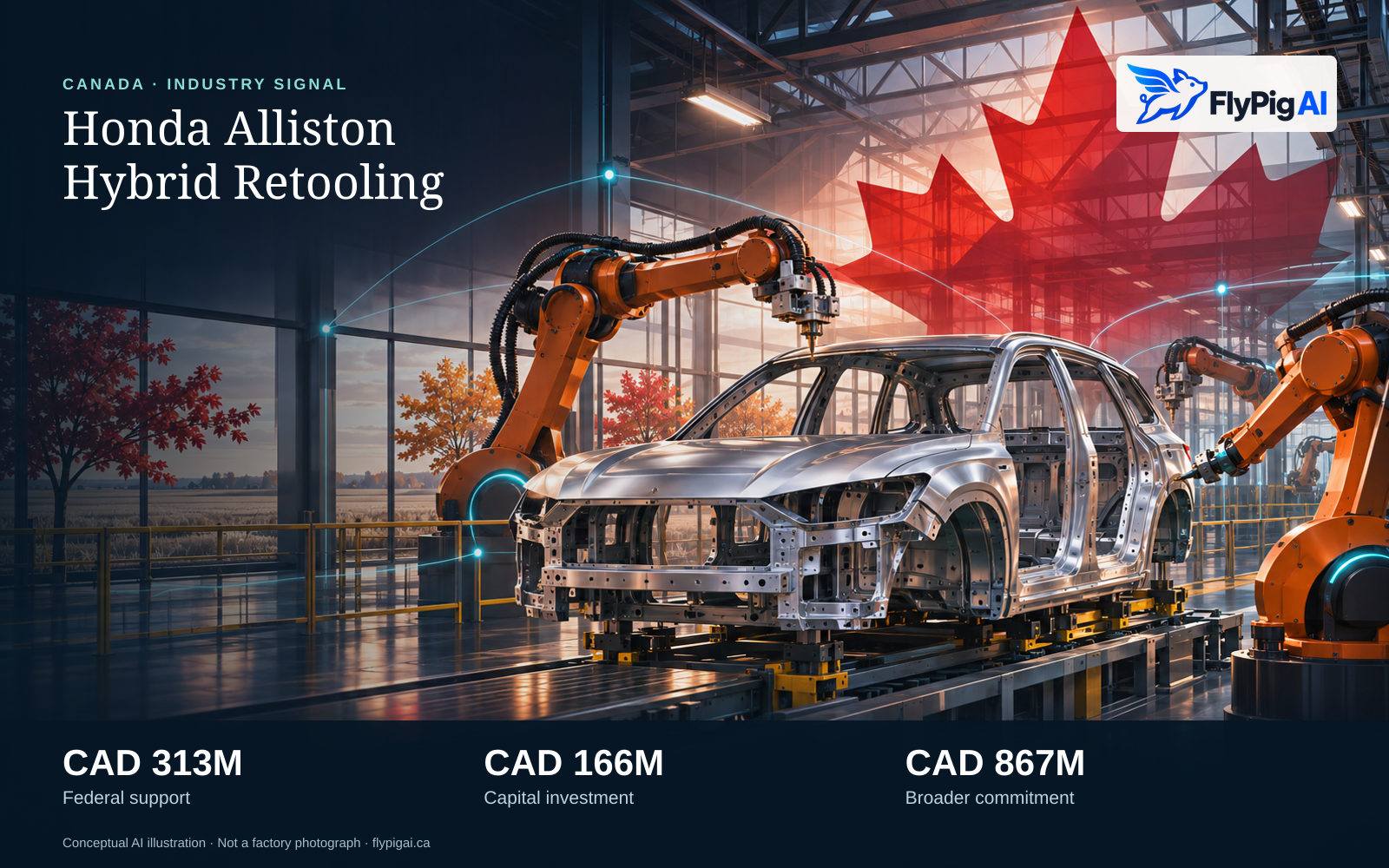
Innovation, Science and Economic Development Canada announced the federal contribution on November 13, 2026. The government links the investment to production of the next-generation Civic and CR-V, increased electrified vehicle production, manufacturing modernisation and employee upskilling. Ontario is contributing a further CAD 156 million. All amounts in this article are Canadian dollars.
Honda had outlined its manufacturing commitment on November 9. Its release places Alliston within an integrated North American network intended to expand hybrid-electric vehicle, engine and hybrid-system production. The Canadian project therefore has both a local manufacturing role and a wider regional production context. The announcement does not establish that the new equipment has been installed or that next-generation production has already started.
CAD 166 million and CAD 867 million describe different scopes
Honda identifies CAD 166 million as capital investment for upgrades and retooling at its Alliston facilities. It says this forms part of a broader CAD 867 million commitment, including future planned investments and related expenses. The federal release describes the CAD 867 million figure as Honda Canada's retooling plan. Reading both sources together is essential: the larger figure should not be presented as the immediate equipment purchase budget.
The federal and provincial contributions are disclosed support for the project. They should not simply be added to the CAD 867 million commitment to create a new project total, nor should an equipment budget or private funding balance be inferred from subtraction. The reviewed releases do not provide a complete cost breakdown, disbursement schedule or accounting reconciliation across these figures.
The employment and production figures are expectations, not delivered outcomes
The federal government expects the project to maintain more than 4,000 jobs and support production of up to 400,000 vehicles annually. Those statements concern jobs maintained and production supported. They do not mean 4,000 newly created jobs or 400,000 additional vehicles on top of existing output.
Honda already describes Alliston as a two-facility operation producing petrol and hybrid variants of the Civic and CR-V. Its November 9 release lists existing annual capacity above 400,000 vehicles. Retooling should consequently be evaluated through model allocation, process readiness, manufacturing flexibility and sustained employment, rather than treating the government's annual production figure as entirely new capacity.
Industrial electronics relevance remains a qualification question
Manufacturing upgrades can create evaluation needs in machine vision, industrial computing, sensing, control, networking and production testing. These are categories Canadian integrators and Taiwan technology suppliers can monitor. The Honda and government releases, however, do not identify a specific AI system, inspection architecture, robotics platform, bill of materials or equipment vendor. They do not establish orders for any of those categories.
For a potential supplier, a useful next signal would be a disclosed production-cell requirement, equipment integrator, qualification timetable or sourcing notice. Any proposed solution would then need to satisfy the actual process, reliability, safety, cybersecurity and service requirements. FlyPig AI treats this as capability research and a watchlist for future engineering evidence, without implying an existing Honda relationship or an open procurement opportunity.
FlyPig AI interpretationAlliston is a concrete manufacturing investment to monitor, with a clear hybrid production direction and public support. Its value as a technology demand signal will become more precise when the retooling scope, process equipment and qualification route are disclosed. For now, the strongest conclusion is that Honda is preparing its existing Canadian manufacturing base for future production. It is too early to convert that commitment into an AI deployment claim or a Taiwan supplier opportunity with a defined order value.
Status, open questions and Canada relevance
Current product status
As of the November 9 Honda announcement and November 13 federal release, investment and government support have been announced. CAD 166 million is Honda's stated capital investment within its broader CAD 867 million commitment. Completion dates, equipment commissioning, next-generation start of production, actual project-supported output, supplier awards and Taiwan sourcing are not established by the reviewed materials.
What remains open
- What are the retooling, engine-manufacturing restart and next-generation vehicle production milestones at Alliston?
- How do capital spending, future planned investments, related expenses and government contributions map to the final project cost and disbursement schedule?
- Which process equipment, integrators and qualification requirements will be disclosed, and will any public sourcing route become available?
Why Canadian teams may care
The project concerns an existing Ontario vehicle-manufacturing base, workforce retention and future production capabilities. Canadian industrial integrators can track implementation milestones, while Taiwan suppliers can research relevant automation and electronics capabilities only as potential matches pending actual requirements and sourcing evidence.