Why it matters
- As AI systems increase bandwidth density, optics is moving closer to switches and compute, creating new mechanical, electrical, thermal and serviceability tradeoffs.
- A removable optical engine can be architecturally attractive if it preserves replaceability while shortening high-speed electrical paths, but the reviewed source does not provide enough engineering detail to judge the tradeoff.
- FIT's connector and manufacturing background makes the disclosure relevant to Taiwan's optical-interconnect supply chain, but no production readiness or customer adoption should be inferred from the event presentation.
What changed
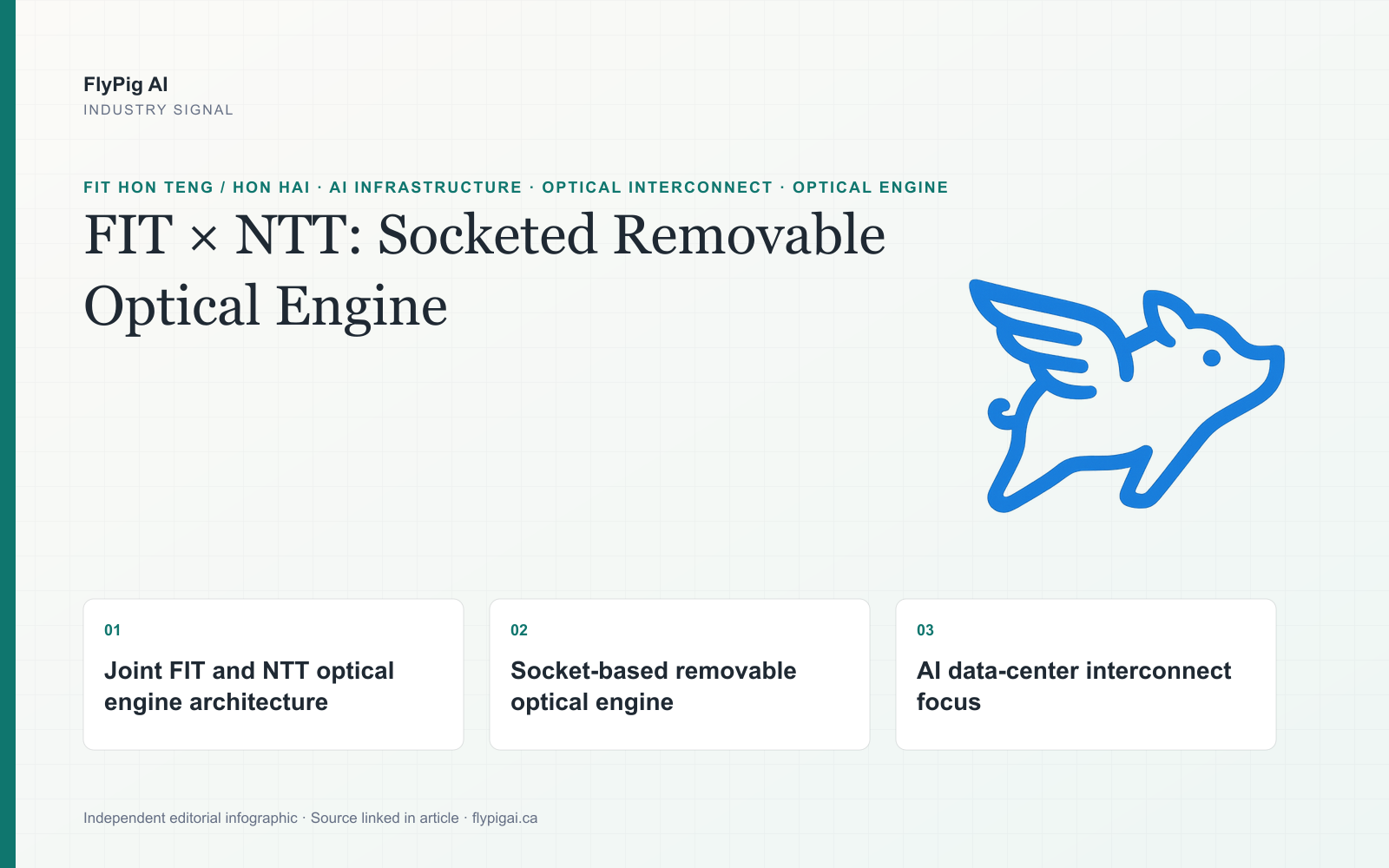
Hon Hai's September 16 FIT Tech Day report says NTT Innovative Devices' Yoshiaki Sato presented an optical engine architecture jointly developed with FIT Hon Teng. The official description specifically calls it socket-based and removable.
That is a narrower and more useful fact than the surrounding event vision. It identifies a concrete co-development direction around optical engines without establishing a finished commercial product.
Why it matters to AI hardware
Moving optics closer to switching and compute can reduce the distance that very high-speed electrical signals must travel, but it also raises questions around heat, packaging, connector integrity, serviceability and manufacturing yield.
A socketed removable approach suggests one attempt to keep optical components replaceable. Whether that is competitive with pluggable optics, near-packaged optics or co-packaged optics depends on interface details and reliability data that were not disclosed in the reviewed source.
Commercial status and design-in questions
The announcement contains no product identifier, sample date, mass-production date, price, MOQ, lead time or named design win. FlyPig therefore treats the event as an architecture disclosure and co-development milestone only.
Next-step evidence would include lane rate, electrical and optical interfaces, laser placement, thermal envelope, mechanical form factor, qualification targets, sampling status and a clear manufacturing roadmap.
FlyPig AI interpretationThe interesting signal is serviceability. AI interconnect architecture is pushing optics inward, but data-center operators still care about replaceable failure domains. A removable engine could be strategically valuable if FIT and NTT can prove signal integrity, thermals and manufacturing economics; the current disclosure is too early to say whether they have.
Status, open questions and Canada relevance
Current product status
Hon Hai reported the jointly developed removable optical engine architecture at FIT Tech Day on September 16, 2026. The reviewed first-party source does not establish a product part number, sample availability, mass-production status, pricing, MOQ, lead time or customer design win.
What remains open
- What lane rate, electrical interface, optical interface and package form factor define the removable engine?
- Where are the laser, driver, receiver and thermal interfaces located, and what reliability or service-cycle targets apply to the socket?
- When will FIT and NTT disclose samples, qualification data, production timing or any customer design-in?
Why Canadian teams may care
North American AI infrastructure and networking teams should treat the announcement as an emerging packaging and serviceability concept rather than a purchasable optical module. Its relevance rises if the partners publish interoperable interfaces and production evidence.