Why it matters
- The funding is tied directly to manufacturing equipment and a domestic pilot line, making this a physical-capacity signal rather than a software, research or hiring-only announcement.
- Optical interconnect manufacturing sits close to advanced packaging because performance depends on reliable optical coupling between fibers, lasers and photonic integrated circuits.
- Dream Photonics already publishes first-party integration capabilities, so the funded project appears to scale an existing technical direction rather than introduce an unrelated roadmap concept.
- The supply-chain opportunity remains pre-award: no equipment supplier, substrate provider, packaging house, customer program, production quantity or Taiwan partner is disclosed.
What changed: Dream Photonics is adding funded pilot-manufacturing capacity
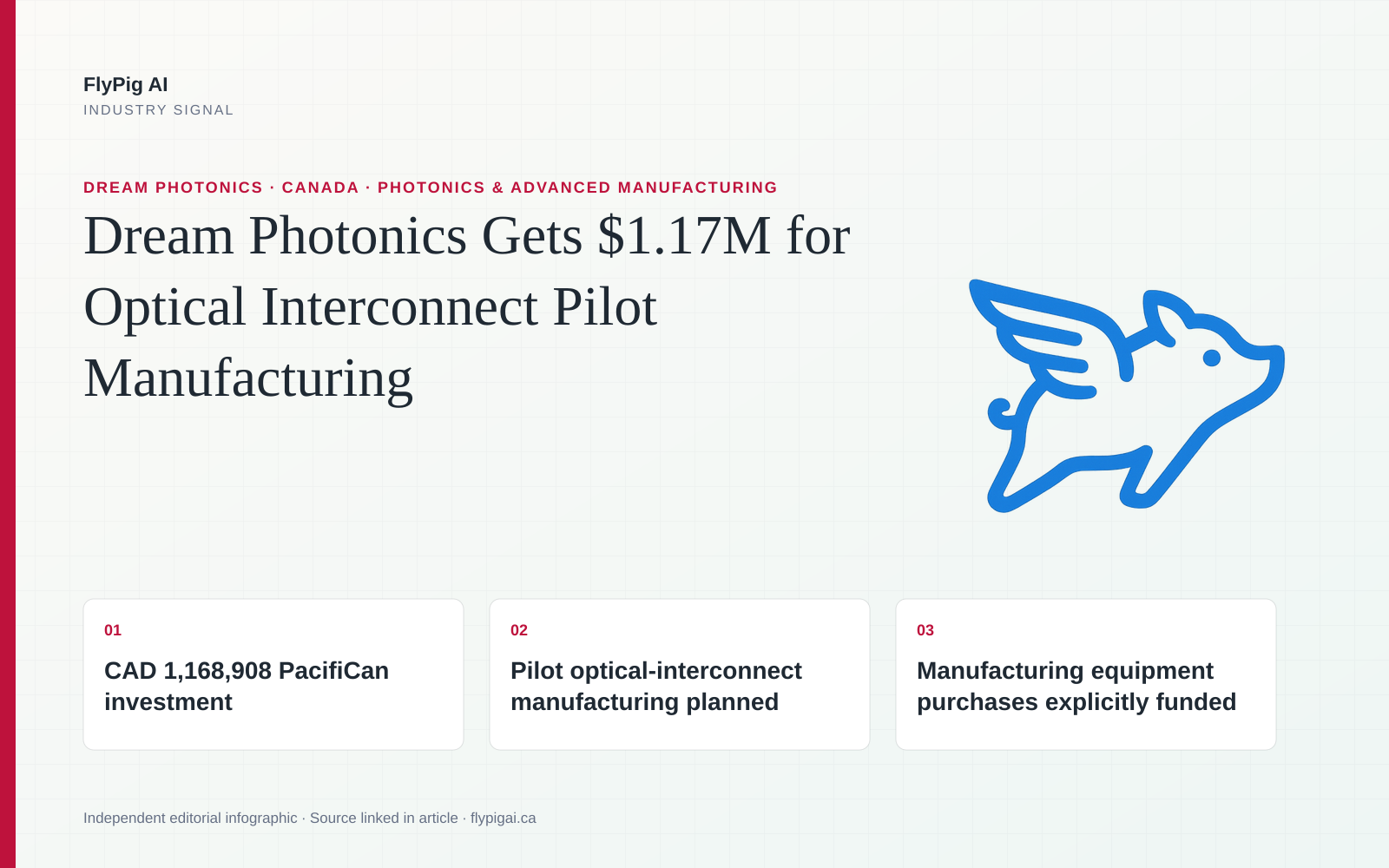
PacifiCan's May 11, 2026 announcement awards Dream Photonics CAD 1,168,908 to purchase manufacturing equipment and hire skilled workers for a domestic pilot-manufacturing capability in British Columbia. The government describes the target output as optical interconnects that enable communication between AI and quantum chips.
That changes the commercial reading of the company. A photonics firm can operate mainly as a design, prototyping or packaging-services organization; a funded pilot line adds equipment, process control, repeatability and manufacturing-readiness questions that matter directly to suppliers.
The technology sits at the optical-packaging boundary
Dream Photonics' first-party pages describe photonic wire bonding for connecting optical fibers to photonic integrated circuits and for integrating lasers with photonic chips. The company also works on process-design-kit development and chip-level integration workflows, placing its technical work between photonic design and physical packaging.
For AI and quantum hardware, that boundary matters because moving light efficiently into and out of photonic devices can become a packaging and manufacturing problem, not just a circuit-design problem. The reviewed sources support that functional role, but they do not disclose the exact architecture, materials stack, process flow or production equipment planned for the funded pilot line.
Canadian commercial context: pilot manufacturing is the bridge between prototyping and repeatable supply
PacifiCan frames the project as a way to anchor production capacity in British Columbia and strengthen Canada's quantum supply chain. The significance is less about immediate mass production than about creating a domestic stage where packaging and optical-interconnect processes can be repeated, qualified and improved before larger-scale manufacturing decisions are made.
Pilot manufacturing can also expose the practical issues that determine whether a photonic process scales: alignment tolerance, cycle time, yield, test coverage, equipment uptime, automation, material handling and customer-specific packaging flows. None of those metrics are disclosed in the funding announcement, so they remain procurement and commercialization questions rather than confirmed capabilities of the new line.
Taiwan supply-chain overlap is meaningful but still capability-level
The most relevant Taiwan capability areas are advanced packaging, substrates, optical and electrical connectors, fiber coupling, precision assembly, test, thermal management, photonics manufacturing equipment and electronics integration. Those categories align with the needs of optical-interconnect pilot manufacturing at a functional level.
The evidence does not support naming a Taiwan supplier as part of Dream Photonics' current buildout. A credible cross-border opportunity would require a disclosed tool requirement, substrate specification, packaging partner, test interface, production target, RFQ or supplier-qualification window. Until then, Taiwan relevance should be treated as a sourcing hypothesis to validate rather than a design win.
What to watch next
The next high-value signals are equipment purchase or installation disclosures, pilot-line commissioning, named packaging or foundry partners, customer qualification programs, process-yield milestones, production-capacity figures, standard package offerings or repeat commercial orders. Those events would show whether the funded line is moving from capacity creation into repeatable commercial manufacturing.
For suppliers, unresolved questions include substrate and package formats, fiber-count and connector requirements, laser-integration flows, optical and electrical test coverage, thermal constraints, automation level, acceptable alignment tolerances, expected annual volumes and whether Dream Photonics intends to manufacture complete interconnect assemblies or provide selected process steps as a service.
FlyPig AI interpretationDream Photonics is a stronger Industry Signal than a typical photonics funding story because the public money is explicitly tied to equipment purchases and pilot manufacturing. That puts packaging, process equipment and test closer to the commercial centre of the story. The Taiwan opportunity is plausible but not yet transactional: the right trigger is a tool, package, substrate, test or partner disclosure that reveals where the pilot line depends on external supply.
Status, open questions and Canada relevance
Current product status
PacifiCan announced CAD 1,168,908 for Dream Photonics on May 11, 2026 to support equipment purchases, hiring and establishment of domestic pilot manufacturing for optical interconnects. Dream Photonics currently offers photonic wire-bonding integration capabilities and related photonics services. The reviewed sources do not confirm full commissioning of the funded pilot line, mass-production status, installed capacity, equipment vendors, production yields, customer orders, pricing, MOQ, lead time or Taiwan sourcing relationships.
What remains open
- Which manufacturing tools and process steps are being added under the PacifiCan-funded pilot line, and when will installation and commissioning be complete?
- What package, substrate, fiber, laser, connector and test specifications define the first pilot-manufacturing offerings?
- Will Dream Photonics disclose named foundry, packaging, equipment or customer-qualification partners as the pilot line comes online?
- What production volume, yield, cycle-time and automation targets separate the pilot capability from the company's existing integration services?
Why Canadian teams may care
Dream Photonics is based in Vancouver, British Columbia. PacifiCan's investment is specifically intended to establish domestic pilot manufacturing for optical interconnects and anchor photonics production capacity in B.C., making the project relevant to Canada's AI-hardware, quantum and semiconductor-manufacturing ecosystem.