Why it matters
- This is a buyer-defined engineering problem rather than a general innovation announcement: Canada has exposed the performance envelope and major subsystem classes it wants industry to integrate.
- Cold-weather operation, icing, endurance and day/night recognition force design trade-offs across sensors, edge compute, radios, batteries, thermal management and ruggedization.
- The challenge requests OEM, model and country-of-origin information for critical components including the radio, ground-control station, onboard computer and software, making provenance part of the design decision.
- The Canadian-SME eligibility rules mean a foreign component maker is more likely to participate through a Canadian prime or integrator than as the direct applicant.
- The opportunity is still prototype-stage. Commercial value depends on whether successful systems later transition into Army validation, production and procurement.
What changed
Canada has moved an Arctic reconnaissance requirement into a funded Phase 2 prototype competition. The Canadian Army says it currently lacks an uncrewed aircraft system that can perform intelligence, surveillance and reconnaissance in Arctic conditions, and the MINERVA challenge asks industry for a domestically produced system that can be operated and maintained in that environment.
The call is unusually concrete for an early procurement signal. It specifies an integrated system rather than a standalone airframe: air vehicle, sensor payload, ground-control station, radio, battery and charger, and a remote antenna are all mandatory elements.
The engineering envelope is the signal
The minimum operating range runs from -40 C to +40 C, with winds up to 55 km/h plus light precipitation and moderate icing. The aircraft must deliver at least a 20 km operational radius and 90 minutes of endurance in continuous movement, fit within a 240-litre container, stay at or below 25 kg maximum takeoff weight and support day-and-night target recognition at specified distances.
Those requirements make the opportunity relevant to more than drone-airframe companies. The design problem touches imaging, thermal management, low-temperature battery behavior, power conversion, rugged embedded computing, resilient communications, antennas, navigation and operator-control hardware.
Prototype funding, not a production order
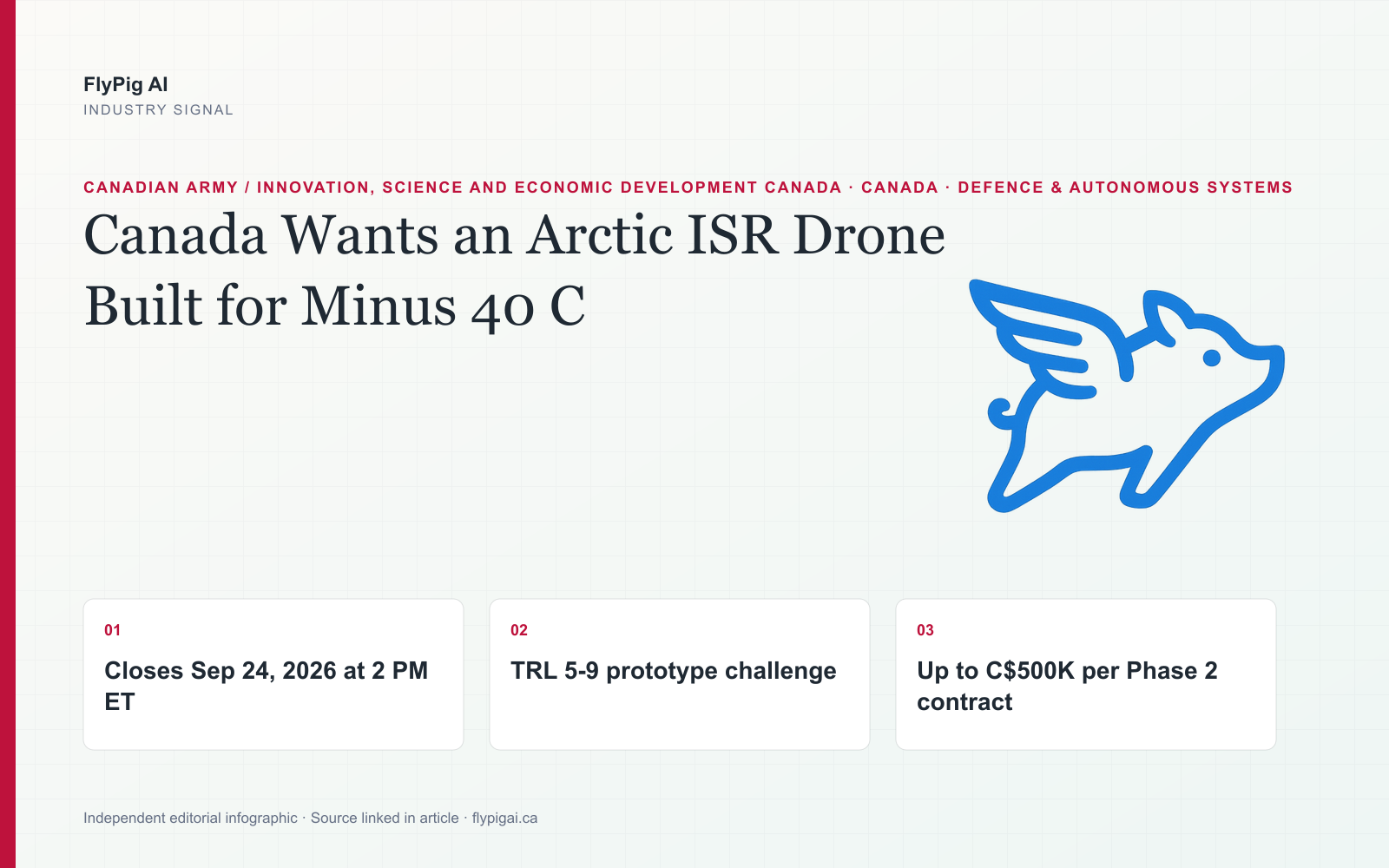
The challenge is open only for Phase 2 prototype development and requires evidence that the proposed solution is already between TRL 5 and TRL 9. Canada lists a maximum of C$500,000 per Phase 2 contract, a project duration of up to 15 months and an estimated five contracts.
That estimate should not be treated as an awarded program value. The official notice says Canada is not committing to the total approximate funding and may change the number of awards, make partial awards or negotiate scope. Likewise, the additional target of an aggregated projected production cost of C$60,000 or less per system is a design objective, not a market price or purchase commitment.
Supply-chain provenance is part of the architecture
One of the scored additional outcomes asks bidders to demonstrate the ability to source critical components from NATO members, NATO partners or Major Non-NATO Allies. The requested attachment identifies the radio, ground-control station, onboard computer and software, and asks for OEM, product, model, URL and country-of-origin information.
That requirement changes how component vendors should read the opportunity. A technically suitable module may still face sourcing, security and provenance constraints. The challenge does not establish that any particular foreign-origin component is eligible, and it does not name a preferred electronics supplier.
Where Taiwan could intersect
For Taiwan's hardware ecosystem, the plausible overlap is at the subsystem level: camera and optics modules, inertial sensing, rugged embedded compute, RF and wireless connectivity, battery-management and power electronics, antennas, board integration and contract manufacturing all map to component classes exposed by the Canadian requirement.
The official material does not identify a Taiwan supplier, RFQ, design win or approved-vendor relationship. The practical route would therefore be through an eligible Canadian SME or integrator that can prove the complete system meets performance, Canadian-program and component-origin requirements. Country-of-origin treatment should be verified before any supplier treats the challenge as an addressable design-in.
What procurement teams still need to know
The open questions are less about whether Canada wants Arctic drones and more about how prototype winners could transition into operational procurement. Suppliers still need clarity on qualification methods for cold soak, icing, battery performance and communications; what security or assurance requirements will apply to radios and onboard compute; and how the domestic-production objective will be evaluated when subsystems are imported.
The challenge also leaves future quantity, production schedule, sustainment volumes and post-prototype acquisition pathways unresolved. None of those should be inferred from the Phase 2 contract ceiling.
FlyPig AI interpretationThe most important part of this signal is not the C$500,000 ceiling. It is that the Canadian Army has published a system-level Arctic requirement with a visible subsystem map and provenance scoring. That turns MINERVA into an early design-in radar for cameras, compute, communications and power. For Taiwan suppliers, the opportunity is real only if a Canadian prime can clear origin, security and cold-weather qualification gates; capability overlap by itself is not a commercial win.
Status, open questions and Canada relevance
Current product status
Open Phase 2 prototype-development challenge as of September 23, 2026. Applications close September 24, 2026 at 2:00 p.m. Eastern time. Proposed solutions must be TRL 5-9. Maximum funding is C$500,000 per Phase 2 contract for up to 15 months, with five contracts estimated but not guaranteed. No production award, fleet quantity, mass-production schedule or supplier award is disclosed.
What remains open
- How will Canada interpret the domestically produced requirement when a Canadian prime integrates imported electronic subsystems?
- How will the scored allied-source outcome affect the eligibility or competitiveness of Taiwan-origin radios, onboard computers and other electronics?
- What environmental qualification evidence will Canada require for cold-soak, icing, battery endurance, optics and RF performance?
- What cybersecurity, software-assurance and supply-chain-security requirements will apply to radios, GCS hardware and onboard compute?
- What criteria would move a successful Phase 2 prototype into later Army trials, production qualification or procurement?
- What production volumes, sustainment requirements and delivery timelines could follow if a system transitions beyond the prototype stage?
Why Canadian teams may care
MINERVA is a Canadian Army modernization path aimed at developing and testing general-purpose uncrewed systems through Canadian industry. The Arctic UAS challenge converts that policy direction into a concrete Canadian-SME prototype contract with explicit cold-weather, sensing, endurance, control and supply-chain requirements.