Why it matters
- The program provides a structured government validation environment for counter-drone systems rather than another conference demonstration. Selected teams can test against DND targets and scenarios while receiving feedback from defence, policing and allied-security users.
- The call spans radar, acoustic, RF and optical detection and highlights interest in beyond-visual-line-of-sight capabilities and low-cost sensor networks. That creates a technically broad entry point for sensing, embedded compute, communications and system-integration suppliers.
- International applicants are eligible, but Canadian content and research-security requirements affect selection. This makes cross-border participation possible without making the market frictionless.
- DND explicitly separates Sandbox testing from future procurement. The useful signal is access to validation, end-user feedback and future capability planning, not an implied order.
What changed: Ottawa opened an urban CUAS validation window for 2027
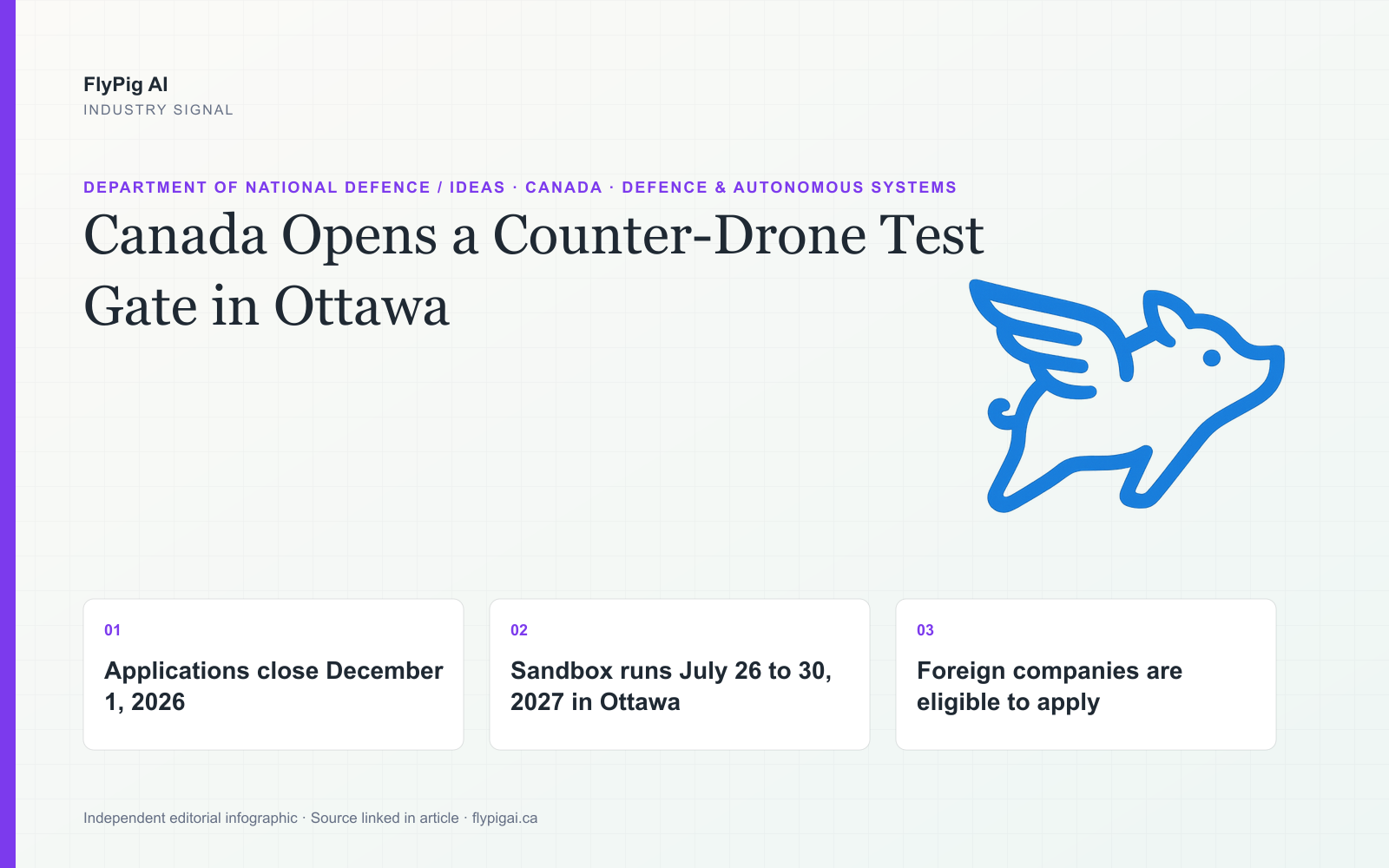
Canada's IDEaS program has opened a Call for Applications for its 2027 urban Counter Uncrewed Aerial Systems Sandbox. The event is scheduled for July 26 to 30, 2027 in Ottawa, with applications due December 1, 2026 at 2:00 PM EDT.
The technical objective is narrower than a general drone showcase. DND wants systems that can detect, track and identify micro and mini UAS in an urban environment, with potential integration into broader command-and-control systems. The official challenge identifies radar, acoustic, RF-signal and optical detection as established methods and says priority may be given to beyond-visual-line-of-sight capabilities and low-cost sensor networks based on demonstrated performance.
The maturity gate is meaningful, but it is not production qualification
Applicants must arrive with technology that is mature enough for near-end-state demonstrations in a simulated operational environment. At the time of application, a solution must have completed TRL 5 validation, or have completed TRL 4 and present a reasonable plan to reach TRL 5 before March 10, 2027.
That threshold makes the Sandbox more commercially relevant than an early-stage research call, but it should not be confused with production readiness. The official page is explicit that the evaluation criteria apply to Sandbox selection and are not final operational requirements for a current or future DND or CAF procurement program.
Why international suppliers should pay attention
Foreign companies are explicitly eligible to apply. For an international counter-drone developer, that creates a relatively direct route into a Canadian test environment with DND and CAF personnel, the RCMP and allied security representatives present to observe demonstrations and provide feedback.
There are still material Canadian-market gates. Canadian content is considered during strategic selection, selected companies are subject to research-security validation, and RF-emitting systems need spectrum-supportability documentation. Participants using controlled goods may also face registration, exclusion or exemption requirements. The route is open, but it is not a bypass around Canadian security and industrial-policy constraints.
Commercial context: validation can influence future acquisition, but there is no order attached
The strongest business value of the Sandbox is the combination of structured testing and direct user observation. DND says the results will inform force development, capability planning, procurement considerations and innovation priorities. Selected participants can also receive up to CAD 20,000 to offset attendance costs.
The line that matters most for procurement teams is the disclaimer: participation, including a successful demonstration, does not commit DND, CAF, RCMP or other partners to future funding, procurement or engagement. The CAD 1.75 million Diamond in the Rough prize pool is also separate from procurement and carries additional eligibility conditions. Prize recipients must be incorporated and validly existing in Canada before the Sandbox begins and must own the overall solution IP.
Taiwan intersection: the best fit is inside a complete CUAS solution
The challenge maps naturally to several areas of Taiwan's electronics supply base. Optical detection can draw on compact cameras, imaging modules and optics; distributed sensor networks need edge compute and connectivity; RF and multi-sensor systems need robust processing, networking, power and integration. Existing Taiwan capability references include Primax and Chicony in imaging, Advantech and AAEON in embedded edge compute, and WNC and AzureWave in communications.
Those names are capability examples, not disclosed suppliers to the Sandbox. DND is asking for complete, demonstrable CUAS solutions, not a catalogue of components. A Taiwan vendor therefore needs an integrator path: either support an applicant that owns the system architecture or participate in a team able to demonstrate a full solution under Canadian research-security, spectrum and industrial-benefit conditions.
What design-in and procurement teams still need to resolve
The public call establishes a validation funnel, but it does not publish a common bill of materials or a future acquisition specification. Suppliers still need to know the accepted sensor architectures, interface and timing requirements, C2 integration details, urban-clutter performance thresholds, environmental and ruggedization requirements, component-origin constraints and the extent to which imported subsystems can qualify as Canadian content after local integration.
The next commercially significant milestones will be the selected participant list, any disclosed platform or subsystem partners, Sandbox results, subsequent funded development, and a transition into a formal acquisition or procurement program. Until those appear, a cross-border match should be treated as a validation and partnership opportunity rather than a purchase order.
FlyPig AI interpretationThe 2027 Urban CUAS Sandbox is a useful entry point because Canada is allowing international teams into a defence-relevant validation environment before a formal procurement requirement exists. For Taiwan suppliers, the opportunity is not to pitch standalone components to DND. It is to get inside a credible Canadian or allied CUAS system early enough that cameras, edge compute, RF modules and integration hardware can be proven under the same conditions that may shape later acquisition decisions.
Status, open questions and Canada relevance
Current product status
The Call for Applications is open. Applications are due December 1, 2026 at 2:00 PM EDT, and the Sandbox is scheduled for July 26 to 30, 2027 in Ottawa. Foreign companies may apply. Technologies must have completed TRL 5 at application or completed TRL 4 with a reasonable plan to reach TRL 5 by March 10, 2027. Selection to participate is not a procurement award, supplier contract, production qualification or commitment to future acquisition. Up to CAD 20,000 per selected company may be available to offset participation costs, while the separate CAD 1.75 million Diamond in the Rough prize program has additional eligibility requirements.
What remains open
- Which companies and sensor architectures will DND select for the 2027 urban Sandbox, and will the participant list identify subsystem or integration partners?
- What C2 interfaces, latency targets, range, urban-clutter metrics, electromagnetic-environment requirements and ruggedization thresholds will matter most during testing?
- How will Canadian-content scoring apply to solutions that use Taiwan-origin cameras, compute, RF modules or other imported electronics but are integrated in Canada?
- Will promising Sandbox results lead to funded follow-on development, a new procurement requirement or integration into an existing DND or CAF counter-UAS program?
Why Canadian teams may care
This is a direct Canadian defence-innovation and validation signal. The program places CUAS developers in an Ottawa urban test environment with DND and CAF users, the RCMP and allied-security representatives, while explicitly linking observations to future force development, capability planning and procurement considerations. It is also unusually relevant to cross-border market entry because foreign companies may apply. The commercial value is access to validation and potential future acquisition influence; no procurement commitment, production volume or supplier award currently exists.