Why it matters
- The proposal links industrial innovation and commercialisation to a multi-year funding horizon. That can inform project planning, but it should not be treated as a near-term sales pipeline or a committed equipment budget.
- AI, defence and aerospace appear alongside other sectors in the minister's update. A list of priorities does not establish individual sector allocations, preferred technologies or an approved supplier list.
- The earlier Honda and Hitachi Energy articles concern named manufacturing projects. This policy update concerns future program capacity. Reading them together is useful only if their different dates, funding scopes and implementation stages remain clear.
The six-year proposal begins in 2028–29
On November 13, 2026, Innovation, Science and Economic Development Canada published a summary of industrial measures highlighted by Minister Mélanie Joly during a visit to Martinrea in Ontario. The release identifies an expanded Strategic Response Fund and describes support for innovation, capital investment and R&D across several strategic sectors. It is a policy update on the budget, not a new announcement that each listed sector has received a funding award.
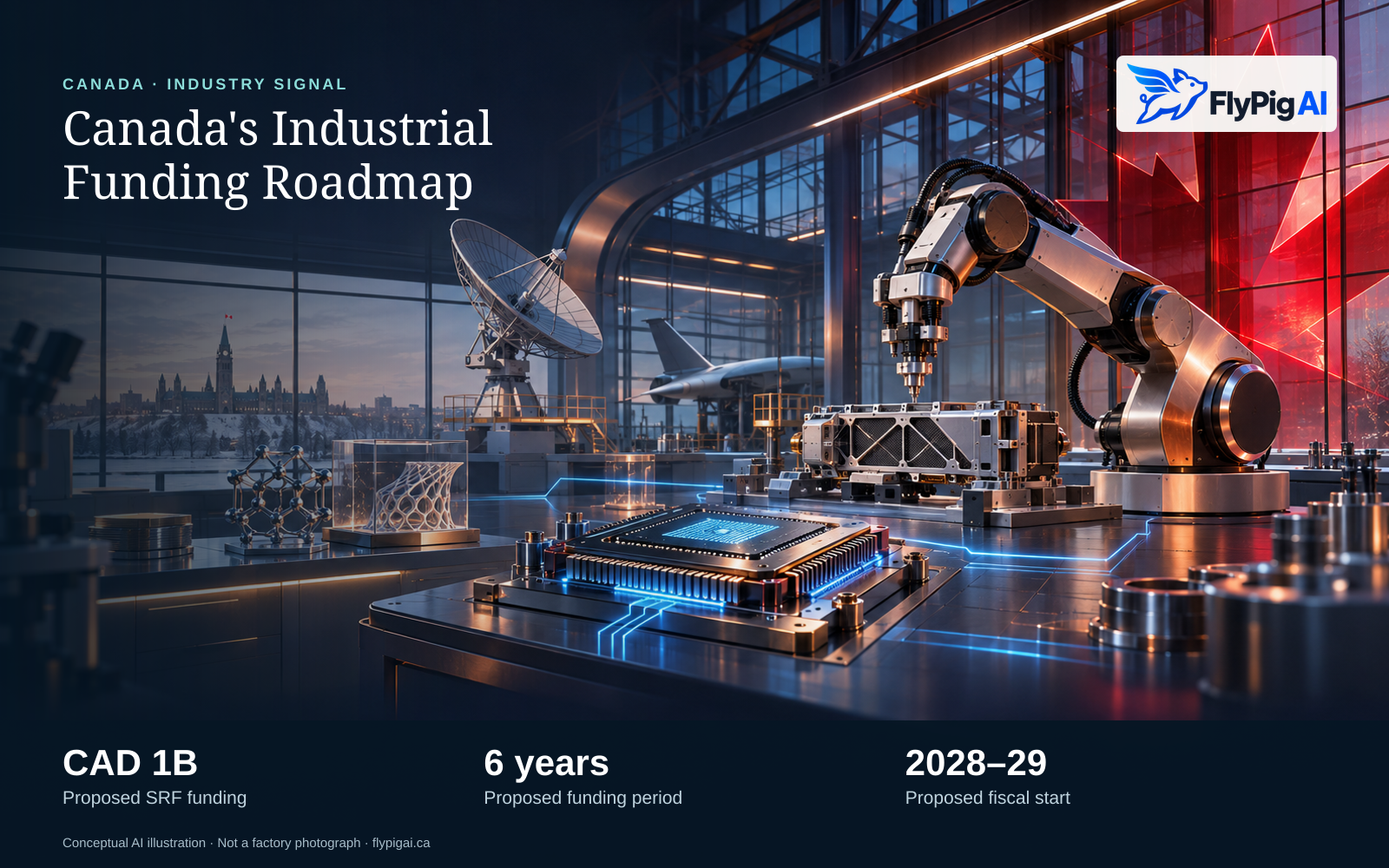
Chapter 1 of Budget 2026 provides the critical timing detail: it proposes CAD 1 billion over six years, starting in 2028–29, for large-scale research and development and innovation projects through the Strategic Response Fund. The amount covers a six-year period; it is not an annual CAD 1 billion commitment. The start is a fiscal year, not a promise that applications or payments begin on January 1, 2028.
The budget uses proposal language. The reviewed materials do not establish a new application round, recipient list, sector-by-sector allocation or disbursement schedule for this envelope. Parliamentary authorisation, program implementation and project-level decisions need to be checked separately before a business treats the proposal as accessible financing. All amounts discussed here are Canadian dollars.
A broad sector list does not define a hardware shopping list
The minister's update names AI, agri-food, defence and aerospace, biomanufacturing and clean technologies. The budget's R&D discussion similarly frames the fund as support for large, risky innovation projects and commercialisation. The signal is a desire to build industrial capability across several markets. The sources do not say how much of the proposed CAD 1 billion would go to any one sector or company.
For FlyPig AI's Canada–Taiwan technology research, this creates a set of application areas to investigate rather than a catalogue of funded components. Industrial computing, sensing, machine vision, communications, power management and manufacturing services may fit particular projects. Their relevance depends on the eventual workload, architecture, qualification needs and integration responsibilities. The policy announcement alone does not establish demand for a specific chip, board, robot or server.
Defence and aerospace also require project-specific qualification and sourcing checks. Inclusion in a policy priority list does not by itself establish a foreign supplier's eligibility, an open procurement path or acceptance of a component's origin. Those questions become actionable only when actual program rules and project requirements are available.
Construction capacity has a separate purpose and funding description
The November 13 release also discusses industrial capacity for modern methods of construction. Chapter 3 of the budget separately proposes CAD 300 million over three years, starting in 2028–29, and CAD 200 million in future years through the Strategic Response Fund for this purpose. It connects industrial capacity with faster adoption of modern construction methods and lower construction costs.
This should not be merged with the general R&D proposal and described as one unrestricted AI funding pool. The construction measure has its own stated purpose and time horizon; the reviewed wording does not supply a project list or equipment procurement schedule. Factory-based building methods could be relevant to automation, inspection and process-control research, but that is an application hypothesis, not a disclosed order for those technologies.
Named projects and future funding are different stages of evidence
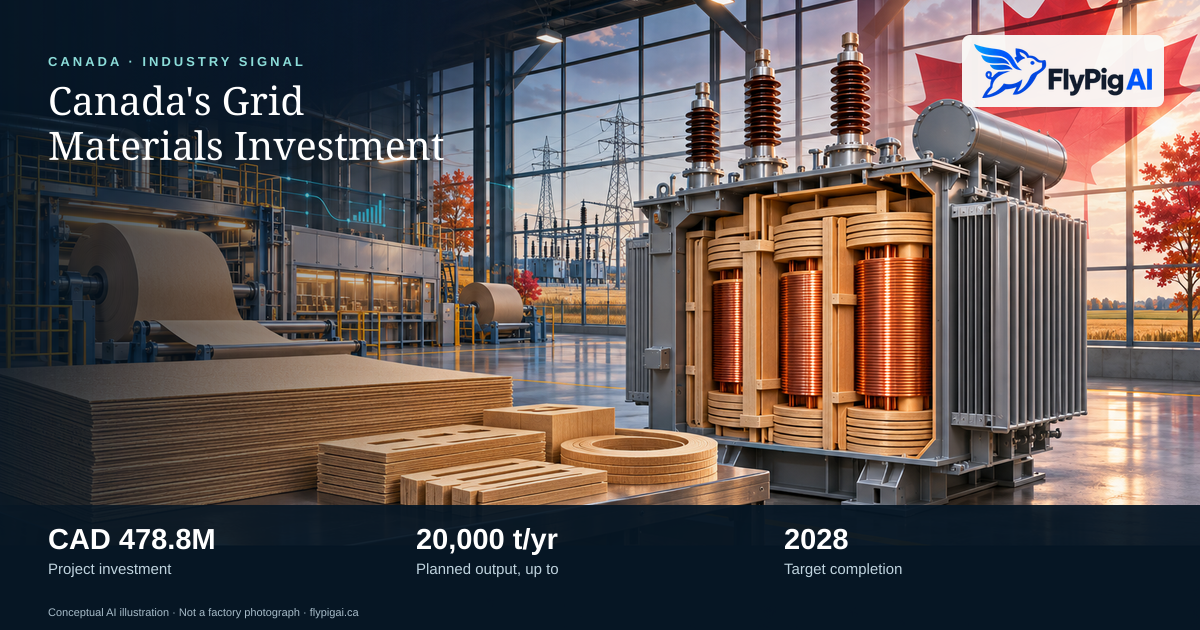
The first two articles in this series examined Honda's Alliston retooling and Hitachi Energy's London transformer-insulation project. Their official releases name a location, a project and specific public support. They illustrate how a general industrial policy can become a concrete manufacturing program, while still leaving equipment suppliers and commissioning details open.
Those earlier announcements must not be reassigned to the proposed six-year budget envelope beginning in 2028–29. The reviewed sources do not establish that this future proposal funds those previously announced projects. Combining headline figures across the series would therefore create an unsupported total and blur the distinction between project support and program expansion.
A practical evidence sequence for suppliers is to follow published program terms, then named projects, then technical specifications and qualification routes, and finally actual procurement or supplier decisions. At each step, the question changes: whether funding can be pursued, what will be built, which capabilities are needed, and who is authorised to buy them. Keeping those steps separate makes the research more useful than treating a national budget as a list of sales leads.
FlyPig AI interpretationThe strongest signal is the relationship between industrial priorities and a longer investment horizon. Canada's budget points toward support for large R&D and commercialisation projects, while the 2028–29 start limits what can be inferred about immediate access. Canadian teams can use the direction to organise project evidence and monitor implementation. Taiwan suppliers can map relevant capabilities and qualification questions, then wait for project-level requirements before claiming an opportunity. Policy attention is a reason to investigate, not proof of procurement.
Status, open questions and Canada relevance
Current product status
The November 13 ISED update highlights Budget 2026 measures. Chapter 1 proposes CAD 1 billion over six years beginning in fiscal 2028–29; Chapter 3 describes a separate construction-capacity measure. The reviewed sources do not establish an open application round, recipient awards, sector allocations or a hardware procurement schedule for these proposed envelopes. Existing project announcements are assessed separately.
What remains open
- How will the proposed funding be authorised, implemented and distributed across fiscal years and supported activities?
- What applicant eligibility, cost-sharing, intellectual-property and commercialisation requirements will apply?
- Which named projects will emerge, and what architecture, qualification and procurement requirements will they disclose?
- How will the general R&D proposal be administered alongside the separately described construction-capacity measure?
Why Canadian teams may care
Canadian industrial innovators and project developers can track how the proposed funding horizon relates to their R&D and commercialisation plans. For Canada–Taiwan technology work, the opportunity is to build evidence about application fit, capability and qualification before a named project creates a real sourcing path; no direct access to funding or supplier award is assumed.