Why it matters
- Heterogeneous fleets are becoming normal in Edge AI, and software portability can matter more than the peak TOPS of any one processor once a product family spans several compute tiers.
- Containerized AI resources and common fleet APIs can reduce repeated BSP, runtime and deployment work when teams move models across x86, Qualcomm and other edge platforms.
- Security capabilities such as Secure Boot, TPM, filesystem integrity and SBOM generation are relevant to commercial deployment, but Advantech frames them as tools to help address requirements rather than a blanket compliance certification.
What changed
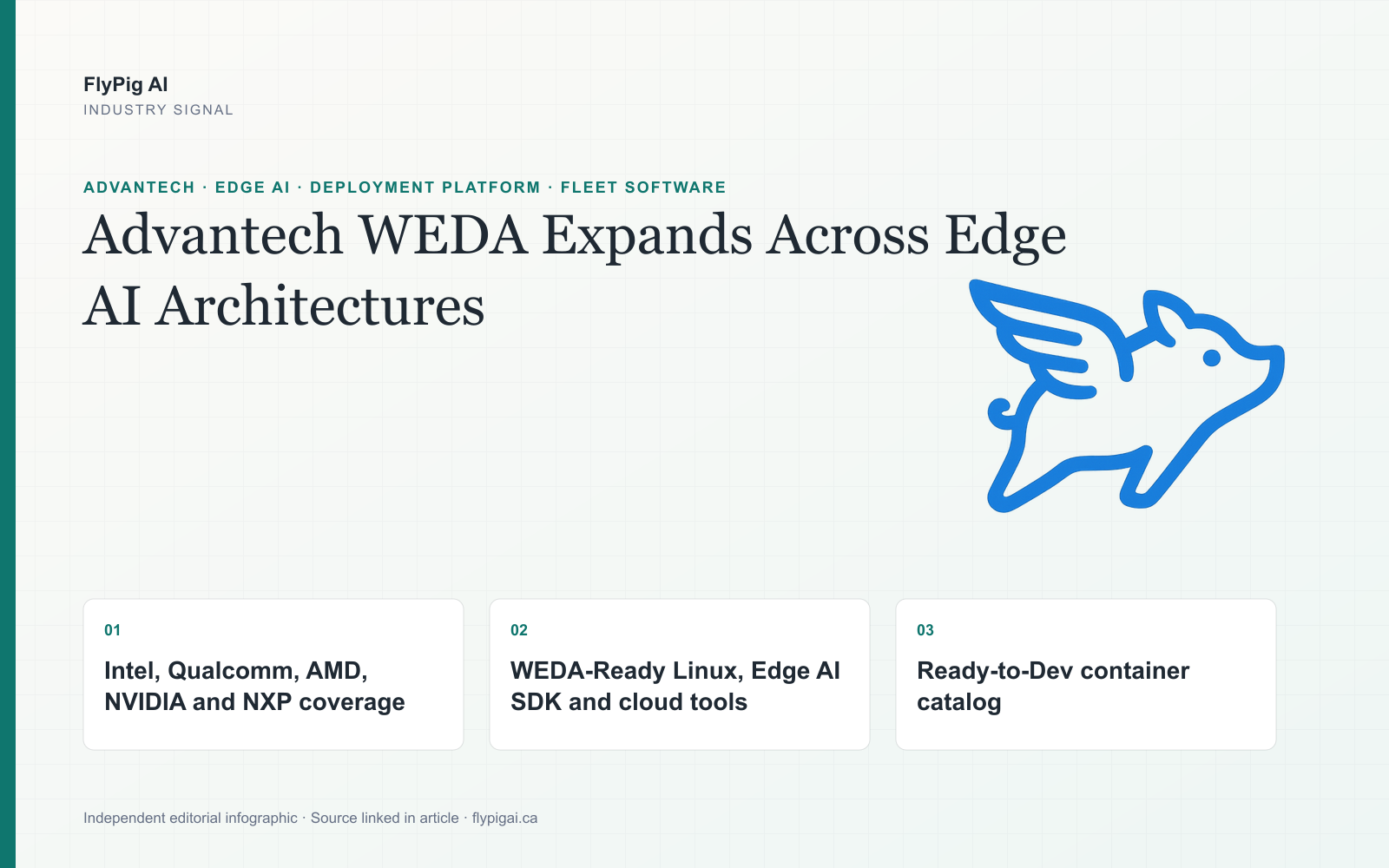
Advantech's September 17 update connects WEDA-Ready Linux, Edge AI SDK, WEDA Edge and Cloud, and the Advantech Container Catalog into a more explicit Build, Scale and Evolve workflow. The company lists Intel, Qualcomm, AMD, NVIDIA and NXP as supported architecture families.
The release goes beyond a generic cross-chip claim by naming Intel OpenVINO container resources and Qualcomm IQ9/QCS6490 workloads including segmentation, detection, pose estimation, ONNX Runtime and MLC LLM. That gives developers specific starting points, although it does not prove parity across all architectures.
Commercial implications
For OEMs and integrators, a common deployment layer can lower the cost of supporting several hardware SKUs and maintaining models after shipment. It can also make processor substitutions less disruptive if containers, device management and update policies remain portable.
Advantech exposes a free SaaS entry point, but the reviewed source does not resolve enterprise licensing, service-level commitments, offline or air-gapped deployment, or which exact board and system combinations carry production validation.
Design-in questions
Teams should ask for a controlled compatibility matrix that ties each container and WEDA function to exact hardware, OS image, accelerator runtime and version. Cross-chip portability is useful only if those combinations can be reproduced and maintained.
Security claims also need system-level interpretation. Secure Boot, TPM, filesystem integrity and SBOM support can help a product program address IEC 62443 or EU CRA obligations, but they do not automatically certify the final device.
FlyPig AI interpretationAdvantech is moving the competitive discussion from hardware selection toward lifecycle economics. If WEDA can make model deployment, rollback, telemetry and fleet management consistent across multiple silicon families, it could reduce one of Edge AI's hidden costs: maintaining the same application on several incompatible software stacks.
Status, open questions and Canada relevance
Current product status
Advantech announced the expanded WEDA ecosystem on September 17, 2026 and currently exposes WEDA resources, the Advantech Container Catalog and a free SaaS entry point. The reviewed source does not establish enterprise pricing, SLA, offline-deployment terms or a complete SKU-by-SKU production validation matrix.
What remains open
- Which exact Advantech SKUs, OS images and accelerator runtime versions are production-validated for each WEDA and ACC workload?
- What licensing, support SLA, offline deployment and long-term container-maintenance terms apply to commercial fleets?
- How are model rollback, SBOM updates, vulnerability response and device recovery handled across mixed Intel, Qualcomm, AMD, NVIDIA and NXP fleets?
Why Canadian teams may care
Canadian industrial automation, robotics, retail and transportation teams often deploy small but heterogeneous edge fleets. A cross-chip lifecycle layer could be useful where system integrators need to maintain one application across several hardware generations and processor families.