Why it matters
- A rugged operator tablet and a higher-capacity edge inference server serve distinct roles in robotics systems: field interaction and local compute.
- An advertised agentic workflow is an integration example, not a certified secure deployment, guaranteed latency level or production license.
- The cited announcement does not supply pricing, samples, standard ordering data or mass-production evidence for the new tablet.
Two devices raise two deployment questions
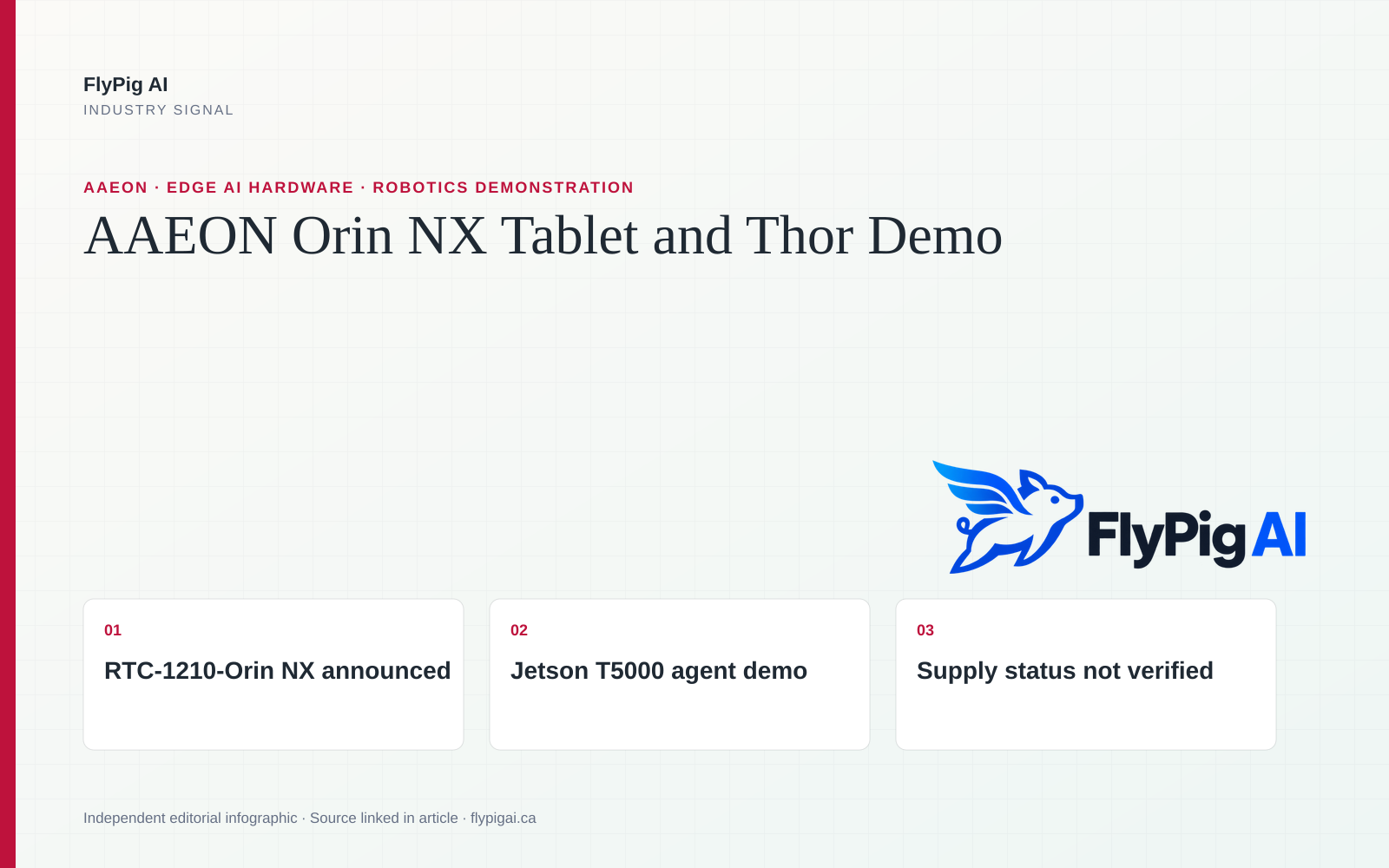
AAEON described five demonstrations planned for Smart City Expo World Congress in Barcelona on November 3–5, 2026. The distinct new hardware name in its October 30 announcement was RTC-1210-Orin NX, which the vendor called a bespoke rugged tablet. AAEON connected that display to an interactive setting involving Pollen Robotics' Reachy Mini. The pre-show material does not provide a complete RTC-1210 datasheet, a standard order code, a battery specification, or independent ruggedness certification.
The same announcement introduced a different integration scenario: MAXER-5000, a Jetson T5000-based inference server, was slated to run a spatial workflow agent from ANIWEAVE supported by Avalanche Computing's software. This is a described hardware-and-software showcase, not evidence of independent performance verification or an industrial deployment. AAEON's product website still marks MAXER-5000 as preliminary.
Design-in fit is broader than an exhibition pairing
A field tablet using an Orin NX module could interest inspection, asset-monitoring and mobile-robot builders who want a human-facing console with some local perception capacity. A purchase decision nevertheless requires thermal and power budgets, screen readability, ingress protection, environmental testing, camera and communications interfaces, application software support and repairability. The announcement does not provide enough data to compare RTC-1210 with shipping rugged tablets.
The MAXER-5000 design route is different. A local agent working on sensor or operational data might reduce the need to move data to an external cloud, but that benefit depends on the selected models, runtimes and security controls. Product teams would need software bills of materials, network segregation, access auditability, update procedures, model rollback and performance under representative workloads. Vendor descriptions of compliance readiness should not be mistaken for third-party certification.
Public show coverage is not proof of commercial supply
The primary statement predates the scheduled November exhibition and establishes what AAEON planned to demonstrate; this review does not independently confirm the completion or results of each presentation. Nor does an exhibition announcement by itself document manufacturing release. RTC-1210 sample availability, certification, customization minimums and commercial delivery dates remain unverified.
Canadian robotics integrators can use the announcement to structure technical questions, especially around in-field HMI, on-prem inference and fleet integration. A sensible next step is to request dated specifications, a supported software matrix, evaluation units and a written distinction between a bespoke demonstration and a catalog configuration.
FlyPig AI interpretationThe signal is the separation between a field-facing Orin NX interface and a Jetson Thor local-agent node. FlyPig would request a complete RTC-1210 product definition and reproducible MAXER-5000 software stack before recommending either as a design route.
Status, open questions and Canada relevance
Current product status
RTC-1210-Orin NX was named in an October 30 pre-show announcement; production, price, samples and ordering remain unconfirmed. MAXER-5000 is marked preliminary on its product page.
What remains open
- What RTC-1210-Orin NX SKU, power, battery, environmental and certification evidence can a Canadian integrator obtain?
- Which MAXER-5000 hardware revision, JetPack software stack, ANIWEAVE licensing terms and security controls have been independently validated?
Why Canadian teams may care
Canadian robotics and industrial system teams can compare field HMI and on-prem inference architectures using these signals, but must verify hardware maturity and software entitlements before specifying a platform.