Why it matters
- Compact board geometry may help engineers fit an x86 AI platform into robots, inspection appliances and controllers with constrained enclosures.
- Network, USB and serial interfaces create integration options, but the system architect must still specify real camera transport, clocking, power and thermal requirements.
- AAEON's up-to-180-TOPS platform figure is vendor reported; precision, processor SKU, sustained inference latency and software maturity determine practical usefulness.
A smaller x86 integration route
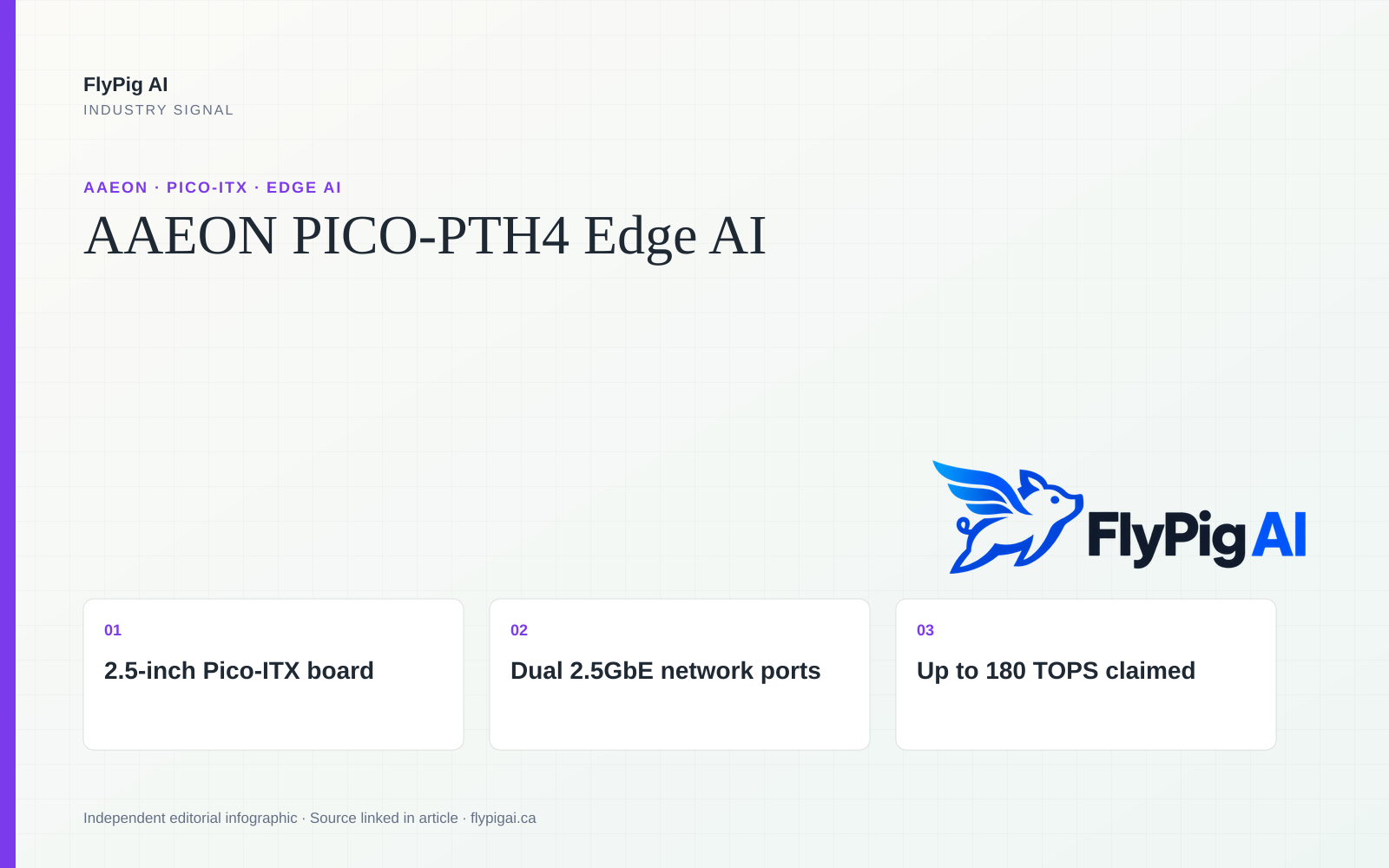
AAEON presented the PICO-PTH4 in an October 16 product update as a 2.5-inch board supporting Intel Core Ultra Series 3, formerly known as Panther Lake. The announcement lists dual 2.5GbE, two USB 3.2 Gen 2 ports, GPIO, I2C/SMBus and configurable serial connections. It also names Windows 11, Ubuntu, TPM 2.0 and an operating temperature range of minus 20 to 70 degrees Celsius. These are vendor specifications, not proof that every SKU has been qualified in every configuration.
The vendor describes up to 180 TOPS of AI capacity, without independently benchmarked model throughput in the article. A real robotics design needs separate measurements for the selected CPU, GPU or NPU path, numerical precision, memory use, sustained thermal envelope and driver stack. It would be misleading to equate an aggregate TOPS figure with a guaranteed number of video streams or a safety-capable inference system.
Why the camera and thermal architecture still dominate
A compact board can reduce physical integration burden, but it does not remove the need for a carrier design, storage selection, cooling, power distribution and lifecycle support. Two Ethernet ports may connect network sensors or uplinks. They are not automatically PoE sources or synchronized multi-camera interfaces. For a vision appliance, cable length, sensor interface, frame timing and recovery behavior may be more important than peak processor capability.
Compared with a larger Mini-ITX design, the PICO approach may be useful where mounting space is severely constrained. That benefit must be traded against serviceability, I/O expansion, heatsink geometry and the ability to maintain stable performance at the device's actual ambient temperature. The declared industrial operating range requires qualification against board revisions and specific processor options.
Procurement remains an evidence question
Before a Canadian integrator commits to the platform, AAEON should be asked for the latest ordering matrix, sustained workload tests, Ubuntu BSP versions, compatible camera references, power profiles, mechanical drawings, sample availability, lead time and warranty or lifecycle terms. A product update and contact-sales link do not by themselves prove stock or volume shipment.
The relevant market signal is that a Taiwanese embedded supplier is bringing current x86 heterogeneous compute into smaller board formats. FlyPig would treat PICO-PTH4 as a design candidate for engineering validation, rather than a settled solution for an inspection robot or an AI camera.
FlyPig AI interpretationSmall-form-factor compute is useful only when the complete camera, power and thermal architecture also fits. The 180-TOPS headline is an invitation to benchmark, not a design-in conclusion.
Status, open questions and Canada relevance
Current product status
AAEON announced PICO-PTH4 on October 16, 2026. Production qualification, regional inventory, price, MOQ and delivery dates were not independently verified.
What remains open
- Which exact CPU configurations, NPU/GPU drivers and supported Linux builds deliver repeatable vision latency under sustained thermal conditions?
- What ordering SKUs, samples, manufacturing support periods, camera options and Canadian lead times are actually available?
Why Canadian teams may care
A possible evaluation platform for Canadian robot controllers, compact industrial vision devices and inspection systems requiring x86 compatibility.