Why it matters
- Multi-camera robots often pay an engineering cost for every driver, serializer and device-tree combination, even when all cameras nominally use GMSL2.
- A shared configuration layer could reduce repeated integration work and let engineers compare perception sensors without rewriting every platform interface.
- Published vendor and camera-family names are not a substitute for validated model, carrier, driver, BSP, synchronization and firmware combinations.
What Advantech has actually announced
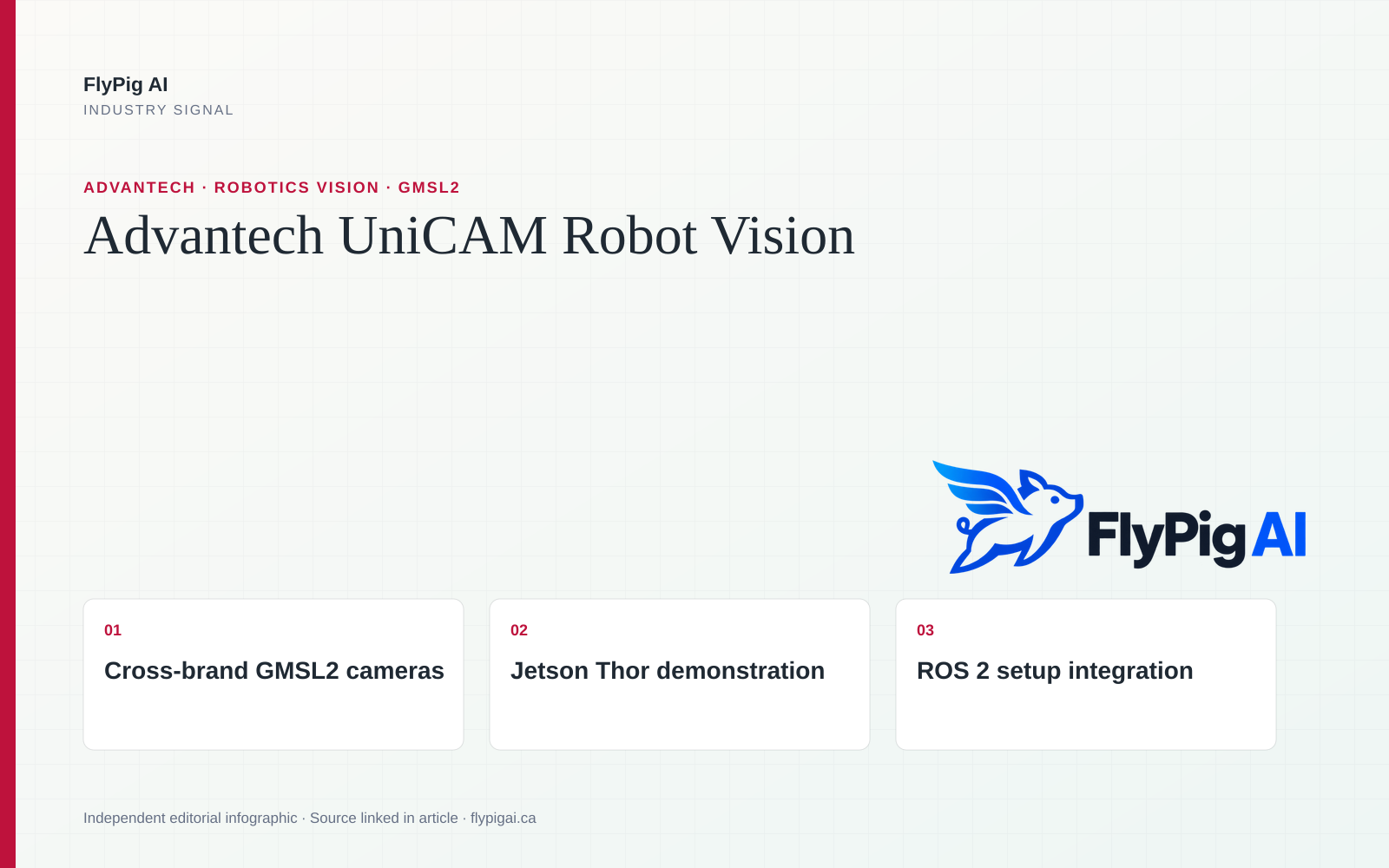
Advantech showed UniCAM at NVIDIA GTC Berlin on October 22 on a Jetson Thor-based AFE-A702 system. Its November 6 release expanded the description of the architecture, presenting a common environment for supported GMSL2 cameras and software components. The company names Stereolabs, RealSense, Orbbec, Sensing World and Leopard Imaging within its camera ecosystem. This does not demonstrate that every camera from each brand is supported.
Advantech describes discovery of supported cameras, automated configuration, simplified device-tree work, shared hardware resource management and ROS 2 integration. These are meaningful targets because a robot with mixed stereo and depth sensors can lose months in driver and synchronization debugging. Yet the supplier's suggestion of dramatically shorter proof-of-concept time remains a vendor assertion rather than a controlled comparison.
A transport standard does not solve system timing
GMSL2 offers a way to transport demanding sensor data, but a mixed-brand arrangement still requires serializer compatibility, lane allocation, power and cable design, timestamping, device firmware and consistent image-processing behavior. For navigation and manipulation, an occasional lost frame or clock error may be more damaging than a small deficit in compute speed. Software abstraction can organize these issues, not remove the underlying physical constraints.
Advantech initially highlights NVIDIA Jetson platforms and describes a direction for extending to other families. Any Intel or Qualcomm expansion must remain a roadmap item until a dated, tested release exists. A Canadian OEM needs to preserve its own hardware and software verification process even when adopting an integration toolkit marketed as reusable.
The design-in questions
Before a team chooses UniCAM as its foundation, it should obtain a versioned compatibility matrix covering exact camera models, lens and serializer options, carrier boards, JetPack versions, ROS 2 distributions and known synchronization limits. Also request licensing, source or binary distribution terms, release notes and long-term defect-fix commitments. A trade-show demonstration is not evidence of general SDK availability.
The larger commercial signal is demand for integration software that sits between sensor vendors and robot applications. FlyPig sees an opportunity to compare robotics platforms by the completeness of their validated sensor stack, rather than by the size of the underlying compute module alone.
FlyPig AI interpretationThe hidden expense of Physical AI is often camera integration. UniCAM is worth evaluating for reducing repeated work, but proof requires an explicit matrix and measured frame-level behavior.
Status, open questions and Canada relevance
Current product status
Demonstrated October 22 and discussed more fully November 6, 2026. SDK distribution terms, exact validated configurations and widespread commercial deployment were not verified.
What remains open
- Which camera SKUs, GMSL2 serializer chains, JetPack builds and ROS 2 versions have passed a common synchronization and error-recovery test?
- What software licensing, support duration and update obligations would a Canadian production robotics team actually receive?
Why Canadian teams may care
Directly relevant to Canadian autonomous-device builders combining depth, stereo and conventional cameras on Jetson-class systems.