Why it matters
- Supporting accelerators from four silicon ecosystems can reduce platform lock-in for OEMs that need to tune cost, model compatibility, power or supply strategy without redesigning the entire host system.
- The 17-liter form factor targets a useful middle ground between compact embedded boxes and rack servers for inspection, medical imaging, local LLM and multi-channel video workloads.
- The unresolved 300W-versus-400W official specification is exactly the kind of integration detail that can change PSU sizing, thermals and qualified GPU choice, so it matters more to design-in than a marketing-level AI performance statement.
AIR-411 separates the host platform from the accelerator decision
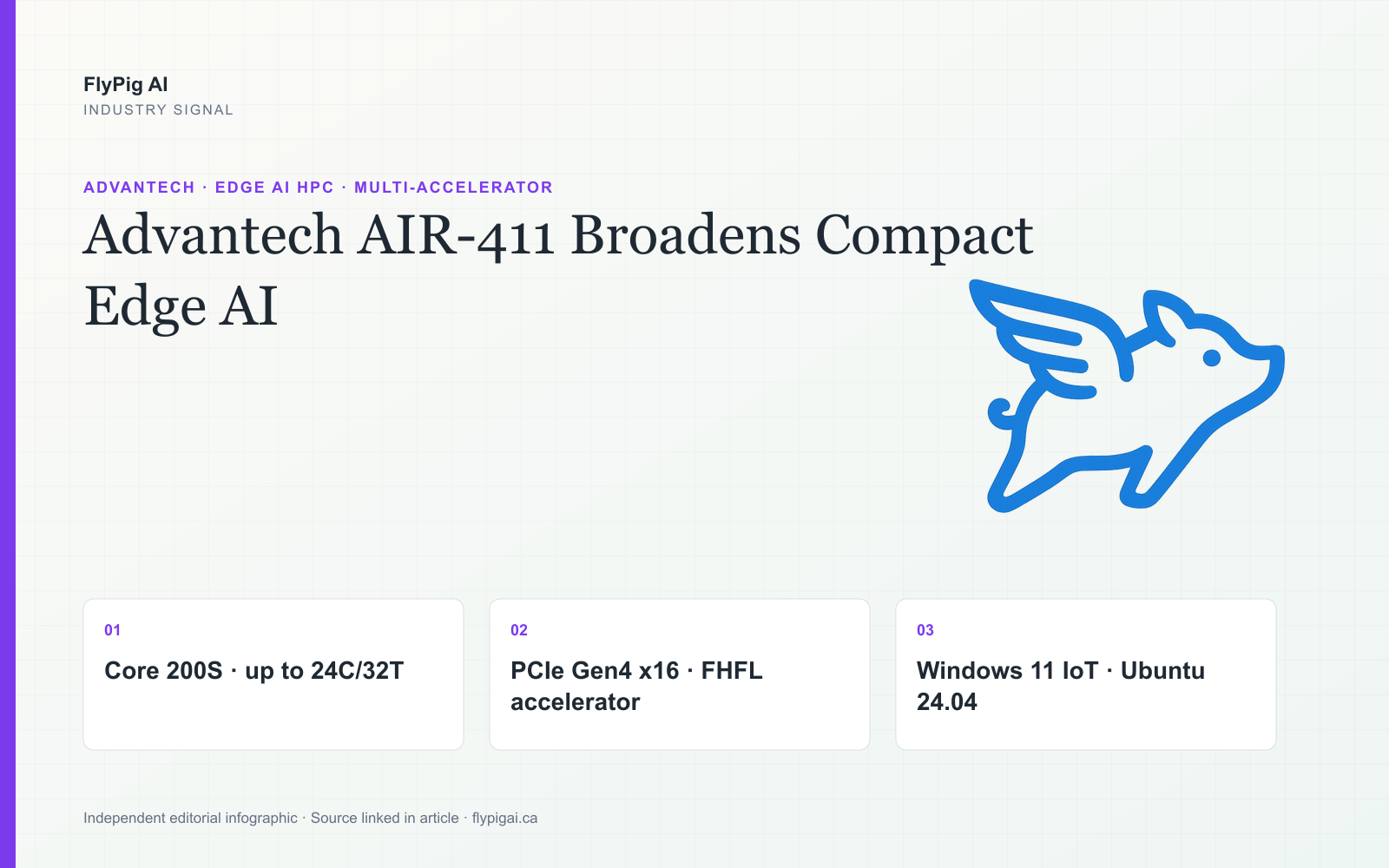
Advantech's launch material specifies Intel Core 200S processors with up to 24 cores and 32 threads, a PCIe Gen4 x16 expansion slot for a full-height, full-length accelerator, and a compact 17-liter chassis. The company lists Intel Arc Pro B60, NVIDIA RTX PRO 6000 Blackwell Max-Q Workstation Edition, AMD Radeon PRO W7900/W7800 and Qualcomm Cloud AI 100 Ultra among supported accelerator options.
That breadth is useful for industrial AI because inference stacks increasingly vary by workload and software ecosystem. A host platform that can accommodate several accelerator families may let a product team preserve cameras, storage, networking and application software while changing the compute card, provided the mechanical, driver and power boundaries are genuinely validated.
The software layer is part of the product proposition
Advantech states support for Windows 11 IoT Enterprise 2024 LTSC, Ubuntu Desktop 24.04 LTS and its Edge AI SDK. It also positions WEDA as a way to manage models, data and software across distributed edge nodes.
For a fleet deployment, that operational layer can matter as much as initial inference throughput. The open question is how much of the advertised cross-accelerator flexibility carries through the actual driver, framework, model-conversion and remote-management stack for each qualified card.
Two official GPU power limits need reconciliation
The launch announcement says the PCIe slot supports a full-height, full-length GPU up to 300W. The current AIR-411 product page, however, states support for high-wattage GPUs up to 400W/FHFL. FlyPig does not choose one figure without a controlled document that explains the configuration or revision difference.
That discrepancy makes the article medium risk rather than low risk, but it does not require holding publication because the conflict can be stated directly. Before design freeze, an integrator should obtain the current datasheet, PSU configuration, qualified accelerator list and thermal test conditions from Advantech.
FlyPig AI interpretationAIR-411's strongest feature is architectural flexibility: one compact host is being positioned across several accelerator ecosystems and a managed edge software stack. But the 300W/400W conflict is not a footnote. Power and thermal limits determine which GPU can actually be sustained in a 17-liter enclosure, so FlyPig would treat the controlled configuration matrix as the deciding document before comparing AIR-411 with other edge AI HPCs.
Status, open questions and Canada relevance
Current product status
Advantech's official news page says AIR-411 is available for ordering. The public source does not establish stock, MOQ, regional lead time or price. The reviewed official pages disagree on the supported GPU power ceiling, listing 300W in the launch announcement and up to 400W/FHFL on the product page; that specification requires direct vendor confirmation.
What remains open
- Which AIR-411 chassis, PSU and thermal configurations correspond to the 300W and 400W GPU limits shown on Advantech's current official pages?
- Which exact Intel, NVIDIA, AMD and Qualcomm accelerator SKUs are production-qualified with validated drivers, Edge AI SDK components and operating-system images?
- What sustained acoustics, temperatures and throttling behavior should users expect during concurrent CPU, accelerator, storage and networking workloads?
Why Canadian teams may care
Canadian machine-vision, medical-imaging, industrial automation and private-AI teams may value AIR-411 as a compact multi-accelerator host that can fit on-premises deployments. Its commercial usefulness depends on reconciling the power specification and confirming which accelerator/software combinations are locally supportable.